

Vector TC4 × Shark Super Stainless safety razor blade pairing data — three shaves on the same physical blade. The pairing averaged 45.7/50 (46 / 46 / 45), placing it fifth in the database. Four of the five rubric axes never moved, and the one point the series gave back went on closeness at the third use — the session that also ran the shortest interval of the three.
Vector TC4 × Shark Super Stainless (TL;DR)
Across 3 shaves the pairing scored 45.7/50 (per-shave 46 / 46 / 45) on the 0.76 mm gap under a conservative 2-pass routine (WTG → ATG, no XTG, SS not BBS). Smoothness, audible feedback and lather compatibility held flat at 10 and irritation at 9 for the whole run. Closeness opened at 7 and eased to 6 at Shave 3. The run recorded zero nicks and one weeper, on the opening session. The pack is made in Egypt by LORD International co. This is pairing data, not a rating of the blade in isolation.
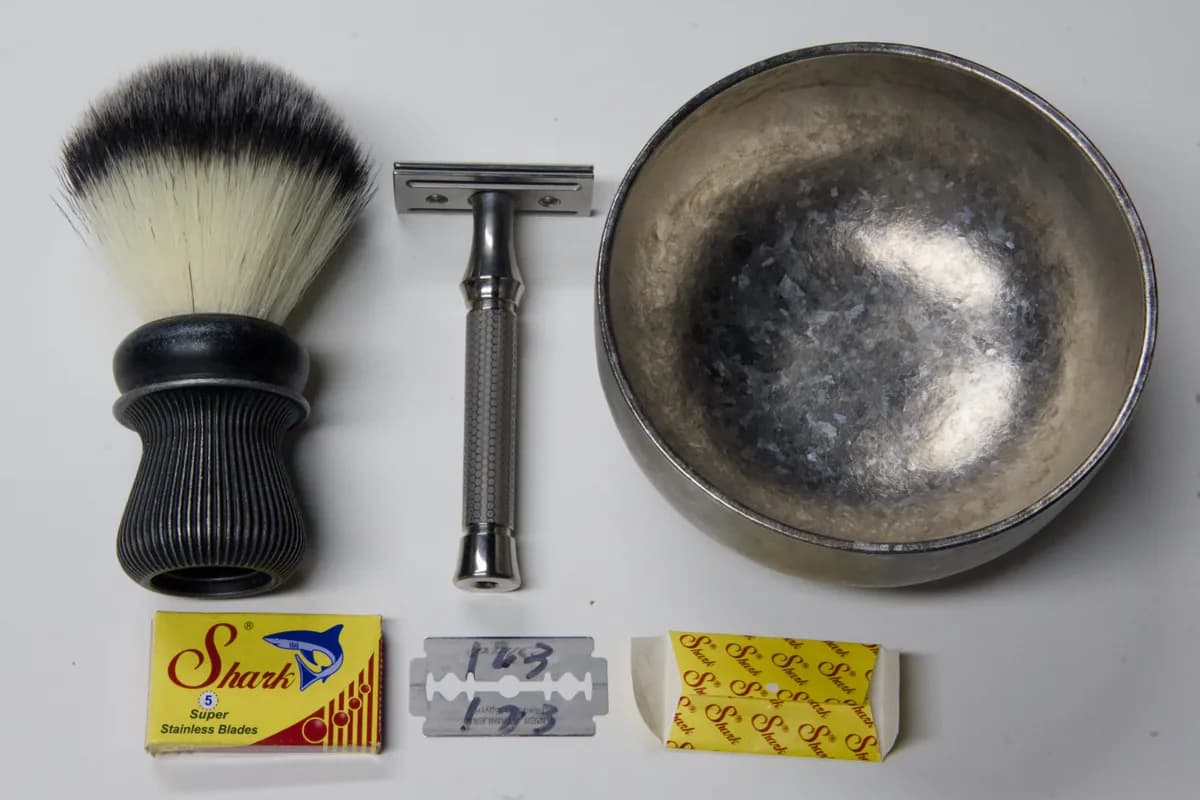
Conducted by a single ORMIXA tester (one skin profile) on the Vector TC4 — the material variant used is logged per entry of the blade compatibility database. Session-by-session notes follow ORMIXA’s published pairing rubric. This article documents pairing data — never a rating of either product on its own.
About the Companion Blade — Shark Super Stainless Identification
Everything in this section comes off the photographs of the tested pack and nothing else. Each printed carrier is recorded separately, because one pack can print different strings on different surfaces.
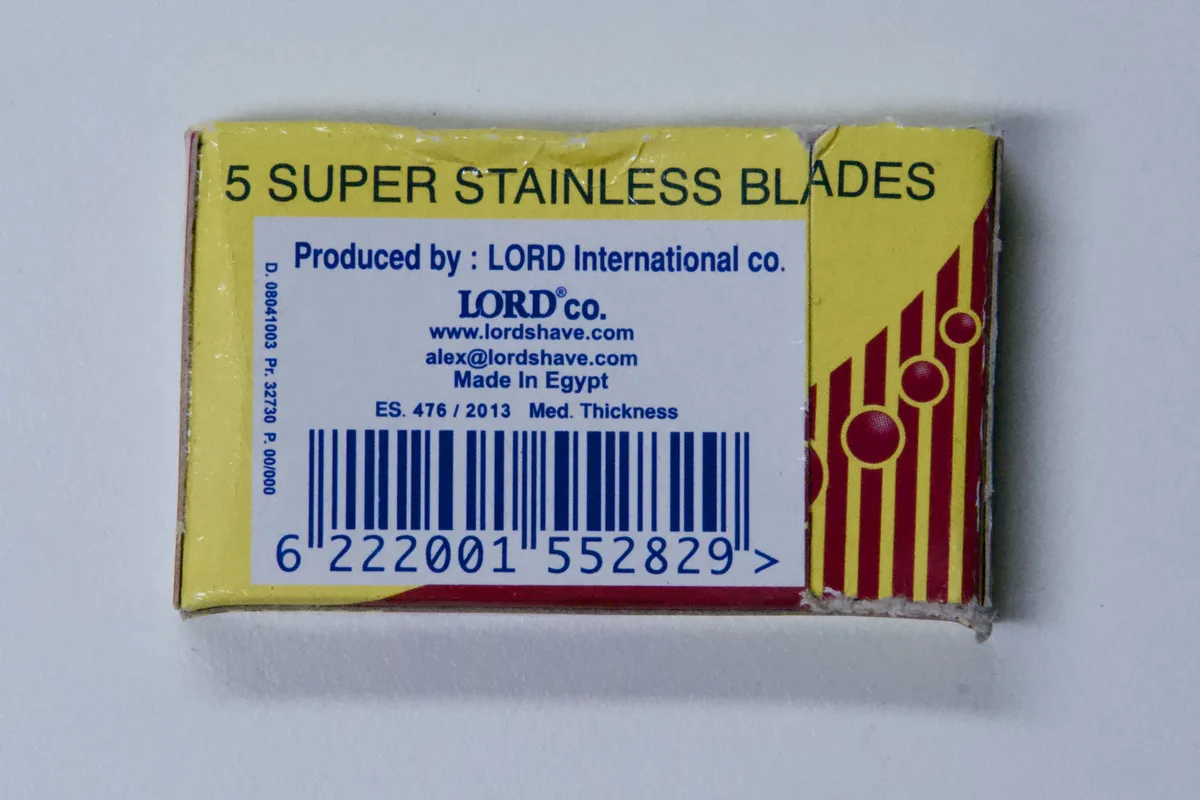
- Box front: Shark with a shark device, 5, and Super Stainless Blades.
- Back panel: 5 SUPER STAINLESS BLADES, Produced by : LORD International co., LORD co., www.lordshave.com, Made In Egypt, ES. 476 / 2013, Med. Thickness, barcode 6222001552829, and a side column reading D. 08041003 Pr. 32730 P. 00/000.
- Wax wrapper: Shark repeated as a ground pattern.
- Blade stamp: not legible in the archived frames. The tested blade carries hand-written use-count marks across its face, so no stamp string is quoted here.
Two company names appear on the pack and they belong to different parties: the front carries the brand Shark, and the back names LORD International co. as the producer. Both are printed, so both are stated. Origin rests on the printed Made In Egypt line. The barcode is recorded in the source data as corroboration only: a barcode prefix identifies the organisation that issued the number rather than the place of manufacture, so the origin here rests on the printed line and nothing else.
The pack prints no street address, no distributor or importer, and no steel or finish specification, so this article asserts none of them. The identification here exists to say which blade was tested. It is not a quality judgement of the blade.
Test Conditions
- Tester: ORMIXA — one skin profile, fixed rubric
- Razor: ORMIXA Vector TC4 titanium (0.76 mm gap)
- Pre-shave: no hot towel; no pre-shave oil; face rinsed with tap water ~6 s
- Soap: Proraso Shaving Soap in a Bowl — Sensitive (green tea & oatmeal), bowl-lathered
- Brush: ORMIXA Harbor — 6061 Aluminum Axis, Tactical Black, one-piece, 26 mm Black & White synthetic bulb
- Bowl: ORMIXA Titanium Shaving Bowl, Double-Wall Lather Bowl (lather built in the bowl)
- Pass pattern: WTG → ATG (2-pass; XTG skipped, target SS not BBS)
- Post-shave: alum block
- Sessions: 3 shaves, 120h / 143h / 92h apart
- Conditions: 30 °C / 75% humidity, skin normal (all three sessions)
Lather condition: this series used Proraso Sensitive bowl-lathered, the same condition as the eight other Proraso entries (Astra SP, Personna, Iridium Super, Dorco Prime, Feather, Nacet, Silver Blue and Derby). Those all ran the Vector 316L, so the razor changes across every one of them. See Methodology Notes for what that leaves comparable.
Test Period Summary
Three sessions on one physical blade, scored on the same five axes:
Shave 1 — Fresh
2026-09-10 · 120h growth
- Closeness
- 7/10
- Smoothness
- 10/10
- Irritation
- 9/10
First blade from the pack, wrapped in a single sheet of wax paper. WTG cut crisply with clear audible feedback, and long strokes went unnoticed. ATG had wide angle tolerance and finished cleanly. Zero nicks; one weeper on ATG at the chin. Alum mild apart from the neck and the chin. Touch: SS (2-pass, BBS not targeted).
Shave 2 — 143h
2026-09-16 · 143h growth
- Closeness
- 7/10
- Smoothness
- 10/10
- Irritation
- 9/10
Every scored axis repeated Shave 1. The session ran completely clean: zero nicks and zero weepers. Skin was relaxed by the 4-hour mark, with mild tightness in places. This session carries no separate in-session description — see Methodology Notes. Touch: SS.
Shave 3 — 92h
2026-09-20 · 92h growth
- Closeness
- 6/10
- Smoothness
- 10/10
- Irritation
- 9/10
Closeness eased one point — the only scored change in the series — and the session summary records the shave reading less close than the first two. Zero nicks, zero weepers, no razor burn. This session ran the shortest interval of the three at 92h. It carries no separate in-session description — see Methodology Notes. Touch: SS.
3-shave scores at a glance
| Axis | Shave 1 | Shave 2 | Shave 3 |
|---|---|---|---|
| Closeness | 7 | 7 | 6 |
| Smoothness | 10 | 10 | 10 |
| Irritation | 9 | 9 | 9 |
| Audible feedback | 10 | 10 | 10 |
| Lather compatibility | 10 | 10 | 10 |
| Total / 50 | 46 | 46 | 45 |
| Touch | SS | SS | SS |
| Nicks / weepers | 0 / 1 | 0 / 0 | 0 / 0 |
Day-by-Day
Shave 1 (2026-09-10, 120h growth)
First blade out of the pack, under a single sheet of wax paper. The WTG pass cut crisply with clear audible feedback, and long strokes ran without the edge making itself felt. ATG held wide angle tolerance and finished clean enough to reach SS on a 2-pass routine. The session recorded zero nicks and one weeper, on ATG at the chin. Alum read mild apart from the neck and the chin, and the 4-hour follow-up found the skin relaxed with sensation only where the weeper had been.
Shave 2 (2026-09-16, 143h growth)
Every scored axis repeated the opening session, for a second 46/50. This was the clean session of the three: zero nicks and zero weepers, with mild tightness in places by the 4-hour mark and nothing else to record. The longest interval of the run sits here, at 143h, and it cost the pairing nothing on any axis.
Shave 3 (2026-09-20, 92h growth)
Closeness eased from 7 to 6, the only scored movement in the series, and the session summary records the shave reading less close than the first two. Everything else held: smoothness, audible feedback and lather compatibility stayed at 10 and irritation at 9. The session ran clean on skin events — zero nicks, zero weepers, no razor burn. It also ran the shortest interval of the three at 92h, which matters for reading the drop and is taken up in Methodology Notes.
What Worked in the Pairing
Four of five axes never moved
Smoothness, audible feedback and lather compatibility each held 10 across all three sessions, and irritation held 9. The entire series-level change is one point of closeness at the third use. On a rubric where one point in one session is the smallest step available, that is as flat as a three-shave curve gets while still moving at all.
Zero nicks across the whole series
Three sessions, six passes, no punctures. The Vector TC4 holds the blade where the 0.76 mm gap puts it, and across the run that geometry stayed predictable enough that no pass produced a nick. A clean nick column appears on eight of the thirteen pairings in the database, and this is one of them.
Audible feedback stayed at 10 throughout
The session notes describe the WTG pass as crisp with clear feedback, and that axis never moved. Audible feedback is the axis that usually reports an edge going soft before touch does, so holding it at 10 into the third use is part of why the closing session note records the blade as still having room left.
Bowl lather matched cleanly
Lather compatibility scored a flat 10 across the series with Proraso Sensitive built in the titanium bowl. The lather held its slickness through both passes at every session.
Friction Points in the Pairing
Closeness gave back a point at the third use
Shave 3 dropped closeness from 7 to 6 and the summary for that session reads the shave as less close than the two before it. The touch grade stayed SS, so the pairing remained inside the window it was aimed at; what moved is where it sat within that window.
Three uses did not find the limit
The closing session note records that three sessions had not reached this blade’s limit and that a longer run would be needed to find it. Testing stopped at three uses, so the record supports a three-use window and carries no blade-life endpoint. Anyone reading this for cost-per-shave should treat three as where the data stops rather than where the pairing stops.
The single weeper landed on the opening session
One weeper across the run, on ATG at the chin during Shave 1, with the two later sessions clean. That shape points at the first-session adjustment to a new edge rather than at anything accumulating, which is the opposite of what a wear signal looks like.
Closeness sat at 7 — set by the 2-pass protocol
The opening 7 is the protocol’s ceiling rather than the pairing’s. Every entry in this database runs WTG → ATG with XTG skipped and SS as the target, and closeness is scored against that target. Reaching closer would take a pass the protocol does not run.
Difficult Areas (Pairing on this skin profile)
The raw record for this series names two areas and leaves the rest unscored, so only those two are reported here.
- Chin: the run’s only weeper, on ATG at Shave 1, and one of the two areas the Shave 1 alum note singles out.
- Neck: named alongside the chin in the Shave 1 alum note as the areas where the block registered, against mild elsewhere.
The per-area fields for jaw line, upper lip and the area under the chin were left blank in all three sessions. They are reported as unrecorded rather than as clean, since a blank field and a recorded zero are not the same evidence.
Pairing Recommendation for Vector TC4 Owners
Conditions where the data supports this pairing for you:
- You want an edge that holds its behaviour across a pack — four of five axes never moved across three uses, and the total settled at 45 after one point back.
- You bowl-lather a Proraso-type soft soap — lather compatibility held a flat 10 across the series.
- You value a quiet skin record — zero nicks across three sessions and a single weeper, on the opening shave.
Conditions where the data does not support this pairing for you:
- You target maximum closeness / BBS — this run produced SS closeness on a conservative 2-pass; reaching closer would need an XTG pass outside the test protocol.
- You want a known blade-life figure — testing stopped at three uses with the edge still reading usable, so this record cannot tell you where the window ends.
- You face-lather a hard stick — this series lathered Proraso in a bowl, and the database has no Vector TC4 run on a bowl-lathered soap to compare it against.
Video Evidence
Three sessions, raw footage, no edits:
- Shave 1 of 3: youtu.be/GqkSiWWXnTA
- Shave 2 of 3: youtu.be/Q9QEhi4C0xs
- Shave 3 of 3: youtu.be/Qy--2lzCL5Q
Cross-Pairing Reference
Where this pairing sits against the other Vector × DE-blade pairings tested so far (5-metric average out of 50):
| Pairing | Avg / 50 | Trend | Best window |
|---|---|---|---|
| Vector 316L × Astra SP (green) | 46.0 | flat, no decay | Shaves 1–3 |
| Vector 316L × Personna Stainless | 46.0 | stable, mild S3 efficiency signal | Shaves 1–3 |
| Vector 316L × Gillette Perma-Sharp | 46.0 | flat with mild S3 long-stroke signal | Shaves 1–3 |
| Vector 316L × Iridium Super | 45.7 | two flat sessions, one point back at S3 | Shaves 1–2 |
| Vector TC4 × Shark Super | 45.7 | two flat sessions, one point back at S3 | Shaves 1–3 |
| Vector 316L × Dorco Prime | 44.3 | one point back at S2, then flat | Shaves 1–3 |
| Vector 316L × Feather Hi-Stainless | 44.0 | flat on all five axes | Shaves 1–3 |
| Vector 316L × Gillette Nacet | 42.7 | clean, mild S3 dip | Shaves 1–2 |
| Vector 316L × Gillette Silver Blue | 42.7 | 2-shave golden window | Shaves 1–2 |
| Vector 316L × Derby Extra | 42.0 | shallow uniform decline, stays in band | Shaves 1–2 |
| Vector TC4 × Voskhod Teflon | 40.0 | S2 dip, partial recovery | Shave 1 |
| Vector 316L × Wilkinson Classic | 35.7 | monotonic decline | Shaves 1–2 |
| Vector 316L × Wilkinson (India) | 35.3 | monotonic decline | Shaves 1–2 |
This row has no single-variable comparison in the table. It ran the Vector TC4 with bowl-built Proraso Sensitive, and no earlier entry shares that combination. The eight other Proraso rows (Astra SP (46.0), Personna (46.0), Iridium Super (45.7), Dorco Prime (44.3), Feather (44.0), Nacet (42.7), Silver Blue (42.7) and Derby (42.0)) share the lather and all ran the Vector 316L, so the razor changes. Voskhod shares the Vector TC4 and lathered an ARKO stick on the face, so the lather changes. Placed among the Proraso rows this pairing’s 45.7 comes fourth, and that placement carries the razor as a second variable rather than isolating the blade.
Against the ARKO face-lathered rows — Perma-Sharp, Voskhod, Wilkinson Classic and Wilkinson Saloon Pack — the lather changed. Voskhod at least shares this pairing’s Vector TC4, so blade and lather are the only things that differ there; the other three ran the Vector 316L and so carry the razor as well. The flat 10 on the lather axis here says this pairing works with a bowl-built Proraso lather on a titanium Vector; it says nothing about how this blade would score under theirs.
→ Full Vector Blade Compatibility Database
Methodology Notes
Transparency about the boundaries of this 3-shave run:
- No single-variable comparison exists: the Vector TC4 with bowl-built Proraso Sensitive is a combination this database has not run before. Every other row changes either the razor or the lather, so no cross-row difference here isolates the blade. That is a property of the run, and it is stated wherever a number from another row appears.
- Single-razor data: this pairing ran only on the Vector TC4, so blade-versus-razor causation is not isolated. A comparison body running the same blade on the Vector 316L would be needed to separate the two contributions.
- Intervals varied and the shortest one lost the point: the sessions ran 120h, 143h and 92h apart. The session that gave back a point is the shortest of the three, so a longer interval cannot account for the drop — less growth should make a close shave easier rather than harder. That reading is cleaner than a run whose only moving axis shares a session with a stretched interval, and it points what signal there is toward the edge rather than the conditions. It remains one point on one axis.
- Sessions 2 and 3 carry no in-session description: the first-impression and pass fields in the raw record for those two sessions were verbatim copies of Shave 1 and each opened by calling itself a first use, which they were not. Those descriptions were withdrawn rather than published, so the two sessions rest on their scored axes and event counts. The scores themselves were recorded per session and are unaffected.
- Closeness was calibrated against the touch grade: the contemporaneous closeness figures were written at 10 while the touch grade was recorded as SS in all three sessions. The published scores follow the rubric’s anchor, where SS sits at 6–7, and the original values are kept in the source record. The other four axes are untouched.
- Three uses, no endpoint: the run stopped at three sessions with touch still SS and the closing session note recording that the blade’s limit had not been reached. A three-use window is the only claimable range.
- n=1: one tester, one skin profile, one razor, no A/B isolation. Read it as a data point, not a population result.
Pairing Verdict
45.7 places the pairing fifth in the database. The curve is two flat sessions and a one-point step at the third use, on a single axis, with the skin record clean apart from one weeper on the opening shave.
What this run establishes is narrow and worth stating plainly: on a Vector TC4, with Proraso Sensitive built in a bowl and a conservative two-pass routine, this blade held a stable, quiet three-shave window and had not run out by the end of it. What it does not establish is how the pairing behaves past three uses, how it behaves with a different lather, or how much of the placement belongs to the blade rather than to the titanium Vector it ran on. The verdict applies to the pairing, not to the blade and not to the razor on their own.
Vector 316L owners: the two variants share the same head geometry — the 0.76 mm blade gap and the same guard span — and differ in in-hand weight, at 60 g for the TC4 titanium against 104 g for the 316L stainless. That shared geometry is a design fact. It is not a measured transfer: no entry in this database runs one blade on both materials, so these scores and this placement are not shown to repeat on a 316L. Read the row as a blade worth trying there, not as a predicted score.
Sources
- AZoM — Ti-6Al-4V (Grade 5) titanium datasheet: density & elastic-modulus data for the TC4 alloy
- American Academy of Dermatology — How to shave (shaving with the grain & lather to reduce irritation)
- Cleveland Clinic — Razor Burn (friction, dull blade & against-the-grain as irritation causes)
- scienceofsharp — Quantifying Sharp (blade-edge apex width & bevel-angle metallurgy)
- ORMIXA blade-test shave logs — one skin profile, fixed rubric; method in the blade compatibility test methodology
Disclosure
Internal lab pairing test. Not sponsored. ORMIXA does not receive commercial consideration from any DE blade vendor for pairing data or scoring.
ORMIXA products are sold by ECE Innovate Homes LLC and manufactured by Guangzhou Yanyang Technology Co., Ltd. under trademark license.
ORMIXA does not sell razor blades. This was a retail pack purchased for evaluation. Neither the pack’s manufacturer nor any blade vendor has a commercial relationship to ORMIXA, ECE Innovate Homes LLC, or Guangzhou Yanyang Technology.
If you think manufacturer-conducted testing biases the methodology, fair concern. Video evidence is linked above for every session, the pairing rubric was published before testing started, and the database includes Vector pairings with blades whose makers are direct competitors. Send your own pairing data — we’ll compare.
Related
- ← Back to the full Vector Blade Compatibility Database
- The other Vector TC4 entry, on an ARKO stick — Vector TC4 × Voskhod →
- Same average on the 316L with the same bowl lather — Vector 316L × Iridium Super →
- The razor used in this test — Vector TC4 →
- The brush used in this test — Harbor →
- The bowl used in this test — Titanium Double-Wall →
Frequently asked questions
- Does the Vector TC4 pair well with Shark Super Stainless blades?
- In a 3-shave test the pairing scored 45.7/50 (46 / 46 / 45). Four of the five rubric axes never moved: smoothness, audible feedback and lather compatibility held 10 and irritation held 9. Closeness opened at 7 under a 2-pass protocol and eased to 6 at the third use. The run recorded zero nicks and one weeper. This is pairing data, not a rating of the blade in isolation.
- Where are Shark Super Stainless blades made?
- The tested pack prints "Made In Egypt" on its back panel, alongside "Produced by : LORD International co." The brand on the box front is Shark and the producer named on the back is LORD International co.; both strings are printed on the pack. The pack carries no street address, distributor, or steel and finish specification, so none of those are stated here.
- How many shaves did the Shark Super Stainless pairing last?
- Testing stopped at three uses with touch still SS and the session note recording that the blade had not reached its limit, so a three-use window is the only claimable range and no blade-life endpoint was measured. Across those three the total moved 46, 46, 45, with the single point coming off closeness at the third use.
- How does this pairing compare to the other Vector blade tests?
- It cannot be compared single-variable against any of them. This run used the Vector TC4 with bowl-built Proraso Sensitive, a combination no earlier entry shares: the other Proraso rows all ran the Vector 316L, so the razor changes, and Voskhod shares the TC4 but lathered an ARKO stick on the face, so the lather changes. Every cross-row number therefore carries a second variable.
- Do these Vector TC4 results apply to the Vector 316L?
- Not as a predicted score. The two variants share the same head geometry and 0.76 mm blade gap and differ in in-hand weight, at 60 g for the TC4 titanium against 104 g for the 316L stainless, but no entry in this database runs one blade on both materials. Shared geometry does not establish that this pairing’s scores or its placement would repeat on a 316L.
- Is ORMIXA recommending Shark Super Stainless blades?
- No. ORMIXA does not sell razor blades and makes no recommendation about Shark Super Stainless blades in isolation or on razors outside this database. This article documents how one pack behaved with one ORMIXA razor, one lather and one tester, and the verdict applies to that pairing.