

Vector 316L × Iridium Super safety razor blade pairing data — three shaves on the same physical blade. The pairing averaged 45.7/50 (46 / 46 / 45), placing it sixth of the fifteen pairings in the database, above Dorco Prime Platinum. Four of the five rubric axes never moved; the series gave back a single point, on smoothness, at the third use.
Vector 316L × Iridium Super (TL;DR)
Across 3 shaves the Vector 316L × Iridium Super pairing scored 45.7/50 (per-shave 46 / 46 / 45). Closeness held a flat 7 (conservative 2-pass: WTG → ATG, no XTG, SS not BBS) on the 0.76 mm gap. Smoothness opened at 10 and eased to 9 at Shave 3, the only scored change; irritation, audible feedback and lather compatibility never moved. The run recorded no nicks and 2 weepers, one per outer session and both in the upper-lip area. The tested pack was box-verified as made in Russia by Petersburg Products International LLC. Pairing data transfers 1:1 to the Vector TC4. This is pairing data, not a rating of the blade in isolation.
Conducted by a single ORMIXA tester (one skin profile) on the Vector 316L — the material variant used is logged per entry of the blade compatibility database. Session-by-session notes follow ORMIXA’s published pairing rubric. This article documents pairing data — never a rating of either product in isolation.
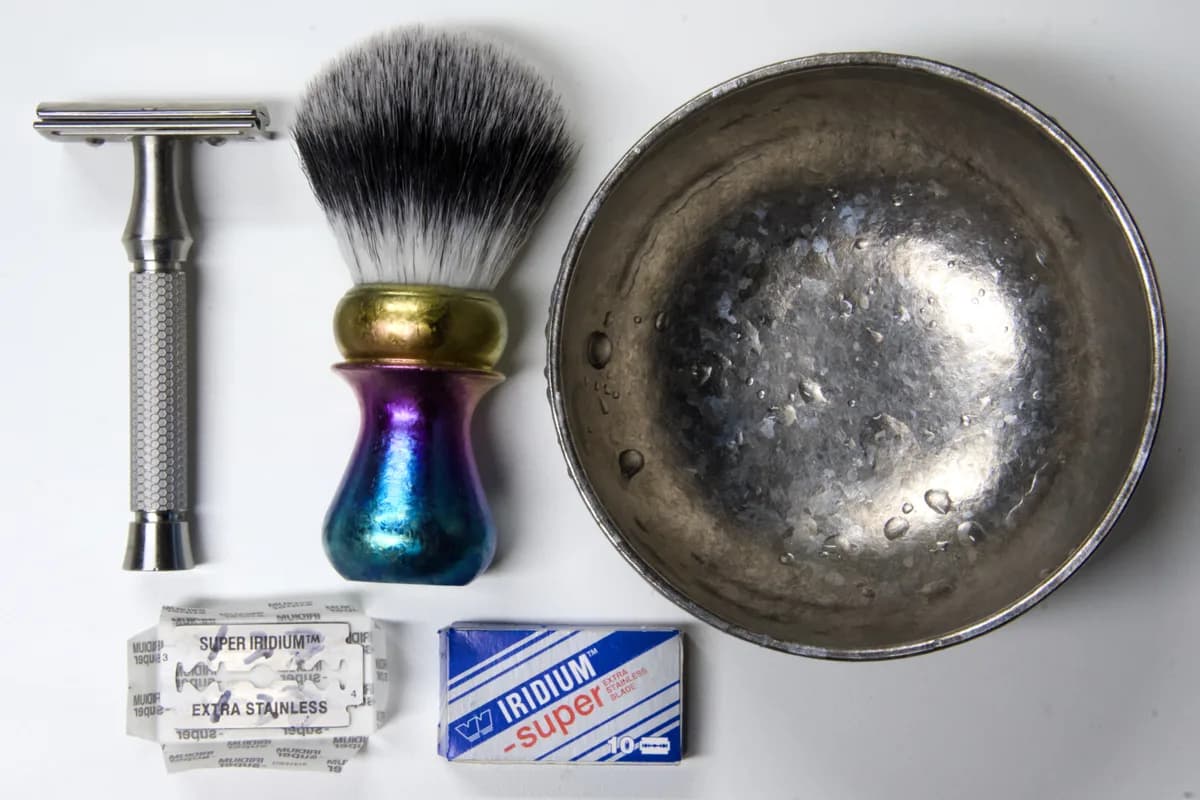
On the Vector 316L with the standard 2-pass routine (WTG → ATG, target SS), the Vector × Iridium Super pairing opened at 46/50, repeated it, and closed at 45/50. Smoothness carried the series: it opened at 10, a figure shared with only six other entries in the database, and held there through two sessions before easing a point at the third use. This is a data point in the Titanium Safety Razor Blade Compatibility Project; additional pairings appear here as each third-party blade passes through the same test cycle on the Vector platform (material variant logged per entry).
About the Companion Blade — Iridium Super Identification
The pack tested here is a 10-blade stainless-steel double-edge unit whose front panel reads “IRIDIUM -super”. Four separate carriers on this pack print text, and they do not all say the same thing, so each is recorded against the surface it came from:
- Country of origin: Russia — the side panel prints, in French, “Fabriqué en Russie”, with the Arabic “صنع في روسيا” (made in Russia) on the same panel.
- Manufacturer: the same panel names “Petersburg Products International” LLC, at 196140 Saint‑Pétersbourg, settlement Shushary, Pulkovskoye shosse, batiment 54 liter A.
- Pack: a 10-blade pack — the front panel prints “10” beside a blade icon — each blade wrapped in a single sheet of wax paper.
- Stated composition: stainless steel. Both the front panel and the blade itself read “EXTRA STAINLESS”, and neither names a coating.
- Carrier differences: the box front prints “IRIDIUM -super”; the blade is stamped “SUPER IRIDIUM”, the reverse word order; the wax wrapper repeats “IRIDIUM -super” with a lot code.
- Brand text: none of the four carriers prints “Wizamet”. The front panel carries a W-shaped mark and nothing more.
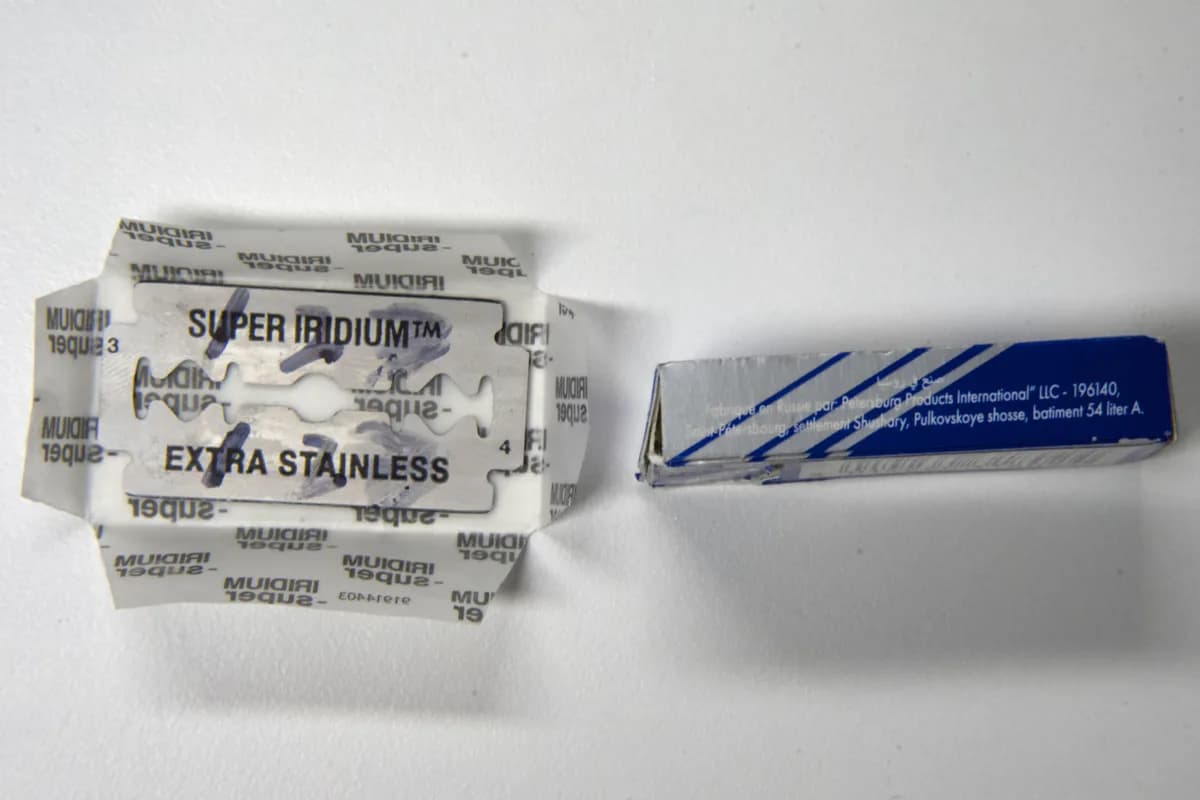
That address is already in this database twice. The Astra Superior Platinum and Gillette Nacet packs both name the same Petersburg Products International plant in Shushary, which makes this the third entry produced there and the first of the three to reach the shelf under the Iridium name.
Two things the pack does not settle. It prints no “Wizamet”, and it says nothing about the blade’s relationship to Polsilver Super Iridium — a lineage the parent pillar has carried as an open question since this pack entered the queue. Specialist wet-shaving retailers name Wizamet as the maker of Polsilver Super Iridium and describe those blades as originally made by Wizamet in Poland before production moved to St Petersburg, following Gillette’s acquisition of the Polsilver brand in 1992. That history is cited here rather than claimed: what this pack itself establishes is Russia, the PPI plant, 10 blades and stainless steel.
The test pack was a retail pack purchased for evaluation. ORMIXA has no commercial relationship to any blade vendor. None of the above is a quality judgement of the blade; it is identification context for the pairing that follows.
Test Conditions
- Tester: ORMIXA — one skin profile, fixed rubric
- Razor: ORMIXA Vector 316L stainless (0.76 mm gap)
- Pre-shave: no hot towel; no pre-shave oil; face rinsed with tap water ~6 s
- Soap: Proraso Shaving Soap in a Bowl — Sensitive (green tea & oatmeal), bowl-lathered
- Brush: ORMIXA Harbor — TA2 Titanium Line, Gradient Crystalline handle, Black & White synthetic knot (the 24 mm knot used here has since left the public catalogue; the line now ships at 26 mm)
- Bowl: ORMIXA Titanium Shaving Bowl, Double-Wall Lather Bowl (lather built in the bowl)
- Brush soak: plain tap water, ~1 minute
- Pass pattern: WTG → ATG (2-pass; XTG skipped, target SS not BBS)
- Stroke length: long strokes attempted and logged as problem-free at Shaves 1 and 2; Shave 3’s log does not mention them
- Post-shave: alum block
- Sessions: 3 shaves, 72h / 72h / 96h apart
- Conditions: 30 °C / 75% humidity, skin normal (all three sessions)
Lather condition: this series used Proraso Sensitive bowl-lathered — the same condition as the ten other Proraso entries (Treet Platinum, Super Treet, Astra SP, Personna, Shark Super, Dorco Prime, Feather, Nacet, Silver Blue and Derby). The Perma-Sharp, Wilkinson Classic and Wilkinson Saloon Pack runs used an ARKO stick applied directly to the face. See Methodology Notes for the confound implications.
Results also apply to the Vector TC4 — same blade gap and head geometry. See the methodology for material-specific perception differences.
Test Period Summary
3 shaves total on one blade. Two sessions ran at 72h, the third at 96h. Pass pattern: WTG → ATG (2-pass) each session.
Shave 1 — Fresh
2026-08-29 · 72h growth
- Closeness
- 7/10
- Smoothness
- 10/10
- Irritation
- 9/10
First blade from the pack, wrapped in a single sheet of wax paper. WTG cut crisply. ATG had room to move and the pass finished cleanly, with long strokes attempted and reported problem-free. One weeper on WTG at the mouth corner. Alum mild overall; the 4-hour follow-up noted sensation only at that one spot. Touch: SS (2-pass, BBS not targeted).
Shave 2 — 72h
2026-09-01 · 72h growth
- Closeness
- 7/10
- Smoothness
- 10/10
- Irritation
- 9/10
Every scored axis matched Shave 1. Long strokes again reported problem-free. This was the only clean session of the three: zero nicks and zero weepers. Alum mild overall, skin relaxed by the 4-hour mark. Touch: SS.
Shave 3 — 96h
2026-09-05 · 96h growth
- Closeness
- 7/10
- Smoothness
- 9/10
- Irritation
- 9/10
Smoothness eased from 10 to 9 — the only scored change in the series. The session note recorded a subjective drop in keenness, read off the post-shave feel against Shaves 1 and 2, alongside a judgement that the edge remained usable. One weeper on ATG at the upper-lip corner. Alum mild in that area rather than overall. This session also ran 96h of growth against 72h. Touch: SS.
3-shave scores at a glance
| Shave | Closeness | Smoothness | Irritation | Touch |
|---|---|---|---|---|
| 1 — fresh | 7 | 10 | 9 | SS |
| 2 — 72h | 7 | 10 | 9 | SS |
| 3 — 96h | 7 | 9 | 9 | SS |
Closeness, Smoothness and Irritation shown above; the full rubric also scores Audible feedback (10/10/10) and Lather compatibility (10/10/10). Pairing totals by shave: 46 / 46 / 45; average 45.7/50.
Day-by-Day
Shave 1 (2026-08-29, 72h growth)
Opening session on a fresh blade. WTG cut crisply and ATG had room to move; long strokes were attempted and finished without difficulty, which the session summary called out directly. Smoothness, audible feedback and lather compatibility all scored 10, with irritation at 9 and closeness at 7 under the 2-pass protocol. Pairing total 46/50.
One weeper appeared during the WTG pass, at the mouth corner. The alum reaction was mild overall, and the 4-hour follow-up recorded skin fully relaxed apart from lingering sensation at that single spot — the two log fields corroborate each other, which is why this weeper stands in the record. Touch: SS.
Shave 2 (2026-09-01, 72h growth)
Same interval, same preparation, and every scored axis repeated: 7 / 10 / 9 / 10 / 10, pairing total 46/50 again. Long strokes were again logged as problem-free.
This was the clean session of the three — no nicks and no weepers. Alum mild overall, skin relaxed at 4 hours. Touch: SS. The second session is the one that establishes the opening figure was repeatable rather than a first-blade effect.
Shave 3 (2026-09-05, 96h growth)
The one session that moved. Smoothness eased from 10 to 9; closeness, irritation, audible feedback and lather compatibility all held. Pairing total 45/50. The session summary recorded a subjective drop in keenness — read off how the face felt afterwards compared with the first two sessions — and, in the same sentence, a judgement that the edge was still worth continuing with.
One weeper appeared during the ATG pass, at the upper-lip corner. The alum reaction was logged as mild in that area rather than mild overall, the only session where that distinction appears. Touch: SS.
This session also ran 96 hours of growth against 72 for the first two. The scored change and the longer interval land together, and three sessions cannot separate them.
What Worked in the Pairing
Smoothness opened at 10 and stayed there for two sessions
A smoothness opening of 10 appears on seven entries in this database: Treet Platinum, Super Treet, Astra SP, Personna, Perma-Sharp, Shark Super and this pairing — which are also the seven highest-scoring entries. Here it held through two full sessions before easing a single point, so the opening figure reflects the pairing rather than a fresh-blade artefact.
Irritation held a flat 9 through all three uses
Irritation scored 9 at every session, and the alum reaction stayed in the mild band throughout. Among the matched Proraso entries, a completely flat irritation line across three uses also appears on Nacet; Astra, Personna and Dorco each gave back a point on that axis.
Four of five axes never moved
Closeness (7), irritation (9), audible feedback (10) and lather compatibility (10) were identical in all three sessions. The whole series is one point of movement on a single axis, which is what the near-flat 46 / 46 / 45 curve reflects.
Long strokes finished cleanly
Both of the first two session summaries state that long strokes ran without difficulty. That axis is absent from the Dorco series altogether, so this is the first entry in the database carrying long-stroke data, and it carries it for two of three sessions.
Bowl lather matched cleanly
The bowl-built Proraso Sensitive lather held through both passes at every session, and lather compatibility scored a flat 10 across the series. Because this is the same lather method on the same Vector 316L used in the other seven Proraso runs on that razor, the comparison against those entries is single-variable on the blade.
Friction Points in the Pairing
Smoothness gave back a point at the third use
Smoothness moved 10 → 10 → 9. The session note describes the drop as reduced keenness, inferred from the post-shave feel rather than from anything that happened during the passes, and the same note judged the edge usable. It is the only scored change in the series.
The third session is confounded by a longer interval
Shave 3 ran at 96h of growth where the first two ran at 72h. A longer interval is a harder test on its own, and it is enough by itself to account for one point of smoothness. Third-use decay and extra growth arrive in the same session here, so this run cannot attribute the drop to blade wear.
Both weepers landed in the same small area
The series produced 2 weepers: one at Shave 1 on the WTG pass at the mouth corner, one at Shave 3 on the ATG pass at the upper-lip corner. They sit in the same region of the face, they fall on opposite pass directions, and the session between them was clean. That distribution tracks an anatomically awkward area rather than blade use, and this run has no way to test it further.
Closeness sat at 7 — set by the 2-pass protocol
The conservative 2-pass (no XTG) targets SS, and closeness scored 7 in every session. A 3-pass run with XTG would be needed to probe DFS or BBS on this pairing.
Difficult Areas (Pairing on this skin profile)
The four per-region fields in this series’ raw log were left blank in all three sessions, so this entry carries no jaw, neck or Adam’s-apple observations. What the event log does locate is the two weepers:
- Upper lip / mouth corner: the site of both weepers — WTG at Shave 1, ATG at Shave 3. Shave 2 was clean here.
- Jaw, neck, Adam’s apple: not recorded either way. No events were logged for these areas, which is an absence of data rather than an all-clear.
Pairing Recommendation for Vector 316L Owners
If you already run a Vector 316L, here is how this blade behaves on it. The data supports the pairing under these conditions:
- You want a high opening ceiling — this pairing opened at 46/50 and repeated it, on the back of a smoothness 10.
- You want steady comfort — irritation held a flat 9 and alum stayed mild across all three uses.
- You shave with long strokes — both of the first two sessions logged them as problem-free.
- You bowl-lather a Proraso-type soft soap — lather compatibility held a flat 10 across the series.
Conditions where the data does not support this pairing for you:
- You target maximum closeness / BBS — this run produced SS closeness (7) on a conservative 2-pass; reaching closer would need an XTG pass outside the test protocol.
- You want a per-region map of the face — the region fields in this series’ log are blank, so there is no jaw, neck or under-chin data here.
- You want blade-life guidance — testing stopped at three uses with the third still at SS, and the one session that moved is confounded by a longer interval.
Note: this is pairing data on the Vector 316L specifically. ORMIXA makes no recommendation about Iridium Super blades in isolation, or on razors outside this database. Other Vector pairings and future ORMIXA × Iridium Super series may differ.
Video Evidence
Three sessions, raw footage, no edits:
- Shave 1 of 3: youtu.be/M96XXLJRZLs
- Shave 2 of 3: youtu.be/p-Tn46zl7xI
- Shave 3 of 3: youtu.be/ZktwzSOr1GE
Cross-Pairing Reference
Where this pairing sits against the other Vector × DE-blade pairings tested so far (5-metric average out of 50):
| Pairing | Avg / 50 | Trend | Best window |
|---|---|---|---|
| Vector TC4 × Treet Platinum | 47.0 | flat on all five axes | Shaves 1–3 |
| Vector TC4 × Super Treet Platinum | 46.7 | two flat sessions, one point back at S3 | Shaves 1–3 |
| Vector 316L × Astra SP (green) | 46.0 | flat, no decay | Shaves 1–3 |
| Vector 316L × Personna Stainless | 46.0 | stable, mild S3 efficiency signal | Shaves 1–3 |
| Vector 316L × Gillette Perma-Sharp | 46.0 | flat with mild S3 long-stroke signal | Shaves 1–3 |
| Vector 316L × Iridium Super | 45.7 | two flat sessions, one point back at S3 | Shaves 1–2 |
| Vector TC4 × Shark Super | 45.7 | two flat sessions, one point back at S3 | Shaves 1–3 |
| Vector 316L × Dorco Prime | 44.3 | one point back at S2, then flat | Shaves 1–3 |
| Vector 316L × Feather Hi-Stainless | 44.0 | flat on all five axes | Shaves 1–3 |
| Vector 316L × Gillette Nacet | 42.7 | clean, mild S3 dip | Shaves 1–2 |
| Vector 316L × Gillette Silver Blue | 42.7 | 2-shave golden window | Shaves 1–2 |
| Vector 316L × Derby Extra | 42.0 | shallow uniform decline, stays in band | Shaves 1–2 |
| Vector TC4 × Voskhod Teflon | 40.0 | S2 dip, partial recovery | Shave 1 |
| Vector 316L × Wilkinson Classic | 35.7 | monotonic decline | Shaves 1–2 |
| Vector 316L × Wilkinson (India) | 35.3 | monotonic decline | Shaves 1–2 |
The cleanest comparisons in the table are the seven runs that used the same Proraso Sensitive bowl lather on the same Vector 316L with the same 2-pass protocol: Astra SP (46.0), Personna (46.0), Dorco Prime (44.3), Feather (44.0), Nacet (42.7), Silver Blue (42.7) and Derby (42.0). Blade is the only variable that changed. Placed among them, this pairing’s 45.7 comes third — 0.3 below the two leaders, which is one point in one session, and 1.4 above Dorco Prime.
Against Perma-Sharp (46.0), Wilkinson Classic (35.7) and Wilkinson Saloon Pack (35.3), blade and lather both changed: those runs used a Turkish ARKO stick face-lathered. The flat 10 on the lather axis here says this pairing works with a bowl-built Proraso lather; it says nothing about how this blade would score under theirs. Voskhod (40.0) ran on the Vector TC4, so that row changes the razor as well.
→ Full Vector Blade Compatibility Database
Methodology Notes
Transparency about the boundaries of this 3-shave run:
- Third interval was longer: Shave 3 ran at 96 hours of growth against 72 for the first two, and it is also the only session whose score moved. The raw log first recorded 72 for that session, which contradicted its own timestamps; it is corrected to 96 in the source data. Longer growth alone can account for one point of smoothness, so this series cannot attribute that point to blade wear.
- Single-razor data: this pairing ran only on the Vector 316L, so blade-vs-razor causation is not isolated. A comparison body (e.g. the Vector TC4 running the same blade) would be needed to separate razor contribution from blade contribution.
- Lather confound: this series used Proraso Sensitive built in the bowl, matching the ten other Proraso entries. Against the Perma-Sharp and both Wilkinson runs, which applied an ARKO stick directly to the face, blade and lather both changed, so any numeric difference carries both variables and should not be attributed to the blade alone.
- Blood-point record corrected before publication: a verbal correction had recorded Shave 1 as free of blood points. The raw log states one weeper on WTG at the mouth corner, and its 4-hour follow-up independently notes sensation at that spot. The raw log stands, and the series total is 2 weepers.
- Nick column is 2-of-3 explicit: Shaves 2 and 3 record zero nicks. Shave 1’s nick field was left blank in the log, so this entry states that no nicks were recorded rather than that the first session was verified nick-free.
- Per-pass notes repeat across sessions: the subjective per-pass fields for Shaves 2 and 3 are verbatim copies of Shave 1 in the raw log, all three opening “this is the first time using this blade”. Those fields are treated as copy residue and are not cited as per-session observation. The session-specific material used here is the scored axes, the event counts, the alum readings and the Shave 3 summary.
- Region fields are blank: all four difficult-area fields were left empty in all three sessions, so this entry has no per-region map beyond where the two weepers occurred.
- Closeness is protocol-capped: the conservative 2-pass (no XTG) targets SS. A 3-pass run with XTG would be needed to probe DFS/BBS on this pairing.
- Three uses did not reach the edge’s limit: testing stopped at three uses with the third still at SS, alum in the mild band, and four axes flat. A three-use window is the only claimable range; nothing about maximum blade life is claimable, which would also fall outside ORMIXA editorial scope.
Pairing Verdict
After 3 shaves of the Vector 316L × Iridium Super pairing: 45.7/50 — the flattest high-opening pairing in the database, whose single give-back arrives in the one session that also ran a longer interval.
The shape of the series is two identical sessions followed by a one-point step: 46, 46, 45, with four of five axes untouched from first shave to last. Smoothness opening at 10 and holding there for two full sessions is what separates this run from the mid-table entries.
The friction is thin and it is not concentrated by pass. Two weepers, one on WTG and one on ATG, both in the upper-lip area, with a clean session between them. That pattern points at one awkward stretch of face rather than at an edge losing keenness, and the scored evidence for wear — a single smoothness point at the third use — arrives alongside 24 extra hours of growth.
45.7 places the pairing sixth in the database. Under matched Proraso bowl-lather conditions on the Vector 316L it sat 0.3 below Astra SP and Personna, which is one point in one session, and 1.4 above Dorco Prime. Against the ARKO face-lathered rows — Perma-Sharp and both Wilkinsons — the comparison carries a lather variable on top of the blade.
Vector TC4 owners: this pairing data transfers 1:1 to your razor. The cutting geometry is identical — only the in-hand feel differs.
Sources
- The Razor Company — Polsilver Super Iridium listing (lists Wizamet as manufacturer and describes production moving from Poland to St Petersburg after Gillette acquired the Polsilver brand in 1992)
- American Academy of Dermatology — How to shave (shaving with the grain & lather to reduce irritation)
- Cleveland Clinic — Razor Burn (friction, dull blade & against-the-grain as irritation causes)
- AZoM — Grade 316/316L Stainless Steel (low-carbon grade & molybdenum corrosion resistance)
- ORMIXA blade-test shave logs — one skin profile, fixed rubric; method in the blade compatibility test methodology
Disclosure
Internal lab pairing test. Not sponsored. ORMIXA does not receive commercial consideration from any DE blade vendor for pairing data or scoring.
ORMIXA products are sold by ECE Innovate Homes LLC and manufactured by Guangzhou Yanyang Technology Co., Ltd. under trademark license.
ORMIXA does not sell razor blades. This was a retail pack purchased for evaluation. Neither the pack’s manufacturer nor any blade vendor has a commercial relationship to ORMIXA, ECE Innovate Homes LLC, or Guangzhou Yanyang Technology.
If you think manufacturer-conducted testing biases the methodology, fair concern. Video evidence is linked above for every session, the pairing rubric was published before testing started, and the database includes Vector pairings with blades whose makers are direct competitors. Send your own pairing data — we’ll compare.
Related
- ← Back to the full Vector Blade Compatibility Database
- Same plant, same razor, same lather — Vector 316L × Astra Superior Platinum →
- Same plant, flat irritation line — Vector 316L × Gillette Nacet →
- The razor used in this test — Vector 316L →
- The brush used in this test — Harbor →
- The bowl used in this test — Titanium Double-Wall →
Frequently asked questions
- Does the Vector 316L pair well with Iridium Super blades?
- In a 3-shave test the pairing scored 45.7/50 (46 / 46 / 45), sixth in the database. Smoothness opened at 10 and held for two sessions before easing to 9 at the third use — the only scored change in the series. Closeness held 7 under a 2-pass protocol, irritation a flat 9, and audible feedback and lather compatibility a flat 10. The run recorded no nicks and 2 weepers. This is pairing data, not a rating of the blade in isolation.
- Where are Iridium Super blades made?
- The pack tested here was made in Russia. Its side panel prints, in French, "Fabriqué en Russie par: Petersburg Products International LLC" with the plant address at 196140 St Petersburg, Shushary, Pulkovskoye shosse 54 liter A, and repeats "made in Russia" in Arabic on the same panel. That is the same Petersburg Products International plant named on the Astra Superior Platinum and Gillette Nacet packs in this database. Other packs may differ; this entry describes the pack ORMIXA tested.
- Is Iridium Super the same as Wizamet Super Iridium or Polsilver?
- The pack ORMIXA tested prints "IRIDIUM -super" on its front panel and "SUPER IRIDIUM" on the blade stamp, and carries no "Wizamet" text on any surface — only a W-shaped mark. Specialist retailers list Wizamet as the manufacturer of Polsilver Super Iridium and describe that production moving from Poland to St Petersburg after Gillette acquired the Polsilver brand in 1992, so the shared lineage is cited here rather than claimed. What this pack itself establishes is Russia, the PPI plant, 10 blades and stainless steel.
- How many shaves does Iridium Super last in this pairing?
- On the Vector 316L the data covers a 3-shave window. All three sessions held SS touch and alum in the mild band. Smoothness eased one point at the third use, but that session also ran 96 hours of growth against 72 for the first two, so wear and interval cannot be separated. A 3-shave window is the claimable range; blade-life count is outside what this data can answer.
- Were the weepers a sign the blade was going dull?
- The distribution says no. The series produced 2 weepers: one on the with-the-grain pass at Shave 1 and one on the against-the-grain pass at Shave 3, both at the upper-lip corner, with a completely clean session between them. Opposite pass directions, non-consecutive sessions and one shared location point at an anatomically awkward area rather than at edge decay. A single 3-shave run cannot isolate the cause, so ORMIXA records the distribution as an observation.
- How does Iridium Super compare to Astra Superior Platinum on the Vector 316L?
- Both runs used the same Vector 316L, the same bowl-built Proraso Sensitive lather and the same 2-pass protocol, so blade is the only variable. Astra averaged 46.0/50 (47 / 46 / 45) and this pairing 45.7/50 (46 / 46 / 45) — 0.3 apart, which is one point in one session and the smallest step this rubric can express. Both packs come from the same Petersburg Products International plant. Astra opened a point higher and stepped down twice; this pairing opened lower, repeated its opening, and stepped down once.
- Is ORMIXA recommending Iridium Super blades?
- No. ORMIXA does not sell razor blades and makes no recommendation about Iridium Super blades in isolation or on razors outside this database. This article documents how one third-party blade performed when paired with the Vector 316L — pairing data only, per ORMIXA editorial scope.