

Vector TC4 × BIC Chrome Platinum safety razor blade pairing data — three shaves on one blade from a five-blade pack made in Greece. The pairing averaged 46.0/50 (46 / 46 / 46), placing it sixth of the sixteen pairings in the database. No axis moved across the three sessions, and irritation sat at 9 from the first shave to the last.
Vector TC4 × BIC Chrome Platinum (TL;DR)
Across 3 shaves the pairing scored 46.0/50 (per-shave 46 / 46 / 46) on the 0.76 mm gap under a 2-pass routine (WTG → ATG, no XTG, SS not BBS). Closeness held 7, smoothness, audible feedback and lather compatibility held 10, and irritation held 9 in every session, each time with a local alum sting. The run recorded zero nicks and one weeper, at the Adam’s apple on the second shave’s ATG pass. This is pairing data, not a rating of the blade in isolation.
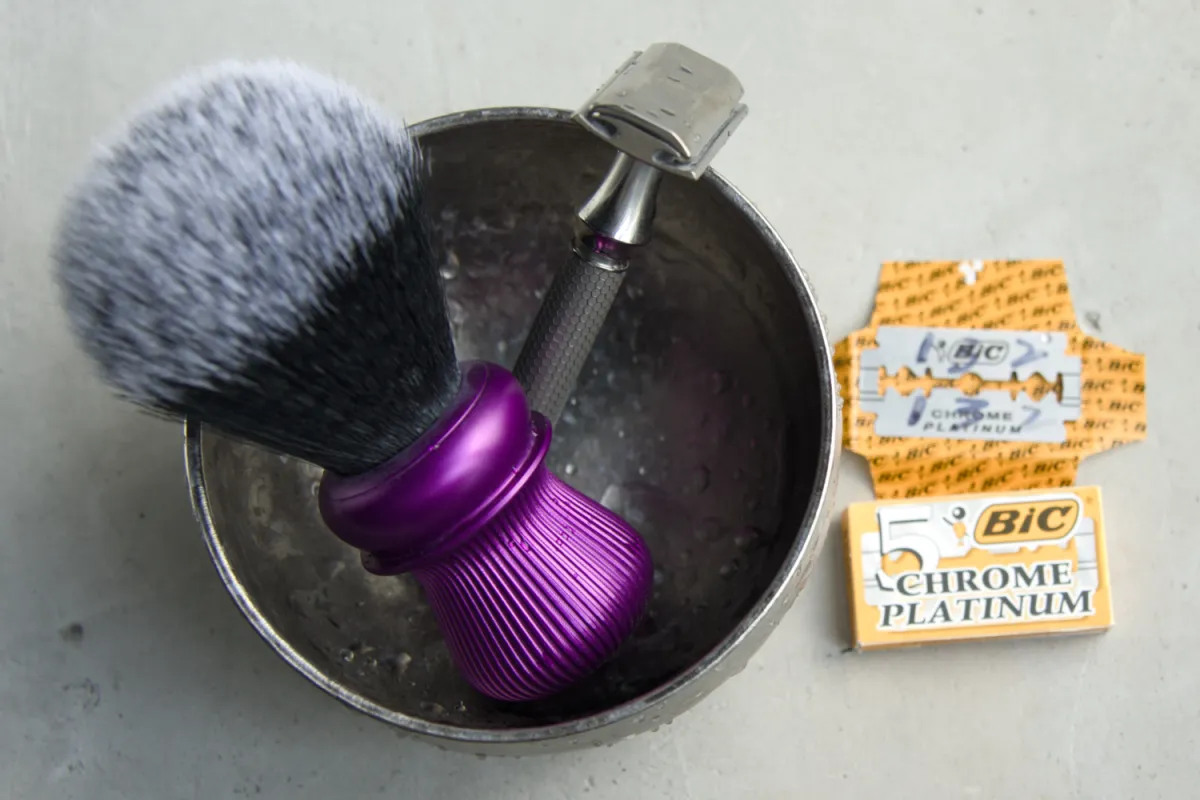
Conducted by a single ORMIXA tester (one skin profile) on the Vector TC4 — the material variant used is logged per entry of the blade compatibility database. Session-by-session notes follow ORMIXA’s published pairing rubric. This article documents pairing data — never a rating of either product on its own.
About the Companion Blade — BIC Chrome Platinum Identification
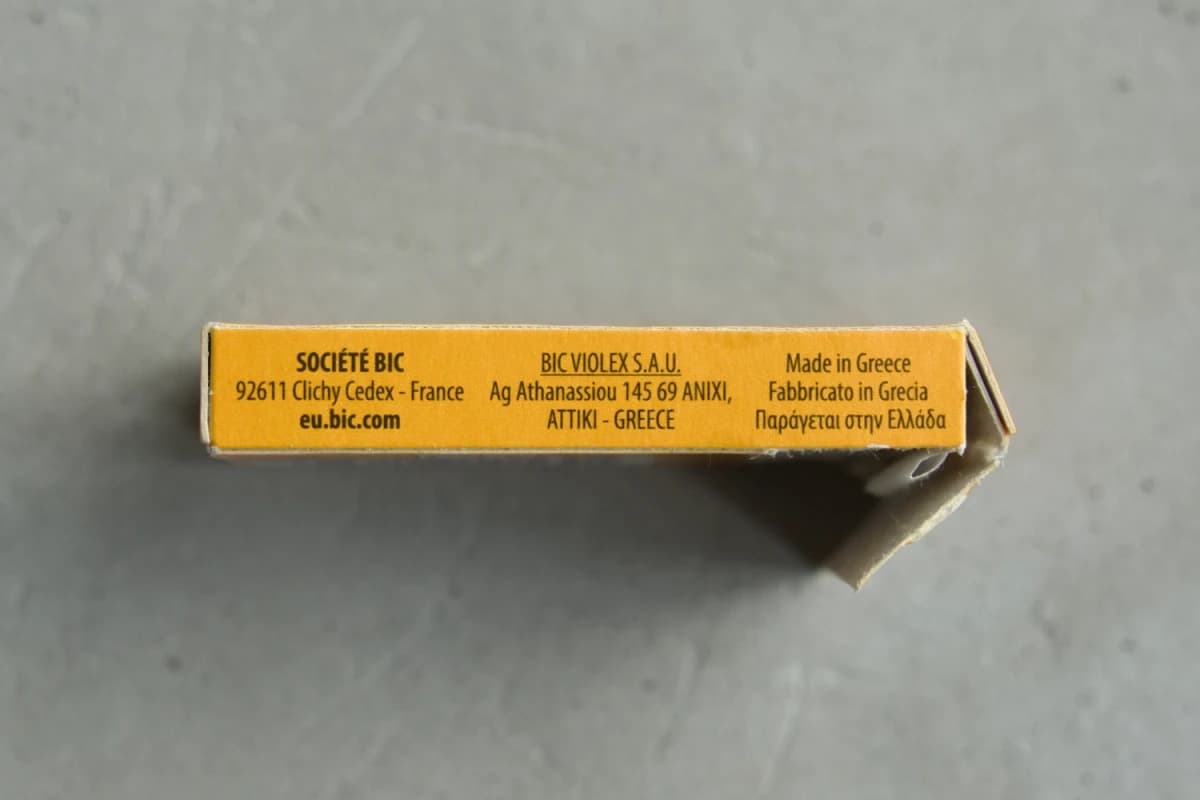
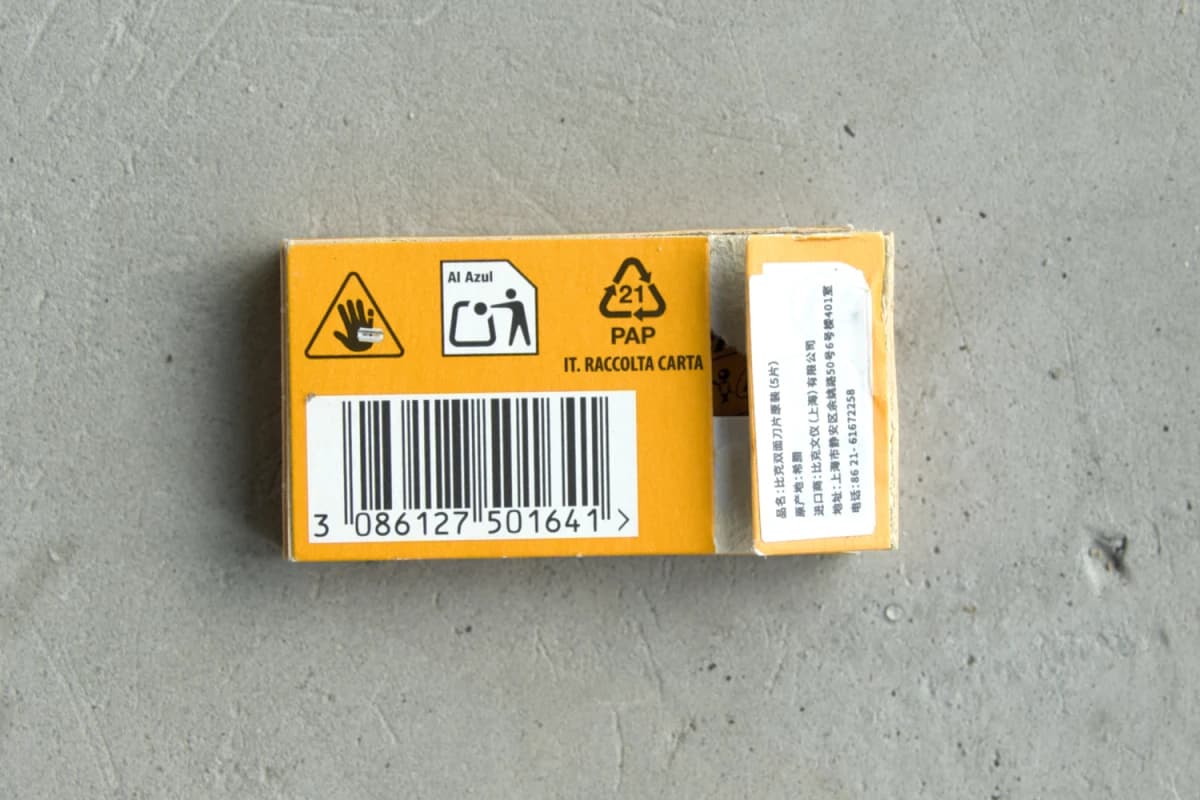
This section reports what the tested pack prints, face by face, from the photographs archived with the test. The printed panels are in English, Italian and Greek; an importer added a sticker in Chinese.
- Box front (in the kit photo): a large 5, the BIC logo and CHROME PLATINUM.
- Printed long side: SOCIÉTÉ BIC, Clichy Cedex, France, with eu.bic.com; BIC VIOLEX S.A.U., with an address in Anixi, Attiki, Greece; and Made in Greece / Fabbricato in Grecia / Παράγεται στην Ελλάδα.
- Importer sticker: 品名:比克双面刀片原装(5片) (“product name: BIC double-edge blades, original pack, 5 blades”), 原产地:希腊 (“place of origin: Greece”) and 进口商:比克文仪(上海)有限公司 (“importer: BIC Stationery (Shanghai) Co., Ltd.”), with an address in Shanghai.
- Back panel: a warning pictogram of a hand and a blade, three recycling marks (Al Azul, 21 PAP, IT. RACCOLTA CARTA) and barcode 3086127501641.
- Blade wrapper: a single orange paper wrapper printed all over with the BIC logo, logged in the session record as wax paper.
- Blade stamp: BIC in an oval and CHROME PLATINUM. Hand-written use-count marks on the tested blade cross the stamp; every string stays readable.
Origin rests on two carriers that agree: the printed Made in Greece line, in three languages, and the importer sticker’s 原产地:希腊. The long side names two BIC companies, one in France and one in Greece, without saying what role either plays, so none is assigned here. The front’s 5 and the sticker’s five-blade count agree. The barcode is recorded as printed and plays no part in the origin call.
Chrome Platinum is the line name, printed on the box and stamped on the blade. The pack says nothing else about the edge or its finish, so the database lists the finish as not stated. The identification says which blade was tested; it passes no judgement on the blade.
Test Conditions
- Tester: ORMIXA — one skin profile, fixed rubric
- Razor: ORMIXA Vector TC4 titanium (0.76 mm gap)
- Pre-shave: no hot towel; no pre-shave oil; face rinsed with tap water ~6 s
- Soap: Proraso Shaving Soap in a Bowl — Sensitive (green tea & oatmeal), bowl-lathered
- Brush: ORMIXA Harbor — 6061 Aluminum Axis · Purple · 26 mm Silver Black synthetic bulb, wetted under the tap and not soaked (Purple is not one of the catalogue finishes for the Axis; the knot is a catalogue option on it)
- Bowl: ORMIXA Titanium Shaving Bowl, Double-Wall Lather Bowl (lather built in the bowl)
- Pass pattern: WTG → ATG (2-pass; XTG skipped, target SS not BBS)
- Stroke length: long WTG strokes at Shaves 1 and 2; short strokes at Shave 3
- Post-shave: alum block
- Sessions: 3 shaves, 138h / 96h / 92h apart
- Conditions: 30 °C / 75% humidity, skin normal (all three sessions)
Lather condition: Proraso Sensitive built in the bowl on the Vector TC4, the combination also used by the Treet Platinum, Super Treet and Shark Super runs. The remaining eight Proraso entries ran the Vector 316L, so the razor changes across each of them. Cross-Pairing Reference below covers what stays comparable.
Test Period Summary
One physical blade, three sessions, five axes scored each time:
Shave 1 — Fresh
2026-10-23 · 138h growth
- Closeness
- 7/10
- Smoothness
- 10/10
- Irritation
- 9/10
First blade from the pack, out of a single printed wrapper. Long WTG strokes from the first use cut crisply with clear audible feedback and no drag. ATG matched the razor with wide angle tolerance and a clean finish. Zero nicks, zero weepers; the alum stung in one spot the log does not name and stayed mild elsewhere. Touch: SS (2-pass, BBS not targeted).
Shave 2 — 96h
2026-10-27 · 96h growth
- Closeness
- 7/10
- Smoothness
- 10/10
- Irritation
- 9/10
Every scored axis repeated Shave 1, and the long strokes again ran without drag. One weeper at the Adam’s apple on the ATG pass. The alum stung on the neck and chin and stayed mild elsewhere. Zero nicks. Touch: SS.
Shave 3 — 92h
2026-10-31 · 92h growth
- Closeness
- 7/10
- Smoothness
- 10/10
- Irritation
- 9/10
Short WTG strokes this time, and every axis held. Zero nicks, zero weepers; the alum stung on part of the left side of the neck and stayed mild elsewhere. Touch: SS.
3-shave scores at a glance
| Axis | Shave 1 | Shave 2 | Shave 3 |
|---|---|---|---|
| Closeness | 7 | 7 | 7 |
| Smoothness | 10 | 10 | 10 |
| Irritation | 9 | 9 | 9 |
| Audible feedback | 10 | 10 | 10 |
| Lather compatibility | 10 | 10 | 10 |
| Total / 50 | 46 | 46 | 46 |
| Touch | SS | SS | SS |
| Interval | 138h | 96h | 92h |
| Nicks / weepers | 0 / 0 | 0 / 1 | 0 / 0 |
| Alum sting | One spot, not named | Neck, chin | Left side of neck |
| Long WTG strokes | Yes | Yes | No |
Day-by-Day
Shave 1 (2026-10-23, 138h growth)
The first blade came out of a single printed wrapper, after the longest interval of the run. The WTG pass used long strokes from the start, cut crisply, gave clear audible feedback and showed no drag. ATG suited the razor well, with plenty of room on angle, and finished at SS on two passes. No nicks and no weepers. The alum stung in one spot, which the log does not name, and stayed mild elsewhere; the skin was mild at 30 minutes and fully relaxed at four hours.
Shave 2 (2026-10-27, 96h growth)
The scores repeated the opening session for a second 46/50, and the session summary again records the long strokes running without drag. The ATG pass drew one weeper at the Adam’s apple. The alum stung on the neck and the chin and stayed mild elsewhere; thirty minutes later the skin was mild, and at four hours fully relaxed. The written first impression and pass notes for this session repeat Shave 1’s wording, so the scores, the event count, the alum note and the summary carry it.
Shave 3 (2026-10-31, 92h growth)
This session used short WTG strokes, and every axis held for a third 46/50 with no nicks and no weepers. The alum stung on part of the left side of the neck and stayed mild elsewhere. The skin was mild at 30 minutes and fully relaxed at four hours. The session summary records that three uses had not reached the pairing’s limit.
What Worked in the Pairing
No axis moved across three uses
All five axes read the same at every session. In the database, three entries have gone three sessions without moving a point: this one, at 46/50, along with Treet Platinum (47.0) and Feather (44.0).
Long and short strokes scored alike
Shaves 1 and 2 used long WTG strokes and Shave 3 short ones, and no score moved between them. Neither long-stroke session recorded drag or drew blood on the with-the-grain pass.
No nicks
Six passes produced no nicks. In the database eleven of the sixteen pairings have gone three sessions without one, and this run is among them. Its one blood point was a weeper, covered under Friction Points below.
Bowl lather scored 10 throughout
With Proraso Sensitive built in the titanium bowl, lather compatibility scored 10 at every session.
Friction Points in the Pairing
Irritation sat at 9 from the first shave
Irritation scored 9 in all three sessions, so the point was already there on a fresh blade and is not a change with use. Each session left a local alum sting: at a spot the log does not name at Shave 1, on the neck and chin at Shave 2, and on the left side of the neck at Shave 3. The rest of the face stayed mild and the skin read mild at 30 minutes every time. The Cross-Pairing Reference below sets that point against the other rows on this razor and lather.
One weeper on the ATG pass
The run’s only blood point came at Shave 2, at the Adam’s apple, on the against-the-grain pass. The AAD and Cleveland Clinic guidance in the Sources both advise shaving in the direction the hair grows. This protocol includes an ATG pass, and on this skin the Adam’s apple is where it drew blood, once in three sessions.
Closeness 7 follows the 2-pass target
Every entry here stops at WTG and ATG with SS as the target, and the closeness score is set against that target. The touch grade was SS all three times; a closer result would take an XTG pass this protocol does not include.
Three uses, no endpoint
Testing ended at the third use with touch still SS and every axis where it started. The record covers a three-shave window and stops there, which is the figure to use for any cost-per-shave reading.
Difficult Areas (Pairing on this skin profile)
- Adam’s apple (Shave 2): one weeper on the ATG pass.
- Neck and chin (Shave 2): alum sting on both, with the rest of the face mild.
- Left side of the neck (Shave 3): alum sting at that spot only.
- Shave 1: the alum stung in one spot that the log does not name.
- Jaw line, upper lip: the per-area fields were left blank in all three sessions. They are reported as unrecorded, since a blank field is weaker evidence than a recorded zero.
Pairing Recommendation for Vector TC4 Owners
Conditions where the data supports this pairing for you:
- You want consecutive shaves to read alike — all three sessions scored 46/50 on identical axes.
- You weigh nicks heavily — none across six passes.
- You use long strokes — Shaves 1 and 2 ran them with no drag recorded and no blood on the WTG pass.
- You bowl-lather a Proraso-type soft soap — lather compatibility held 10 in every session.
Conditions where the data does not support this pairing for you:
- You target maximum closeness / BBS — this run produced SS on a conservative 2-pass; closer would need an XTG pass outside the test protocol.
- You want a finish with no sting at all — every session logged a local alum sting and irritation held at 9 from the first shave.
- You want a known blade-life figure — testing stopped at three uses, so this record cannot tell you where the window ends.
- You face-lather a hard stick — this series lathered Proraso in a bowl, so the data says nothing about this blade under a face-lathered stick.
Video Evidence
Three sessions, raw footage, no edits:
- Shave 1 of 3: youtu.be/cOh-Ntjh8xE
- Shave 2 of 3: youtu.be/M-id_iSm0qs
- Shave 3 of 3: youtu.be/AeA79TI0zSM
Cross-Pairing Reference
Where this pairing sits against the other Vector × DE-blade pairings tested so far (5-metric average out of 50):
| Pairing | Avg / 50 | Trend | Best window |
|---|---|---|---|
| Vector TC4 × Treet Platinum | 47.0 | flat on all five axes | Shaves 1–3 |
| Vector TC4 × Super Treet Platinum | 46.7 | two flat sessions, one point back at S3 | Shaves 1–3 |
| Vector 316L × Astra SP (green) | 46.0 | flat, no decay | Shaves 1–3 |
| Vector 316L × Personna Stainless | 46.0 | stable, mild S3 efficiency signal | Shaves 1–3 |
| Vector 316L × Gillette Perma-Sharp | 46.0 | flat with mild S3 long-stroke signal | Shaves 1–3 |
| Vector TC4 × BIC Chrome Platinum | 46.0 | flat on all five axes | Shaves 1–3 |
| Vector 316L × Iridium Super | 45.7 | two flat sessions, one point back at S3 | Shaves 1–2 |
| Vector TC4 × Shark Super | 45.7 | two flat sessions, one point back at S3 | Shaves 1–3 |
| Vector 316L × Dorco Prime | 44.3 | one point back at S2, then flat | Shaves 1–3 |
| Vector 316L × Feather Hi-Stainless | 44.0 | flat on all five axes | Shaves 1–3 |
| Vector 316L × Gillette Nacet | 42.7 | clean, mild S3 dip | Shaves 1–2 |
| Vector 316L × Gillette Silver Blue | 42.7 | 2-shave golden window | Shaves 1–2 |
| Vector 316L × Derby Extra | 42.0 | shallow uniform decline, stays in band | Shaves 1–2 |
| Vector TC4 × Voskhod Teflon | 40.0 | S2 dip, partial recovery | Shave 1 |
| Vector 316L × Wilkinson Classic | 35.7 | monotonic decline | Shaves 1–2 |
| Vector 316L × Wilkinson (India) | 35.3 | monotonic decline | Shaves 1–2 |
Same razor, soap and bowl. Treet Platinum (47.0), Super Treet (46.7) and Shark Super (45.7) ran the Vector TC4 with Proraso Sensitive built in the titanium bowl and the same 2-pass protocol. None of these comparisons isolates the blade; the paragraphs below list what else changed in each.
Treet Platinum Super Stainless (W13) scored 47 in all three sessions, a flat curve like this one and one point higher in every session, each time on irritation: 10 there, 9 here. Its brush was a 6061 Aluminum Line with a badger knot, soaked before every session; its intervals were 99h / 72h / 163h, and it used long strokes in all three sessions.
Super Treet Platinum scored 47 / 47 / 46. Its first two sessions sit one irritation point above this run’s; at the third both read 46, Super Treet having given back a smoothness point while this run kept its irritation at 9. Its brush was a Line in a prototype Silver finish with a Black & White synthetic knot, soaked every session, and it used long strokes only at its third session.
Shark Super Stainless (W15) scored 46 / 46 / 45. Its first two sessions match this run axis for axis, irritation 9 included; at the third it gave back a closeness point. Its brush shares this run’s 6061 Aluminum Axis handle, in Tactical Black, with a Black & White synthetic knot where this run used Silver Black. Shark’s brush was soaked at its first session only, and its intervals were 120h / 143h / 92h.
Read together, W13 and Super Treet, at irritation 10 in every session, both ran a Line handle and soaked the brush every time; Shark and this run, at 9 in every session, both ran an Axis handle and left the brush unsoaked at two of Shark’s sessions and all three of this run’s. The blade changed between all four as well, so this data cannot say whether the point belongs to the blade, the handle, the knot or the soak.
The other eight Proraso rows (Astra SP (46.0), Personna (46.0), Iridium Super (45.7), Dorco Prime (44.3), Feather (44.0), Nacet (42.7), Silver Blue (42.7) and Derby (42.0)) ran the Vector 316L, so every gap to them carries the razor as a second variable. Among all the Proraso rows this pairing’s 46.0 comes fifth, with tied scores listed in publish order.
Against the ARKO face-lathered rows — Perma-Sharp, Voskhod, Wilkinson Classic and Wilkinson Saloon Pack — the lather changes. Voskhod shares the Vector TC4; the other three ran the Vector 316L as well. A flat 10 on lather compatibility here describes a bowl-built Proraso lather on a titanium Vector and predicts nothing about this blade under an ARKO stick.
→ Full Vector Blade Compatibility Database
Methodology Notes
What limits this 3-shave run:
- No single-variable comparison: W13 Treet Platinum, Super Treet and Shark share the razor, soap, bowl and protocol, but each differs from this run in brush build, brush soak and intervals, and W13 and Super Treet in stroke length as well. Every other row changes the razor, the lather, or both.
- Single-razor data: this pairing ran only on the Vector TC4, so blade-versus-razor causation is not isolated. The same blade on the Vector 316L would be needed to separate them.
- The brush was not soaked: it was wetted under the tap before each session, where W13 and Super Treet soaked theirs for about a minute every time.
- Stroke length changed inside the run: long WTG strokes at Shaves 1 and 2, short ones at Shave 3. No axis moved either way.
- Intervals ran long: 138h, 96h and 92h, each above the 72-hour target.
- Closeness was calibrated against the touch grade: the session log wrote closeness at 10 while recording the touch grade as SS in all three sessions. The published scores follow the rubric’s anchor, where SS sits at 6–7, and the original values stay in the source record. No other axis was changed.
- Irritation stands as recorded: each session logged a local alum sting with irritation at 9, and Shave 2 also a weeper. Scores are not rewritten after the session, so the events are reported next to the score.
- Corrections made to the session log: the Shave 1 interval was recorded as 96 hours and corrected to 138 against the previous logged shave; Shave 3 was logged under Shave 2’s date and corrected to 2026-10-31, which made its interval 92 hours rather than the 90 recorded. Shave 3’s four-hour field was filled in under an hour after the shave; the four-hour state reported here was observed once the four hours had passed, and it matches the early entry. The first-impression notes for Shaves 2 and 3 repeat Shave 1 and are not used, and the WTG and ATG notes are the same sentence in all three sessions; long strokes are reported for Shaves 1 and 2, and a follow-up check confirmed Shave 3 used none.
- The brush finish is not a catalogue one: the Purple 6061 Aluminum Axis handle is not sold. The knot is a catalogue option on that series.
- n=1: one tester, one skin profile, one razor, no A/B isolation. Read it as a data point, not a population result.
Pairing Verdict
46.0 places the pairing sixth in the database, with tied scores listed in publish order. Three sessions at 46/50 on identical axes, no nicks, one weeper at the Adam’s apple on an ATG pass, and an irritation point that was there from the first shave.
On a Vector TC4, with Proraso Sensitive built in a bowl and a two-pass routine, the pairing gave three usable shaves that read identically and had not reached an endpoint by the third. The record leaves open where the irritation point comes from on this rig, how the pairing runs past three uses or with another lather or brush, and how much of the placement belongs to the titanium Vector rather than the blade. The verdict applies to the pairing, not to the blade or the razor on its own.
Vector 316L owners: both variants use the same head geometry — the 0.76 mm blade gap and the same guard span — and differ in in-hand weight, 60 g for the TC4 titanium against 104 g for the 316L stainless. The shared geometry is a design fact, not a measured transfer: no entry in this database has run one blade on both materials, so these scores and this placement are not shown to carry over to a 316L. Take the row as a blade worth trying there rather than a predicted score.
Sources
- American Academy of Dermatology — How to shave (shave in the direction the hair grows)
- Cleveland Clinic — Razor Burn (shaving against the direction of hair growth as an irritation cause)
- AZoM — Ti-6Al-4V (Grade 5) titanium datasheet: density & elastic-modulus data for the TC4 alloy
- scienceofsharp — Quantifying Sharp (blade-edge apex width & bevel-angle metallurgy)
- ORMIXA blade-test shave logs — one skin profile, fixed rubric; method in the blade compatibility test methodology
Disclosure
Internal lab pairing test. Not sponsored. ORMIXA does not receive commercial consideration from any DE blade vendor for pairing data or scoring.
ORMIXA products are sold by ECE Innovate Homes LLC and manufactured by Guangzhou Yanyang Technology Co., Ltd. under trademark license.
ORMIXA does not sell razor blades. This was a retail pack purchased for evaluation. No company printed on the pack and no blade vendor has a commercial relationship to ORMIXA, ECE Innovate Homes LLC, or Guangzhou Yanyang Technology.
If you think manufacturer-conducted testing biases the methodology, fair concern. Video evidence is linked above for every session, the pairing rubric was published before testing started, and the database includes Vector pairings with blades whose makers are direct competitors. Send your own pairing data — we’ll compare.
Related
- ← Back to the full Vector Blade Compatibility Database
- Same razor, soap, bowl and handle series — Vector TC4 × Shark Super Stainless →
- Same razor, soap and bowl — Vector TC4 × Treet Platinum Super Stainless →
- Same razor, soap and bowl — Vector TC4 × Super Treet Platinum →
- The razor used in this test — Vector TC4 →
- The brush line used in this test — Harbor →
- The bowl used in this test — Titanium Double-Wall →
Frequently asked questions
- Does the Vector TC4 pair well with BIC Chrome Platinum blades?
- In a 3-shave test the pairing scored 46.0/50 (46 / 46 / 46) and no axis moved across the run: closeness 7 under a 2-pass protocol aimed at SS, smoothness, audible feedback and lather compatibility 10, and irritation 9 in every session. The run recorded no nicks and one weeper. This is pairing data, not a rating of the blade in isolation.
- Where are BIC Chrome Platinum blades made?
- The tested pack prints Made in Greece on its long side, in English, Italian and Greek, beside two BIC company lines: Société BIC in Clichy, France, and BIC Violex S.A.U. in Anixi, Attiki, Greece. A Chinese importer sticker on the same pack gives the place of origin as Greece (原产地:希腊) and names an importer in Shanghai. The pack does not say which role either BIC company plays.
- Why did irritation score 9 in every session?
- The point was there from the first shave, so it does not track blade wear. Each session logged a local alum sting, on the neck and chin at Shave 2 and on the left side of the neck at Shave 3, and the skin read mild at 30 minutes every time. On the same Vector TC4 and lather, the two Treet runs scored irritation 10 with a soaked brush on a Line handle, while Shark scored 9 with a mostly unsoaked brush on an Axis handle, as this run did. The blade changed too, so the data cannot assign the point to the blade, the handle, the knot or the soak.
- What caused the weeper in this test?
- The run had one weeper, at the Adam’s apple on the against-the-grain pass of the second shave. No session drew blood on the with-the-grain pass, including the two that used long strokes.
- How many shaves did the BIC Chrome Platinum pairing last?
- Testing stopped at three uses with touch still SS and every axis unchanged, so a three-use window is the only claimable range and no blade-life endpoint was measured.
- Do these Vector TC4 results apply to the Vector 316L?
- Not as a predicted score. The two variants share the same head geometry and 0.76 mm blade gap and differ in in-hand weight, at 60 g for the TC4 titanium against 104 g for the 316L stainless, but no entry in this database runs one blade on both materials. Shared geometry does not establish that this pairing’s scores or its placement would repeat on a 316L.
- Is ORMIXA recommending BIC Chrome Platinum blades?
- No. ORMIXA does not sell razor blades and makes no recommendation about BIC Chrome Platinum blades in isolation or on razors outside this database. This article documents how one pack behaved with one ORMIXA razor, one lather and one tester, and the verdict applies to that pairing.