

Vector 316L × Gillette Nacet safety razor blade pairing data — three shaves on the same physical razor. The pairing averaged 42.7/50 and ran the cleanest safety profile in the database so far: zero weepers across all three shaves, irritation flat at 9, with the only softening a mild sharpness dip on the third use.
Vector 316L × Gillette Nacet (TL;DR)
Across 3 shaves the Vector 316L × Gillette Nacet pairing scored 42.7/50 (per-shave 43 / 43 / 42). Shaves 1–2 held a flat golden window; Shave 3 softened only on the sharpness axis — smoothness eased to 8 and ATG left detectable stubble, while comfort held (zero weepers, irritation flat at 9). Closeness sat at 7 by design (conservative 2-pass, WTG → ATG, no XTG, SS not BBS) on the 0.76 mm gap. The one blood point across the run was a single technique nick at the Adam’s apple (Shave 2, over-pressure). Same PPI factory as Astra, same Proraso lather, same razor — a near-single-variable read (the brush differed; see Methodology Notes). Pairing data transfers 1:1 to the Vector TC4. This is pairing data, not a rating of the blade in isolation.
Conducted by a single ORMIXA tester (one skin profile) on the Vector 316L — the material variant used is logged per entry of the blade compatibility database. Session-by-session notes follow ORMIXA’s published pairing rubric. This article documents pairing data — never a rating of either product in isolation.
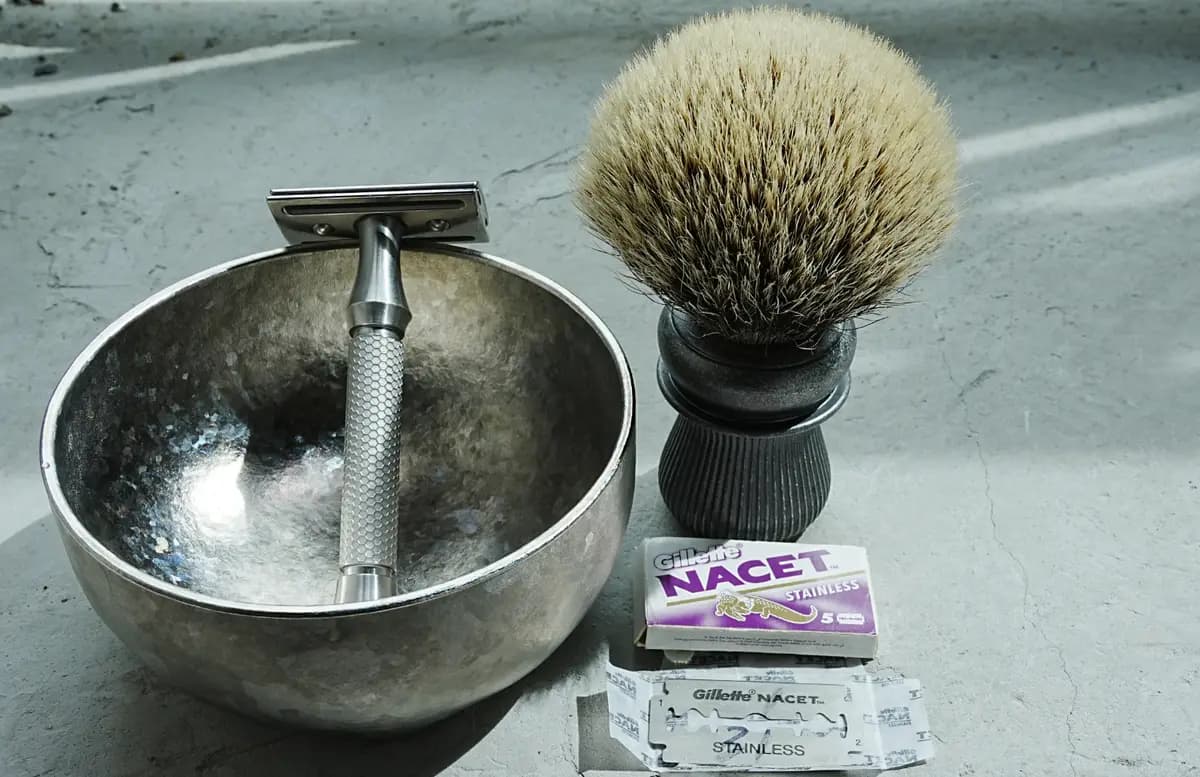
On the Vector 316L with the standard 2-pass routine (WTG → ATG, target SS), the Vector × Nacet pairing opened at peak sharpness and held flat for two sessions, then eased slightly on the third. Pairing total rolled up to 42.7/50 (43 / 43 / 42), with the small Shave-3 change landing on the sharpness axis while comfort and safety stayed put. This is a data point in the Titanium Safety Razor Blade Compatibility Project; additional pairings appear here as each third-party blade passes through the same test cycle on the Vector platform (material variant logged per entry).
About the Companion Blade — Gillette Nacet Identification
Gillette Nacet is a Russian-made double-edge blade with a devoted following in the wet-shaving world, recognisable by the alligator on the pack. The pack tested here is the standard Nacet Stainless line. Provenance is verified directly from the box, never from common knowledge:
- Country of origin: Made in Russia, printed in English on the end panel of the box.
- Manufacturer: Petersburg Products International LLC, St. Petersburg (Shushary) — the same plant named on the Astra Superior Platinum pack in this database.
- Brand owner: a Procter & Gamble / Gillette brand; the pack carries the Gillette mark and the Nacet alligator logo.
- Pack: a 5-blade pack of stainless-steel double-edge blades, each individually wax-paper wrapped. This was an Arabic-market retail pack (the remaining panels are printed in Arabic).
The box carries a datamatrix code but no human-readable EAN, so none is asserted here. The blade itself is stamped Gillette Nacet Stainless.
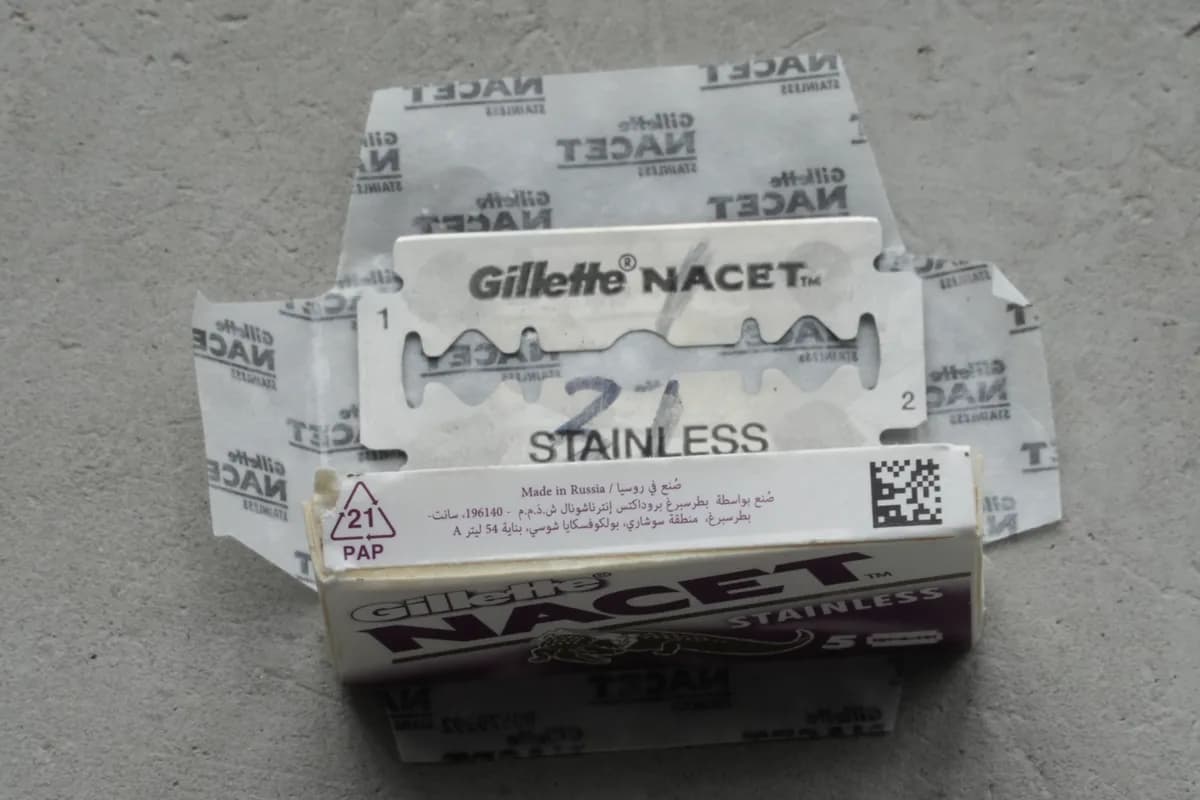
The test pack was a retail pack purchased for evaluation. ORMIXA has no commercial relationship to Gillette or any blade vendor. None of the above is a quality judgement of the blade; it is identification context for the pairing that follows.
Test Conditions
- Tester: ORMIXA — one skin profile, fixed rubric
- Razor: ORMIXA Vector 316L stainless (0.76 mm gap)
- Pre-shave: no hot-towel; no pre-shave oil; brush soaked in tap water ~1 min
- Soap: Proraso Shaving Soap in a Bowl — Sensitive (green tea & oatmeal), bowl-lathered
- Brush: ORMIXA 6061 Aluminum Axis — Tactical Black, 26 mm Two-Band Badger
- Bowl: ORMIXA Titanium Shaving Bowl, Double-Wall Lather Bowl — Silver
- Pass pattern: WTG → ATG (2-pass; XTG skipped, target SS not BBS)
- Post-shave: alum block
- Sessions: 3 shaves — Shave 1 on a ~5-day (121h) baseline, then a 72h cadence for Shaves 2–3
- Conditions: 30 °C / 85% humidity (all three sessions)
Results also apply to the Vector TC4 — same blade gap and head geometry. See the methodology for material-specific perception differences.
Test Period Summary
3 shaves total. Shave 1 is a ~5-day-stubble baseline (121h); Shaves 2 and 3 run a 72h cadence. Pass pattern: WTG → ATG (2-pass) each session.
Shave 1 — Fresh
2026-06-27 · ~5-day baseline (121h)
- Closeness
- 7/10
- Smoothness
- 9/10
- Irritation
- 9/10
First stroke landed sharp with no blade feel and no drag, and the angle tolerance was wide. WTG passed clean and ATG left barely any stubble to the touch. Zero blood points — no nicks, no weepers. Alum mild across the whole face. Touch: SS (2-pass, BBS not targeted).
Shave 2 — 72h
2026-06-30 · 72h growth
- Closeness
- 7/10
- Smoothness
- 9/10
- Irritation
- 9/10
Sensory feel was almost identical to Shave 1 — sharpness, audible feedback, angle tolerance and lather all held. The one event was a single nick at the Adam’s apple on ATG, from over-confidence and too much pressure: a technique slip, not a blade event. Zero weepers. Alum mild. Touch: SS.
Shave 3 — 72h
2026-07-03 · 72h growth
- Closeness
- 7/10
- Smoothness
- 8/10
- Irritation
- 9/10
Closeness-feel and lather held, but the edge softened slightly: ATG left detectable stubble and the overall shave read a touch less clean than the first two. Smoothness eased to 8. Comfort stayed intact — zero weepers, irritation flat at 9, alum still mild. The change is a mild sharpness signal, kept off the comfort axis. Touch: SS.
3-shave scores at a glance
| Shave | Closeness | Smoothness | Irritation | Touch |
|---|---|---|---|---|
| 1 — fresh | 7 | 9 | 9 | SS |
| 2 — 72h | 7 | 9 | 9 | SS |
| 3 — 72h | 7 | 8 | 9 | SS |
Closeness, Smoothness and Irritation shown above; the full rubric also scores Audible feedback (9/9/9) and Lather compatibility (9/9/9). Pairing totals by shave: 43 / 43 / 42; average 42.7/50.
Day-by-Day
Shave 1 (2026-06-27, ~5-day baseline)
First time recording this blade on the Vector 316L. Packaging was simple — wax paper, no extra wrap inside the box. The edge went on sharp: no blade feel against the face, no drag on contact. The angle tolerance was wide enough that the cutting plane presented no difficulty.
WTG was crisp end to end — no pull, sharpness clearly on. XTG was skipped by protocol (target SS). ATG then left barely any stubble to the touch, and the whole shave completed with zero blood points: no nicks, no weepers. That puts it among the cleanest opening sessions in the database, alongside the Astra run’s opener.
Alum went on mild across the whole face. At 30 minutes the skin read clean; at 4 hours, fully relaxed.
Touch: SS. Scores: Closeness 7 / Smoothness 9 / Irritation 9 / Audible 9 / Lather 9.
Shave 2 (2026-06-30, 72h growth)
Second session on the Vector 316L, and the sensory read was almost indistinguishable from Shave 1. Sharpness held: on-face contact again had no blade feel and no drag. Audible feedback, angle tolerance and lather compatibility all tracked Shave 1.
The one event was on ATG: a single nick at the Adam’s apple, from over-confidence and too much pressure through that pass. The cause sits in the pressure, not in the edge — a reminder that the neck rewards a light hand even when the blade is behaving. Everywhere else finished with zero blood points, and there were no weepers.
Alum was mild again, with a little sting at the nick. 30 min: clean. 4 hr: fully relaxed.
Touch: SS. Scores: Closeness 7 / Smoothness 9 / Irritation 9 / Audible 9 / Lather 9.
Shave 3 (2026-07-03, 72h growth)
Third use of the same blade. First contact still had no drag and no blade feel, and the cut remained workable through WTG. By the third use the edge had softened a touch: ATG left detectable stubble, and the overall shave read slightly less clean than the first two sessions.
Smoothness eased a point to 8 — the honest signal of that softening. What did not move is comfort: zero weepers again, irritation flat at 9, and alum still mild across the face. So the third-use change on this pairing is a mild sharpness dip, and it stays off the comfort and safety axis where a tiring edge usually shows first.
Alum went on mild. 30 min: clean. 4 hr: fully relaxed.
Touch: SS. Scores: Closeness 7 / Smoothness 8 / Irritation 9 / Audible 9 / Lather 9.
What Worked in the Pairing
Comfort stayed flat across all 3 shaves
The standout axis of this pairing on the Vector 316L is comfort. Across all three sessions the run produced zero weepers, irritation held a flat 9, and alum stayed mild every time. The single blood point of the whole series was a technique nick at the Adam’s apple (Shave 2, over-pressure), not a blade event. That ties the Astra run for the lowest blood-point count of any pairing in the database to date.
Sharpness peaked for two full shaves
Shaves 1 and 2 both posted 43/50 with matched scores across the rubric. Through that window first contact had no blade feel and no drag, WTG stayed crisp, and ATG left barely any stubble. The edge behaved as a sharp, forgiving companion on the 0.76 mm gap for both sessions before easing on the third.
Proraso Sensitive lather chemistry matched cleanly
Bowl-lathered Proraso Sensitive (green tea & oatmeal) stayed dense through both passes; the Vector × Nacet head + edge held its slickness at every session, and lather compatibility scored a flat 9 across the series.
Friction Points in the Pairing
Shave 3 softens on sharpness
The friction point on this pairing is a mild third-use dulling. By Shave 3 the ATG pass left detectable stubble and the shave read a touch less clean, so smoothness eased to 8. It is a gentle change — comfort and safety held, so the golden window is Shaves 1–2 with the third use still clean and usable rather than past its edge.
Closeness sat at 7 — set by the 2-pass protocol
Closeness held a flat 7 every session. That is a property of the test design: the conservative 2-pass routine (WTG → ATG, no XTG) targets SS, and BBS was never attempted. So 7 is the floor this routine produces, and reaching closer would need an added XTG pass outside the protocol. The Shave-3 softening showed up on smoothness precisely because closeness was already capped at that floor.
Difficult Areas (Pairing on this skin profile)
- Jaw / jawline: clean across all 3 shaves — no nicks, no weepers.
- Neck: clean on Shaves 1 and 3. The Shave 2 event was a single nick at the Adam’s apple from over-pressure on ATG — technique, not edge condition.
- Upper lip / under nose: clean across all 3 shaves — no blood points either pass.
- Adam’s apple / under chin: the only zone to log a blood point in the series — one nick on Shave 2, caused by too much pressure on ATG. Clean on Shaves 1 and 3.
Pairing Recommendation for Vector 316L Owners
If you already run a Vector 316L, here is how this blade behaves on it. The data supports the pairing under these conditions:
- You want a comfortable, low-drama shave — the run posted zero weepers across all 3 sessions with irritation flat at 9 and alum mild throughout.
- You want a sharp 2-shave window — Shaves 1–2 held a flat 43/50 with sharpness on and ATG leaving barely any stubble.
- You run a simple dense soap such as Proraso Sensitive — the pairing kept its slickness across all 3 sessions with lather compatibility at 9.
Conditions where the data does not support this pairing for you:
- You want to push a single blade well past 3 shaves at peak sharpness — the edge had already softened a touch by Shave 3 on this pairing.
- You target maximum closeness / BBS — this run produced SS closeness (7) on a conservative 2-pass; reaching closer would need an XTG pass outside the test protocol.
- You need a confirmed blade-life count — the longevity read here is a 3-shave window, not a measured blade-life figure.
Note: this is pairing data on the Vector 316L specifically. ORMIXA makes no recommendation about Gillette Nacet blades in isolation, or on razors outside this database. Other Vector pairings and future ORMIXA × Gillette Nacet series may differ.
Video Evidence
Three sessions, raw footage, no edits:
- Shave 1 of 3: youtu.be/LsccSfJzQWs
- Shave 2 of 3: youtu.be/30saL1CttWY
- Shave 3 of 3: youtu.be/KhJOOZwMp_k
Cross-Pairing Reference
Where this pairing sits against the other Vector × DE-blade pairings tested so far (5-metric average out of 50):
| Pairing | Avg / 50 | Trend | Best window |
|---|---|---|---|
| Vector 316L × Astra SP (green) | 46.0 | flat, no decay | Shaves 1–3 |
| Vector 316L × Personna Stainless | 46.0 | stable, mild S3 efficiency signal | Shaves 1–3 |
| Vector 316L × Gillette Perma-Sharp | 46.0 | flat with mild S3 long-stroke signal | Shaves 1–3 |
| Vector 316L × Iridium Super | 45.7 | two flat sessions, one point back at S3 | Shaves 1–2 |
| Vector TC4 × Shark Super | 45.7 | two flat sessions, one point back at S3 | Shaves 1–3 |
| Vector 316L × Dorco Prime | 44.3 | one point back at S2, then flat | Shaves 1–3 |
| Vector 316L × Feather Hi-Stainless | 44.0 | flat on all five axes | Shaves 1–3 |
| Vector 316L × Gillette Nacet | 42.7 | clean, mild S3 dip | Shaves 1–2 |
| Vector 316L × Gillette Silver Blue | 42.7 | 2-shave golden window | Shaves 1–2 |
| Vector 316L × Derby Extra | 42.0 | shallow uniform decline, stays in band | Shaves 1–2 |
| Vector TC4 × Voskhod Teflon | 40.0 | S2 dip, partial recovery | Shave 1 |
| Vector 316L × Wilkinson Classic | 35.7 | monotonic decline | Shaves 1–2 |
| Vector 316L × Wilkinson (India) | 35.3 | monotonic decline | Shaves 1–2 |
The two cleanest comparisons in the table are the same-soap, same-razor runs against Astra and Silver Blue. All three ran on the same Vector 316L with the same Proraso Sensitive lather; apart from the lathering brush (logged per entry), the blade is the only variable that changed. Against Astra it is even tighter: the Nacet and Astra packs both trace to the same Petersburg Products International plant, so it is two Russian-made P&G blade lines from one factory on one razor. Astra held flat at 46.0/50 with 10s on smoothness, audible and lather; Nacet holds those axes at 9 and eases a point on the third use, for 42.7/50.
Against Silver Blue the totals tie at 42.7, but the shape differs. The Nacet run kept comfort flat — zero weepers, irritation at 9 — and lost its point on the sharpness axis at Shave 3. The Silver Blue run held a 2-shave window, then its weepers rose to 4 and irritation eased on the third use, so its decline sat on the comfort and safety axis. Same number, cleaner safety record for Nacet.
The Voskhod run and both Wilkinson runs used an ARKO stick, a drier lather with less slip than the Proraso Sensitive used here, so any gap against those rows moves blade and lather together rather than being a clean single-variable read. Those rows are context, not head-to-head blade reads.
→ Full Vector Blade Compatibility Database
Methodology Notes
Transparency about the boundaries of this 3-shave run:
- Single-razor data: this pairing ran only on the Vector 316L, so blade-vs-razor causation is not isolated. The Shave-3 softening is read as the blade’s longevity on this pairing (Hypothesis A), but a comparison body (e.g. the Vector TC4 running the same blade) would be needed to rule out the 0.76 mm gap shaping the curve (Hypothesis B). That isolation is noted as a limit, not claimed as settled.
- The Shave-2 nick is technique, not decay: it came from over-pressure on ATG at the Adam’s apple, at peak sharpness on the second use. It is logged as a technique slip and kept out of the degradation read.
- The degradation signal is on smoothness: because the 2-pass protocol caps closeness at the SS floor (7), the mild Shave-3 softening surfaced on smoothness (9 → 8) plus the test team’s in-session read of detectable ATG stubble.
- Closeness is protocol-capped: the conservative 2-pass (no XTG) targets SS. A 3-pass run with XTG would be needed to probe DFS/BBS on this pairing.
- Brush differs from the Astra/Silver Blue runs: those used a 24 mm TA2 titanium brush; this run used a 26 mm 6061 aluminum badger brush. The soap and razor are held constant, so the brush is a minor lathering-tool difference, not a scored variable.
- Scoring note: Shave 2’s Irritation 9 is the contemporaneous call — read strictly against the rubric’s blood-point bands, one technique nick would sit a band lower. It is logged as-is (no retroactive adjustment), with the nick attributed to over-pressure at the Adam’s apple, not the blade.
Pairing Verdict
After 3 shaves of the Vector 316L × Gillette Nacet pairing: 42.7/50 — a sharp, low-drama 2-shave window, then a mild sharpness dip while comfort holds.
Shaves 1 and 2 held a flat 43/50 with sharpness on, ATG leaving barely any stubble, and zero weepers. The third use is where the edge eased: smoothness slid to 8 and ATG left detectable stubble, while comfort and safety stayed intact — no weepers, irritation flat at 9, alum mild. The one blood point in the whole run was a technique nick at the Adam’s apple on Shave 2. On the question this series can answer, the pairing runs sharp and comfortable for two shaves on the Vector and stays clean, if slightly less close, on the third.
For Vector 316L owners weighing Gillette Nacet as a companion blade, the data supports it as a comfortable everyday pairing with a 2-shave sharpness peak. Because the run was single-razor, whether the Shave-3 softening is the blade’s own longevity or the 0.76 mm gap shaping it is unresolved; a follow-up on the Vector TC4 with the same blade would calibrate that.
Vector TC4 owners: this pairing data transfers 1:1 to your razor. The cutting geometry is identical — only the in-hand feel differs.
Sources
- American Academy of Dermatology — How to shave (shaving with the grain & lather to reduce irritation)
- Cleveland Clinic — Razor Burn (friction, dull blade & against-the-grain as irritation causes)
- scienceofsharp — Quantifying Sharp (blade-edge apex geometry & sharpness measurement)
- AZoM — Grade 316/316L Stainless Steel (low-carbon grade & molybdenum corrosion resistance)
- ORMIXA blade-test shave logs — one skin profile, fixed rubric; method in the blade compatibility test methodology
Disclosure
Internal lab pairing test. Not sponsored. ORMIXA does not receive commercial consideration from Gillette or any DE blade vendor for pairing data or scoring.
ORMIXA products are sold by ECE Innovate Homes LLC and manufactured by Guangzhou Yanyang Technology Co., Ltd. under trademark license.
ORMIXA does not sell razor blades. This was a retail pack purchased for evaluation. Gillette has no commercial relationship to ORMIXA, ECE Innovate Homes LLC, or Guangzhou Yanyang Technology.
If you think manufacturer-conducted testing biases the methodology, fair concern. Video evidence is linked above for every session, the pairing rubric was published before testing started, and the database includes Vector pairings with blades whose makers are direct competitors. Send your own pairing data — we’ll compare.
Related
- ← Back to the full Vector Blade Compatibility Database
- Same factory (PPI), same razor — Vector 316L × Astra Superior Platinum →
- The razor used in this test — Vector 316L →
- The brush used in this test — Harbor →
- The bowl used in this test — Titanium Double-Wall →
Frequently asked questions
- Does the Vector 316L pair well with Gillette Nacet blades?
- In a 3-shave test the pairing scored 42.7/50 (43 / 43 / 42). It ran the cleanest safety profile in the database: zero weepers across all three shaves and irritation flat at 9. Shaves 1-2 held a sharp golden window; Shave 3 eased only on smoothness (to 8) while comfort held. The one blood point was a single technique nick at the Adam’s apple on Shave 2. This is pairing data, not a rating of the blade in isolation.
- How many shaves does Gillette Nacet last in this pairing?
- On the Vector 316L the sharp golden window was Shaves 1-2, both scoring 43/50 with matched rubric values. The edge softened slightly on the third use — smoothness eased to 8 and ATG left detectable stubble — while comfort stayed flat. The data supports a 2-shave sharpness peak with the third use still clean; that is a 3-shave-window read, not a measured blade-life count.
- How does Gillette Nacet compare to Astra on the Vector 316L?
- The Nacet and Astra packs both trace to the same Petersburg Products International plant in St. Petersburg, and both ran on the same Vector 316L with the same Proraso Sensitive lather — so apart from the lathering brush, the blade is the only variable. Astra held flat at 46.0/50 with 10s on smoothness, audible and lather; Nacet holds those at 9 and eases a point on the third use, for 42.7/50. This compares two pairings, not a rating of either blade alone.
- Nacet and Silver Blue both scored 42.7 — what is the difference?
- The totals tie, but the shape differs. The Nacet run kept comfort flat (zero weepers, irritation 9) and lost its point on the sharpness axis at Shave 3. The Silver Blue run held a 2-shave window, then weepers rose to 4 and irritation eased on the third use, so its decline sat on the comfort and safety axis. Same number, cleaner safety record for the Nacet pairing on this routine.
- Does this pairing data apply to the Vector TC4?
- Yes, 1:1. The Vector 316L and Vector TC4 share the same head geometry and 0.76 mm blade gap — only the in-hand weight and feel differ, so the cutting behaviour of the pairing transfers directly.
- Is ORMIXA recommending Gillette Nacet blades?
- No. ORMIXA does not sell razor blades and makes no recommendation about Gillette Nacet blades in isolation or on razors outside this database. This article documents how one third-party blade performed when paired with the Vector 316L — pairing data only, per ORMIXA editorial scope.