

Vector 316L × Dorco Prime Platinum safety razor blade pairing data — three shaves on the same physical razor. The pairing averaged 44.3/50 (45 / 44 / 44), placing it seventh of the fourteen pairings in the database, just above Feather Hi-Stainless. The series gave back a single point, at Shave 2, and then held. Every blood point in the run appeared on the with-the-grain pass; the against-the-grain pass produced none.
Vector 316L × Dorco Prime (TL;DR)
Across 3 shaves the Vector 316L × Dorco Prime Platinum pairing scored 44.3/50 (per-shave 45 / 44 / 44). Closeness held a flat 7 (conservative 2-pass: WTG → ATG, no XTG, SS not BBS) on the 0.76 mm gap. Irritation eased from 9 to 8 at Shave 2; smoothness, audible feedback and lather compatibility never moved. The run produced zero nicks and 5 weepers, all 5 on WTG passes. The tested pack was box-verified as made in Vietnam at Dorco’s Vietnam factory (model STP300-5P). This series used Proraso Sensitive bowl-lathered, matching the nine other Proraso entries. Pairing data transfers 1:1 to the Vector TC4. This is pairing data, not a rating of the blade in isolation.
Conducted by a single ORMIXA tester (one skin profile) on the Vector 316L — the material variant used is logged per entry of the blade compatibility database. Session-by-session notes follow ORMIXA’s published pairing rubric. This article documents pairing data — never a rating of either product in isolation.
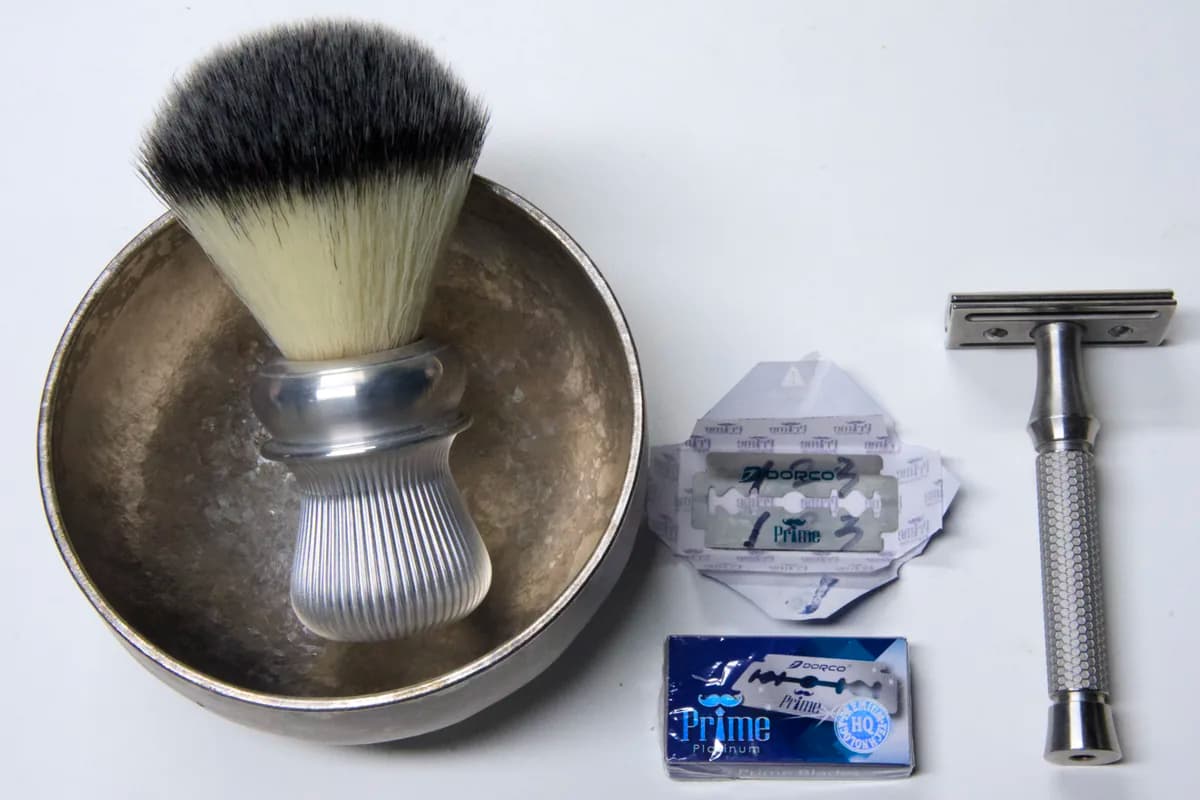
On the Vector 316L with the standard 2-pass routine (WTG → ATG, target SS), the Vector × Dorco Prime pairing opened at 45/50 and settled at 44/50 for the remaining two sessions. The single point it gave back landed on irritation at Shave 2, alongside the one session that produced more than a single weeper. Smoothness stayed at 9, audible feedback and lather compatibility at 10, through all three uses. This is a data point in the Titanium Safety Razor Blade Compatibility Project; additional pairings appear here as each third-party blade passes through the same test cycle on the Vector platform (material variant logged per entry).
About the Companion Blade — Dorco Prime Platinum Identification
Dorco Prime Platinum is a stainless-steel double-edge blade sold under the Dorco brand. Dorco runs several double-edge lines in parallel — ST-300 Platinum, the Prime Platinum series (STP300 / STP301) and Titan — and the pack tested here is model STP300-5P, a Chinese-market Prime Platinum retail unit whose front panel carries a “PREMIUM TECHNOLOGY HQ” seal. Provenance is verified directly from the box, never from common knowledge:
- Country of origin: Vietnam — the reverse panel states “产地:越南” (Production place: Vietnam).
- Manufacturer: the same panel names 多乐可越南工厂 (Dorco’s Vietnam factory), with an address at Pho Noi A Industrial Park, Văn Lâm, Hưng Yên, Vietnam.
- Importer: 派宜思贸易(上海)有限公司, a Shanghai trading company — the panel lists it as the importer of this pack.
- Brand owner: a Dorco brand; the box reads “Dorco Prime is Premium Trademarks of Dorco” and “Designed by DORCO CO., LTD.”
- Model: STP300-5P. Stated composition: stainless steel — the panel names no coating.
- Pack: a 5-blade pack — the front panel reads “5 Prime Blades” — each blade individually wrapped inside the wax paper.
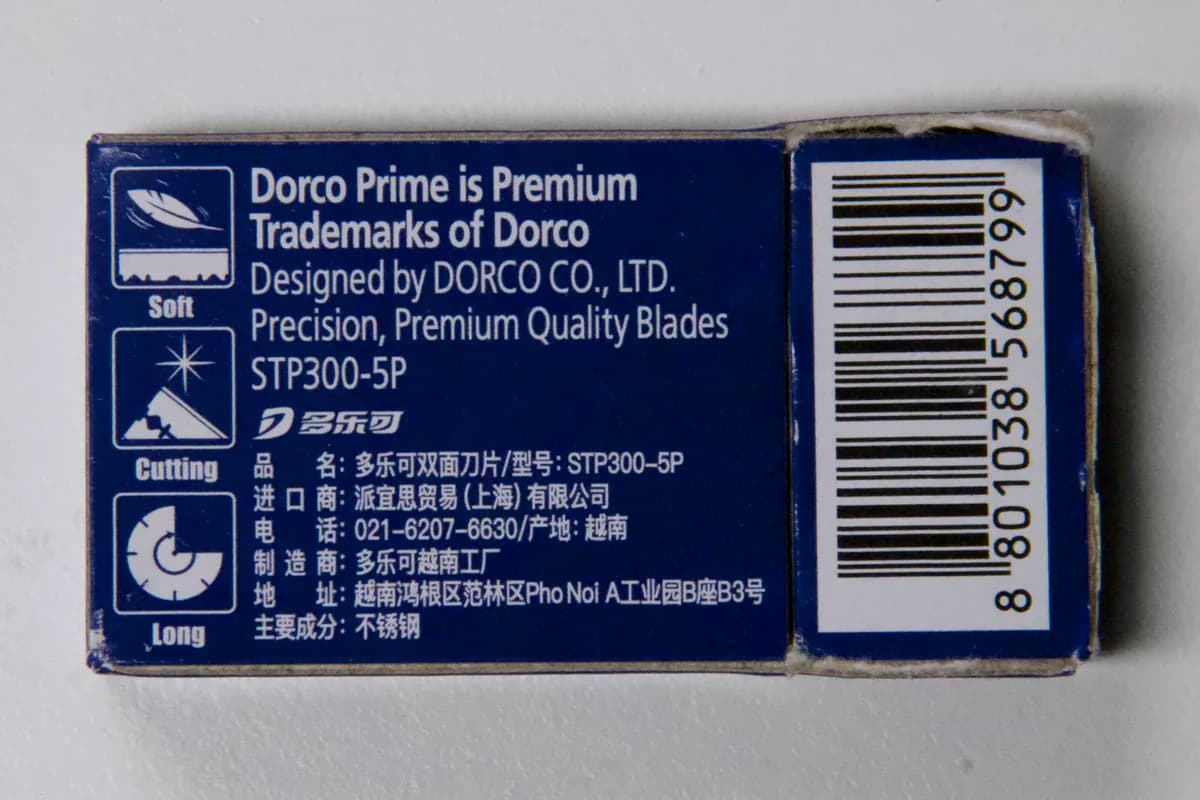
Two things the panel does not settle, and one it does. It lists stainless steel as the composition and names no coating; specialist wet-shaving retailers describe the Prime Platinum edge as platinum plus a PTFE (Teflon) coat, against a platinum coat on the ST-300 Platinum line, so that spec is cited here rather than claimed. Nor does the panel say which Dorco line sits above which. What it does settle is origin: the factory address it prints matches Dorco’s Vietnamese subsidiary, DORCO VINA, at Pho Noi A Industrial Park in Văn Lâm, Hưng Yên. That matters because retail listings for this line split between Vietnam and Korea — one more reason this database locks origin to the pack in hand.
This pack sat in the test queue as South Korean, because Dorco is a Korean company and the barcode on the box (8801038568799) opens with 880, the prefix issued by GS1 Korea. Both facts describe the brand, and GS1 is explicit that a prefix identifies the member organisation that allocated the number: the product “may have been produced anywhere in the world.” The panel on this box says Vietnam, so the database entry says Vietnam. The queue listing and the production-regions tally on the parent pillar were corrected in the same edit.
The test pack was a retail pack purchased for evaluation. ORMIXA has no commercial relationship to Dorco or any blade vendor. None of the above is a quality judgement of the blade; it is identification context for the pairing that follows.
Test Conditions
- Tester: ORMIXA — one skin profile, fixed rubric
- Razor: ORMIXA Vector 316L stainless (0.76 mm gap)
- Pre-shave: no hot towel; no pre-shave oil; face rinsed with tap water ~6 s
- Soap: Proraso Shaving Soap in a Bowl — Sensitive (green tea & oatmeal), bowl-lathered
- Brush: ORMIXA Harbor — 6061 Aluminum Axis, 24 mm Ivory Charcoal synthetic (the 24 mm knot used here has since left the public catalogue; the line now ships at 26 mm)
- Bowl: ORMIXA Titanium Shaving Bowl, Double-Wall Lather Bowl — Silver (lather built in the bowl)
- Pass pattern: WTG → ATG (2-pass; XTG skipped, target SS not BBS)
- Stroke length: short strokes only — long strokes were not attempted in any session
- Post-shave: alum block
- Sessions: 3 shaves, 72h / 72h / 93h apart
- Conditions: 30 °C / 75% humidity (all three sessions)
Lather condition: this series used Proraso Sensitive bowl-lathered — the same condition as the nine other Proraso entries (Treet Platinum, Astra SP, Personna, Iridium Super, Shark Super, Feather, Nacet, Silver Blue and Derby). The Perma-Sharp, Wilkinson Classic and Wilkinson Saloon Pack runs used an ARKO stick applied directly to the face. See Methodology Notes for the confound implications.
Results also apply to the Vector TC4 — same blade gap and head geometry. See the methodology for material-specific perception differences.
Test Period Summary
3 shaves total. Two sessions ran at 72h, the third at 93h. Pass pattern: WTG → ATG (2-pass) each session.
Shave 1 — Fresh
2026-08-18 · 72h growth
- Closeness
- 7/10
- Smoothness
- 9/10
- Irritation
- 9/10
First blade from the pack, individually wrapped inside the wax paper. WTG cut crisply; ATG angle tolerance was wide and the pass finished without fuss. One weeper on the lower lip, produced during WTG. Zero nicks. Alum mild overall with slight tightness at the neck and cheeks. Touch: SS (2-pass, BBS not targeted).
Shave 2 — 72h
2026-08-21 · 72h growth
- Closeness
- 7/10
- Smoothness
- 9/10
- Irritation
- 8/10
Sharpness and angle tolerance held. WTG produced three weepers this session — two on the lower lip, one on the neck — and ATG again produced none. Zero nicks. The 30-minute tightness spread from the face alone to the neck and cheeks, and irritation eased from 9 to 8. Touch: SS.
Shave 3 — 93h
2026-08-25 · 93h growth
- Closeness
- 7/10
- Smoothness
- 9/10
- Irritation
- 8/10
Every axis matched Shave 2. Weepers dropped back to one, on the chin, again during WTG. Zero nicks. The session note recorded that the shave felt slightly less close than the first two, and separately that three uses had not reached this edge’s limit. Alum still mild. Touch: SS.
3-shave scores at a glance
| Shave | Closeness | Smoothness | Irritation | Touch |
|---|---|---|---|---|
| 1 — fresh | 7 | 9 | 9 | SS |
| 2 — 72h | 7 | 9 | 8 | SS |
| 3 — 93h | 7 | 9 | 8 | SS |
Closeness, Smoothness and Irritation shown above; the full rubric also scores Audible feedback (10/10/10) and Lather compatibility (10/10/10). Pairing totals by shave: 45 / 44 / 44; average 44.3/50.
Day-by-Day
Shave 1 (2026-08-18, 72h growth)
First blade from the pack on the Vector 316L. Each blade came individually wrapped inside the wax paper.
WTG cut crisply across the face. ATG followed with wide angle tolerance — the cutting plane held and the pass finished without fuss. One weeper appeared on the lower lip, produced during the WTG pass. Zero nicks.
Alum went on mild, with slight tightness at the neck and cheeks. At 30 minutes the face read lightly tight; at 4 hours, fully relaxed.
Touch: SS. Scores: Closeness 7 / Smoothness 9 / Irritation 9 / Audible 10 / Lather 10.
Shave 2 (2026-08-21, 72h growth)
Second blade from the pack. Sharpness and angle tolerance held: WTG still crisp, ATG still wide in the angle it accepted. Smoothness, audible feedback and lather compatibility all tracked the opening session.
The blood points moved. WTG produced three weepers — two on the lower lip, one on the neck — where Shave 1 had produced one, and ATG again produced none. Zero nicks. On the comfort axis, the 30-minute tightness spread from the face to the neck and cheeks, and irritation eased from 9 to 8.
At 4 hours the skin was fully relaxed.
Touch: SS. Scores: Closeness 7 / Smoothness 9 / Irritation 8 / Audible 10 / Lather 10.
Shave 3 (2026-08-25, 93h growth)
Third and final blade from the tested pack, run on a longer 93-hour growth. Every axis matched Shave 2: closeness 7, smoothness 9, irritation 8, audible feedback and lather compatibility 10. Weepers dropped back to one, on the chin, and again it came on the WTG pass. Zero nicks.
Two session notes are worth recording separately, because they say different things. The first: the shave felt slightly less close than the first two sessions. That is a subjective read which did not move any scored axis, so it is logged as prose rather than folded into the numbers. The second: three uses had not reached this edge’s limit. Touch was still SS at the end, alum stayed inside the mild band, and four of the five axes had never moved. A mild subjective drop in closeness and an edge reaching its endpoint are separate events, and this run only saw the first.
Alum stayed mild with the same neck-and-cheek tightness as Shave 2. At 4 hours the skin was fully relaxed.
Touch: SS. Scores: Closeness 7 / Smoothness 9 / Irritation 8 / Audible 10 / Lather 10.
What Worked in the Pairing
Zero nicks across the whole series
Three sessions, six passes, no punctures. The Vector 316L holds this blade with the cutting plane where the 0.76 mm gap puts it, and across the run that geometry stayed predictable enough that no pass produced a nick. A clean nick column appears on nine of the fourteen pairings in the database, and this is one of them.
Angle tolerance on ATG stayed wide all three sessions
The against-the-grain pass was the comfortable half of every session. The session logs recorded wide angle tolerance each time, and the ATG pass produced no blood points at all across the run — every weeper in the series came from WTG. On a 2-pass routine that is the more demanding pass, so the pairing held where it usually costs the most.
Four of five axes never moved
Smoothness stayed at 9, audible feedback and lather compatibility at 10, and closeness at its protocol-capped 7, through all three uses. The entire series-level change is one point of irritation at Shave 2. That shape — one axis moving once, four flat — is close to the flat curve Feather Hi-Stainless posted, and unlike the progressive give-back of the Perma-Sharp run.
Bowl lather matched cleanly
The bowl-built Proraso Sensitive lather held its slickness through both passes at every session, and lather compatibility scored a flat 10 across the series. Because this is the same lather method on the same Vector 316L used in the other seven Proraso runs on that razor, the comparison against those entries is single-variable on the blade.
Friction Points in the Pairing
Every weeper in the series came on WTG
Five weepers occurred across the three sessions, and every one landed on the opening with-the-grain pass: one on the lower lip at Shave 1, two on the lower lip plus one on the neck at Shave 2, and one on the chin at Shave 3. They cluster along the same lower-lip-to-chin-to-neck line, and every session opened on full-height stubble (72–93 h growth).
The against-the-grain pass produced none, in any of the three sessions. That is the reverse of the Perma-Sharp run, where the one non-technique weeper of the series appeared on ATG at the third use. An edge losing keenness usually shows on the harder pass first, so a WTG-only concentration fits the opening pass itself — hair length, lather and stroke angle over curved contours — better than it fits edge decay. A single 3-shave run cannot separate those causes, so the distribution is recorded as an observation and the explanation stays a hypothesis.
Shave 2 cost a point of comfort
The one scored change of the run landed at Shave 2: irritation from 9 to 8, together with the 30-minute tightness spreading from the face to the neck and cheeks. It arrived in the same session as the weeper spike, and both recovered partially at Shave 3 — weepers back to one, though irritation stayed at 8.
Closeness sat at 7 — set by the 2-pass protocol
Closeness held a flat 7 every session. That is a property of the test design: the conservative 2-pass routine (WTG → ATG, no XTG) targets SS, and BBS was never attempted. Reaching closer would need an added XTG pass outside the protocol.
Long strokes were never tested
All three sessions ran on short strokes. The long-stroke axis, which is where the Perma-Sharp series produced its first directional signal at Shave 3, is simply absent from this dataset. A future run on the same pairing would need to add long strokes to fill that gap.
Difficult Areas (Pairing on this skin profile)
- Jaw / jawline: clean across all 3 shaves — no nicks, no weepers.
- Neck: clean on Shaves 1 and 3. One weeper on WTG at Shave 2. Alum reported slight tightness here every session.
- Upper lip / under nose: clean across all 3 shaves. The lower lip is the recurring site instead — one weeper at Shave 1, two at Shave 2, both on WTG.
- Adam’s apple / under chin: clean on Shaves 1 and 2. One weeper on the chin during WTG at Shave 3.
Pairing Recommendation for Vector 316L Owners
If you already run a Vector 316L, here is how this blade behaves on it. The data supports the pairing under these conditions:
- You want a forgiving ATG pass — angle tolerance stayed wide across all 3 sessions and the against-the-grain pass produced zero blood points.
- You want an edge that holds its behaviour across a pack — four of five axes never moved across three uses, and the total settled at 44 after one point back.
- You bowl-lather a Proraso-type soft soap — lather compatibility held a flat 10 across the series.
Conditions where the data does not support this pairing for you:
- You want a high opening ceiling — this pairing started at 45/50, where the four top entries opened at 47/50.
- You target maximum closeness / BBS — this run produced SS closeness (7) on a conservative 2-pass; reaching closer would need an XTG pass outside the test protocol.
- You shave with long strokes — this series ran short strokes only, so there is no data for you here.
Note: this is pairing data on the Vector 316L specifically. ORMIXA makes no recommendation about Dorco Prime Platinum blades in isolation, or on razors outside this database. Other Vector pairings and future ORMIXA × Dorco Prime Platinum series may differ.
Video Evidence
Three sessions, raw footage, no edits:
- Shave 1 of 3: youtu.be/_fIQZIbLLf4
- Shave 2 of 3: youtu.be/JUgHmcfuC94
- Shave 3 of 3: youtu.be/hUlmmfqbGhQ
Cross-Pairing Reference
Where this pairing sits against the other Vector × DE-blade pairings tested so far (5-metric average out of 50):
| Pairing | Avg / 50 | Trend | Best window |
|---|---|---|---|
| Vector TC4 × Treet Platinum | 47.0 | flat on all five axes | Shaves 1–3 |
| Vector 316L × Astra SP (green) | 46.0 | flat, no decay | Shaves 1–3 |
| Vector 316L × Personna Stainless | 46.0 | stable, mild S3 efficiency signal | Shaves 1–3 |
| Vector 316L × Gillette Perma-Sharp | 46.0 | flat with mild S3 long-stroke signal | Shaves 1–3 |
| Vector 316L × Iridium Super | 45.7 | two flat sessions, one point back at S3 | Shaves 1–2 |
| Vector TC4 × Shark Super | 45.7 | two flat sessions, one point back at S3 | Shaves 1–3 |
| Vector 316L × Dorco Prime | 44.3 | one point back at S2, then flat | Shaves 1–3 |
| Vector 316L × Feather Hi-Stainless | 44.0 | flat on all five axes | Shaves 1–3 |
| Vector 316L × Gillette Nacet | 42.7 | clean, mild S3 dip | Shaves 1–2 |
| Vector 316L × Gillette Silver Blue | 42.7 | 2-shave golden window | Shaves 1–2 |
| Vector 316L × Derby Extra | 42.0 | shallow uniform decline, stays in band | Shaves 1–2 |
| Vector TC4 × Voskhod Teflon | 40.0 | S2 dip, partial recovery | Shave 1 |
| Vector 316L × Wilkinson Classic | 35.7 | monotonic decline | Shaves 1–2 |
| Vector 316L × Wilkinson (India) | 35.3 | monotonic decline | Shaves 1–2 |
The cleanest comparisons in the table are the seven runs that used the same Proraso Sensitive bowl lather on the same Vector 316L with the same 2-pass protocol: Astra SP (46.0), Personna (46.0), Iridium Super (45.7), Feather (44.0), Nacet (42.7), Silver Blue (42.7) and Derby (42.0). Blade is the only variable that changed. Placed among them, this pairing’s 44.3 comes fourth — 1.7 below the two leaders, 1.4 below Iridium Super, and 0.3 above Feather, which is one point in one session (Shave 1: 45 against Feather’s 44) and the smallest step this rubric can express.
Against Perma-Sharp (46.0), Wilkinson Classic (35.7) and Wilkinson Saloon Pack (35.3), blade and lather both changed: those runs used a Turkish ARKO stick face-lathered. The flat 10 on the lather axis here says this pairing works with a bowl-built Proraso lather; it says nothing about how this blade would score under theirs. The 1.7 to Perma-Sharp and the roughly nine points to both Wilkinson pairings each carry that second variable.
→ Full Vector Blade Compatibility Database
Methodology Notes
Transparency about the boundaries of this 3-shave run:
- Lather confound: this series used Proraso Sensitive built in the bowl, matching the nine other Proraso entries. Against the Perma-Sharp and both Wilkinson runs, which applied an ARKO stick directly to the face, blade and lather both changed, so any numeric difference carries both variables and should not be attributed to the blade alone.
- Single-razor data: this pairing ran only on the Vector 316L, so blade-vs-razor causation is not isolated. A comparison body (e.g. the Vector TC4 running the same blade) would be needed to separate razor contribution from blade contribution.
- Long strokes untested: all three sessions ran short strokes only. The long-stroke axis is absent from this dataset, and the absence of a long-stroke signal here carries no information — it was never probed.
- Three uses did not reach the edge’s limit: testing stopped at three uses with the third still at SS, alum in the mild band, and four axes flat. A three-use window is the only claimable range; nothing about maximum blade life is claimable, which would also fall outside ORMIXA editorial scope.
- No technique split on the blood points: unlike the Perma-Sharp run, no weeper in this series was flagged in-session as an accidental movement. All five are therefore counted as pairing signal. That is the conservative treatment, and it may over-count: the WTG-only concentration is equally consistent with lather and stroke discipline on the opening pass.
- Closeness is protocol-capped: the conservative 2-pass (no XTG) targets SS. A 3-pass run with XTG would be needed to probe DFS/BBS on this pairing. The Shave 3 note that the shave felt slightly less close is recorded as a subjective read and did not move the scored axis.
- Third interval was longer: Shave 3 ran at 93 hours of growth against 72 for the first two. Longer growth is a mildly harder test, which sits alongside the fact that the third session matched the second on every axis.
Pairing Verdict
After 3 shaves of the Vector 316L × Dorco Prime Platinum pairing: 44.3/50 — a stable, forgiving pairing with a clean nick column, whose only scored give-back is one point of comfort at the second use.
The shape of the series is a modest opening followed by a flat line: 45, then 44, then 44, with four of five axes untouched from first shave to last. Angle tolerance on ATG was the constant, and the against-the-grain pass produced no blood points at all across three sessions.
The friction is concentrated in one place: every weeper in the run came on WTG, along the lower-lip-to-chin-to-neck line, peaking at three in Shave 2 and dropping back to one in Shave 3. That distribution points away from edge decay and toward the opening pass’s lather and stroke discipline, and this run cannot separate those two.
44.3 places the pairing seventh in the database. Under matched Proraso bowl-lather conditions on the Vector 316L it sat below Astra SP, Personna and Iridium Super, and above the other four Proraso rows, the 0.3 over Feather amounting to one point in one session. Against the ARKO face-lathered rows — Perma-Sharp and both Wilkinsons — the comparison carries a lather variable on top of the blade.
Vector TC4 owners: this pairing data transfers 1:1 to your razor. The cutting geometry is identical — only the in-hand feel differs.
Sources
- GS1 — Does the GS1 prefix show the country of origin? (a prefix identifies the allocating member organisation; the product “may have been produced anywhere in the world”)
- Maggard Razors — Dorco range (parallel DE lines: Prime Platinum, ST-300 Platinum, ST-301, Titan)
- Maggard Razors — Dorco Prime Platinum listing (platinum plus PTFE coating spec; states the line is made in Vietnam)
- American Academy of Dermatology — How to shave (shaving with the grain & lather to reduce irritation)
- Cleveland Clinic — Razor Burn (friction, dull blade & against-the-grain as irritation causes)
- AZoM — Grade 316/316L Stainless Steel (low-carbon grade & molybdenum corrosion resistance)
- ORMIXA blade-test shave logs — one skin profile, fixed rubric; method in the blade compatibility test methodology
Disclosure
Internal lab pairing test. Not sponsored. ORMIXA does not receive commercial consideration from Dorco or any DE blade vendor for pairing data or scoring.
ORMIXA products are sold by ECE Innovate Homes LLC and manufactured by Guangzhou Yanyang Technology Co., Ltd. under trademark license.
ORMIXA does not sell razor blades. This was a retail pack purchased for evaluation. Dorco has no commercial relationship to ORMIXA, ECE Innovate Homes LLC, or Guangzhou Yanyang Technology.
If you think manufacturer-conducted testing biases the methodology, fair concern. Video evidence is linked above for every session, the pairing rubric was published before testing started, and the database includes Vector pairings with blades whose makers are direct competitors. Send your own pairing data — we’ll compare.
Related
- ← Back to the full Vector Blade Compatibility Database
- Same razor, different lather — Vector 316L × Gillette Perma-Sharp →
- Same lather, closest comparison — Vector 316L × Feather Hi-Stainless →
- The razor used in this test — Vector 316L →
- The brush used in this test — Harbor →
- The bowl used in this test — Titanium Double-Wall →
Frequently asked questions
- Does the Vector 316L pair well with Dorco Prime Platinum blades?
- In a 3-shave test the pairing scored 44.3/50 (45 / 44 / 44), seventh in the database. Four of the five rubric axes never moved across three uses; the only scored change was irritation easing from 9 to 8 at Shave 2. The run produced zero nicks, and all 5 weepers came on with-the-grain passes. Touch held SS throughout and alum stayed mild. This is pairing data, not a rating of the blade in isolation.
- Where are Dorco Prime Platinum blades made?
- The pack tested here was made in Vietnam. Its reverse panel states production in Vietnam and names Dorco’s Vietnam factory at Pho Noi A Industrial Park, Hưng Yên, with model STP300-5P. The 880 barcode prefix identifies GS1 Korea as the organisation that allocated the number — per GS1, a prefix does not indicate where a product was manufactured. Other Dorco packs may be produced elsewhere; this entry describes the pack ORMIXA tested.
- Is Dorco Prime Platinum the same as the Dorco ST-300 blade?
- No — they are separate Dorco double-edge lines. The pack ORMIXA tested is Prime Platinum, model STP300-5P, made in Vietnam. Specialist wet-shaving retailers describe the Prime edge as platinum plus a PTFE (Teflon) coat and the ST-300 Platinum line as platinum-coated; the pack panel itself lists stainless steel and names no coating, so ORMIXA cites that spec rather than claiming it. Only the Prime Platinum pack was tested here, so this dataset says nothing about how ST-300 behaves on the Vector 316L.
- How many shaves does Dorco Prime Platinum last in this pairing?
- On the Vector 316L the data covers a 3-shave window. All three sessions held SS touch and alum in the mild band, and the third matched the second on every scored axis. The in-session note recorded that three uses had not reached the edge limit. A 3-shave window is the claimable range; blade-life count is outside what this data can answer.
- Why did every blood point happen on the with-the-grain pass?
- All 5 weepers in this run were produced during the opening with-the-grain passes, on the lower lip, chin and neck; the against-the-grain pass produced none across three sessions. The opening pass runs on full-height stubble (72–93 h growth) over curved contours, so hair length, lather and stroke angle are the likeliest contributors, and an edge losing keenness would normally show on the harder pass first. A single 3-shave run cannot isolate the cause, so ORMIXA records the distribution as an observation and keeps the explanation labelled as a hypothesis.
- How does Dorco Prime Platinum compare to Gillette Perma-Sharp on the Vector 316L?
- Both runs used the same Vector 316L and the same 2-pass protocol, but not the same lather: Perma-Sharp ran on an ARKO stick applied to the face, this pairing on a bowl-built Proraso Sensitive lather. Perma-Sharp averaged 46.0/50 with a higher opening (47) and a point given back each session; this pairing averaged 44.3/50 with a lower opening (45), a flatter curve and zero nicks. Blade and lather both changed, so the 1.7 between them carries two variables. The clean single-variable comparisons for this pairing are the seven Proraso-lathered entries on the Vector 316L, and Feather Hi-Stainless at 44.0 is the closest of them.
- Is ORMIXA recommending Dorco Prime Platinum blades?
- No. ORMIXA does not sell razor blades and makes no recommendation about Dorco Prime Platinum blades in isolation or on razors outside this database. This article documents how one third-party blade performed when paired with the Vector 316L — pairing data only, per ORMIXA editorial scope.