

Vector 316L × Feather Hi-Stainless pairing data — three shaves on one physical razor and one blade. The pairing scored 44.0/50 (44 / 44 / 44), the first flat curve in this database: every one of the five axes read the same in all three sessions. The quantity that moved was blood points — ten weepers across the run, nine of them during the with-the-grain pass, all on the chin, lip and neck curves.
Vector 316L × Feather Hi-Stainless (TL;DR)
Three uses posted an identical 44/50 for an average of 44.0/50. Smoothness held at 9, audible feedback at 10 and lather compatibility at 10 throughout, with zero nicks and no drag in any session. What stayed constant alongside those scores is the more useful signal: ten weepers, nine of them produced going with the grain, concentrated on three curved regions. A flat score curve plus persistent blood points points at entry-angle control rather than edge condition — this pairing rewards settled technique and gives back little room for a bad approach angle. Closeness is recorded at 7 because the routine was WTG → ATG with no XTG, explicitly targeting SS rather than BBS. The result describes the pairing on the Vector 316L; it is not a standalone blade assessment or a measured blade-life claim.
Conducted by one ORMIXA tester (one skin profile) using the same razor, soap, brush and pass pattern across the series. Session data follows the published compatibility-test rubric.
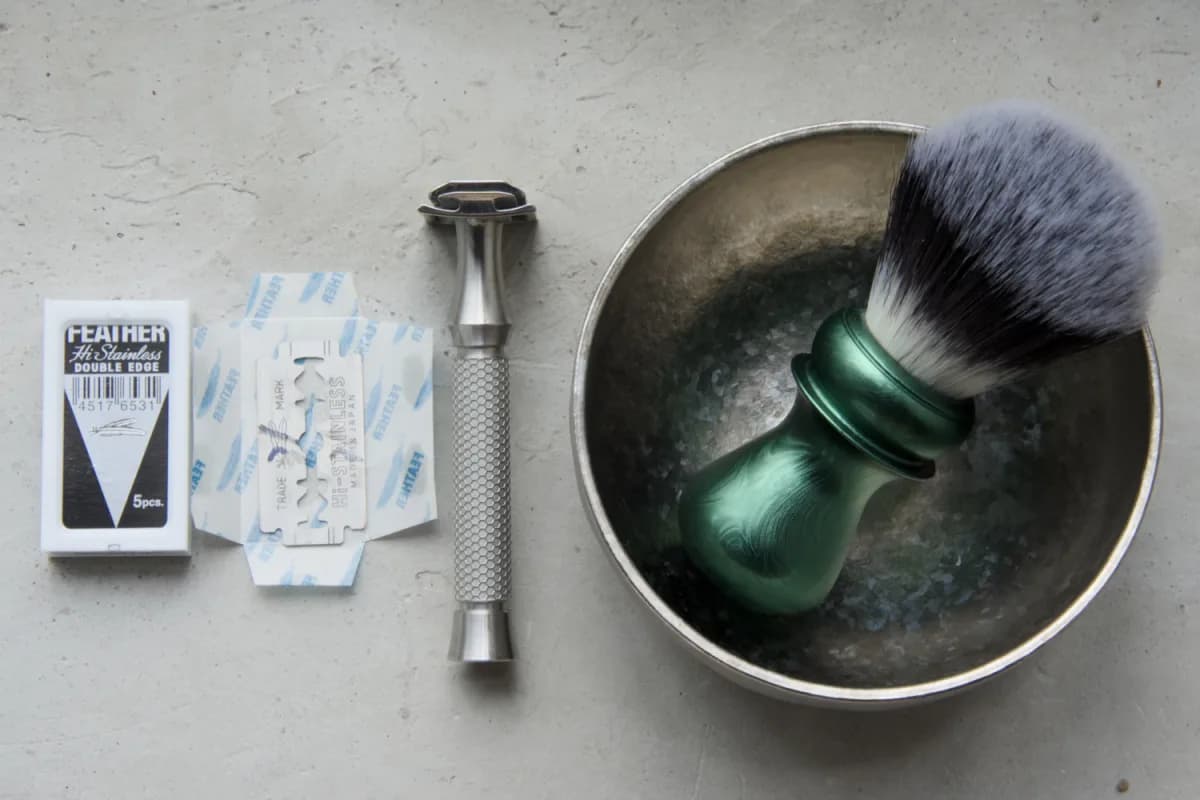
The test question is narrow: how does the photographed Feather blade behave when mounted in the 0.76 mm-gap Vector 316L and used with one fixed two-pass routine? Across the recorded window the pairing held every score it opened with, while the cost of that consistency showed up as blood points on curved regions. This entry joins the Vector Blade Compatibility Database.
Blade Identification: What the Pack Actually Shows
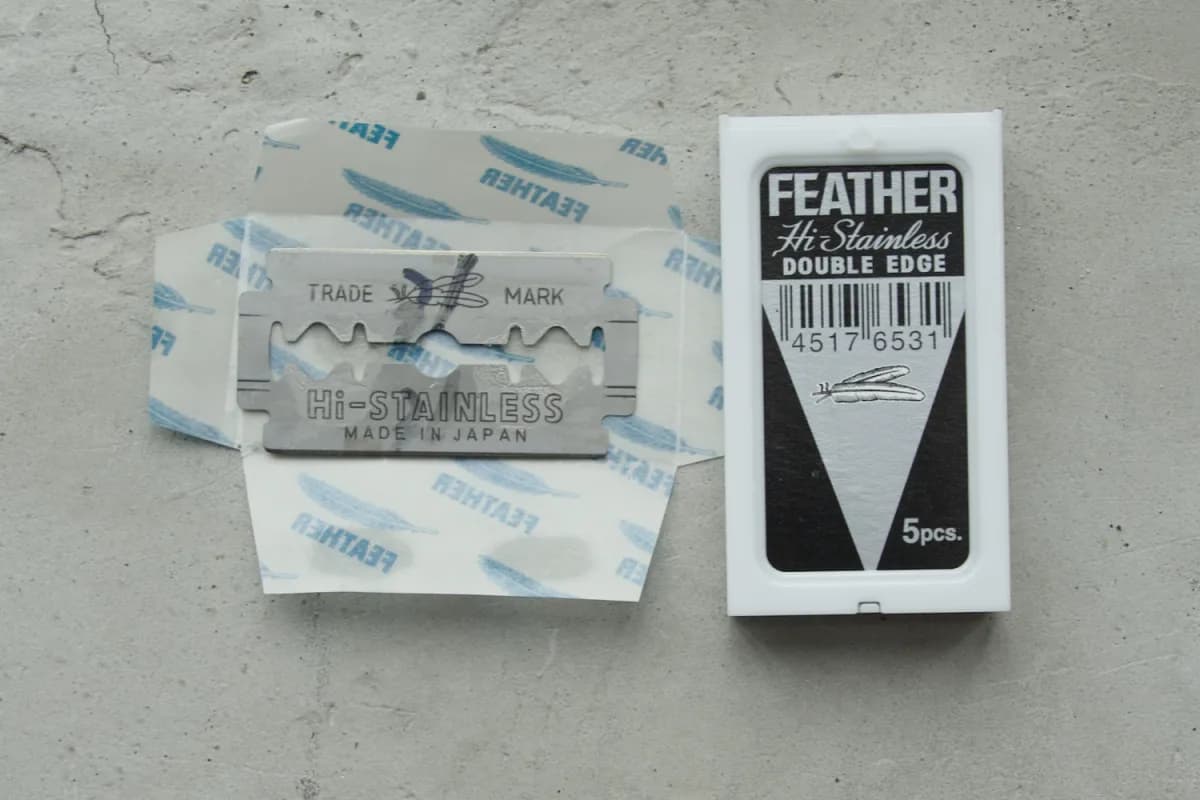
Everything in this section comes off the two photographs and nothing else. The white plastic case carries a black-and-white label reading FEATHER, the product line Hi-Stainless, the words DOUBLE EDGE, barcode 4517 6531 and a count of 5pcs. The loose blade is stamped TRADE MARK, Hi-STAINLESS and MADE IN JAPAN.
One boundary matters here. The origin string is a stamp on the blade itself; no box back or side panel was photographed, so this article credits the origin to the blade and says nothing about where the packaging was printed or filled. The supplied faces also identify no manufacturer, distributor or brand owner, so none is assigned.
The label carries no “Platinum” marking, which separates this pack from the Platinum-labelled variant of the same product line. That distinction is drawn from the printed label alone.
Test Conditions
- Tester: ORMIXA — one skin profile, fixed rubric
- Razor: ORMIXA Vector 316L stainless, 0.76 mm gap
- Bowl: ORMIXA Titanium Shaving Bowl, Double-Wall Lather Bowl — Silver
- Soap: Proraso Shaving Soap in a Bowl — Sensitive (green tea & oatmeal), bowl-lathered
- Brush: ORMIXA 6061 Aluminum Line handle, 24 mm Black & White synthetic (the 24 mm knot used here has since left the public catalogue; the line now ships at 26 mm)
- Preparation: no hot-water face wash; no pre-shave oil; brush soaked in tap water for about 1 minute
- Pass pattern: WTG → ATG; XTG skipped; target SS, not BBS
- Post-shave: alum block, followed at 30 minutes and 4 hours
- Intervals: 118h recorded baseline, then 72h and 74h
- Room conditions: 28 °C / 85% RH in all three sessions
Test Period Summary
Three uses of the same blade were logged from 21–27 July 2026. Each session used the same WTG → ATG pattern and deliberately skipped XTG, so the run measures a stable SS-target routine. A BBS attempt and a maximum-lifespan test sit outside this record.
Shave 1 — Fresh
2026-07-21 · 118h recorded growth
- Closeness
- 7/10
- Smoothness
- 9/10
- Irritation
- 8/10
The fresh edge read as very sharp from the first stroke. WTG cut decisively with no drag, and after ATG stubble was almost impossible to detect by touch. Five weepers appeared on the chin (four during WTG, one during ATG). Zero nicks. Alum stung at the lip and chin, mild elsewhere. Touch: SS (2-pass, BBS not targeted).
Shave 2 — 72h
2026-07-24 · 72h growth
- Closeness
- 7/10
- Smoothness
- 9/10
- Irritation
- 8/10
All five axes repeated the opening session exactly. WTG stayed crisp and ATG again left almost nothing to find. Weepers dropped to two, both during WTG (chin and corner of the mouth). Zero nicks. Alum stung at the lip, chin and now the neck. Touch: SS.
Shave 3 — 74h
2026-07-27 · 74h growth
- Closeness
- 7/10
- Smoothness
- 9/10
- Irritation
- 8/10
The third use held every score from the first two, with no drag and no change in audible feedback. Three weepers, all during WTG: two on the lower lip and the first one on the neck. Zero nicks. Alum stung at the same three regions. Touch: SS.
Five-Axis Scores
| Shave | Closeness | Smoothness | Irritation | Audible | Lather | Total |
|---|---|---|---|---|---|---|
| 1 — fresh | 7 | 9 | 8 | 10 | 10 | 44 |
| 2 — 72h | 7 | 9 | 8 | 10 | 10 | 44 |
| 3 — 74h | 7 | 9 | 8 | 10 | 10 | 44 |
Average: 44.0/50. Touch was SS in all three sessions. Closeness is normalized to 7 so the numeric score agrees with the SS touch result and the no-XTG, non-BBS protocol; the correction is logged in the source record and score lock. The other four axes keep the values recorded at the time of each shave.
Where the Blood Points Landed
With the score axes flat, the weeper log carries the whole session-to-session story:
| Shave | Chin | Lip / mouth corner | Neck | Pass | Total |
|---|---|---|---|---|---|
| 1 — fresh | 5 | 0 | 0 | WTG 4 + ATG 1 | 5 |
| 2 — 72h | 1 | 1 | 0 | WTG 2 | 2 |
| 3 — 74h | 0 | 2 | 1 | WTG 3 | 3 |
Ten weepers, zero nicks. Nine of the ten were produced with the grain. The count fell from five to two and then rose to three, following the region worked and the approach taken. Alum feedback widened in the same period: two stinging regions in Shave 1, three from Shave 2 onward once the neck joined the list.
Day-by-Day
Shave 1 (2026-07-21, 118h recorded growth)
The fresh blade read as very sharp on contact. WTG cut decisively from the opening stroke with no pulling anywhere on the face. XTG was skipped because BBS was not the target; after ATG, stubble was almost impossible to find by touch.
The chin produced five weepers — four during WTG and one more during ATG. No difficult-area events were logged at the jawline, neck, upper lip or Adam’s apple, meaning no region needed repeat strokes or resisted the pass. Zero nicks. Alum stung at the lip and chin and stayed mild across the rest of the face. Skin felt fresh at 30 minutes and fully relaxed at 4 hours.
Touch: SS. Scores: Closeness 7 / Smoothness 9 / Irritation 8 / Audible 10 / Lather 10.
Shave 2 (2026-07-24, 72h growth)
The second use repeated the first session on every axis. Sharpness was unchanged, WTG stayed crisp and ATG again left almost nothing to detect.
Weepers dropped to two, both produced with the grain: one on the chin and one at the corner of the mouth. Zero nicks again. The alum reading moved the other way — lip, chin and now the neck registered stinging, with the rest of the face mild. The jaw, neck, upper lip and Adam’s apple logged no pass-level difficulty. Skin was fresh at 30 minutes and fully relaxed at 4 hours, with no burn, rash or tightness.
Touch: SS. Scores: Closeness 7 / Smoothness 9 / Irritation 8 / Audible 10 / Lather 10.
Shave 3 (2026-07-27, 74h growth)
On the third use the edge still completed both passes without drag, and audible feedback stayed at the level recorded in the first two sessions. Every score matched Shaves 1 and 2 exactly.
Three weepers appeared, all with the grain: two on the lower lip and the run’s first on the neck. Zero nicks. Alum stung at the same three regions as Shave 2. The 30-minute and 4-hour follow-ups remained fresh and fully relaxed. The contemporaneous session note states that three uses fell well short of what this pairing could still do, and the test stopped before finding that point.
Touch: SS. Scores: Closeness 7 / Smoothness 9 / Irritation 8 / Audible 10 / Lather 10.
What Worked in the Pairing
Three uses with a completely flat score curve
Every one of the five axes returned the same value in all three sessions. Of the fifteen pairings currently in the database, two have no point of movement across three sessions (Treet Platinum and Feather), and this run was the first of them. Sharpness, cutting smoothness, audible feedback and lather behaviour were as available on the third use as on the first.
Nothing was ever pulled or dragged
The WTG notes are identical across the three sessions: decisive cutting, no pulling, no need to work around a deteriorating edge. Combined with the flat audible-feedback score, the run offers no evidence of edge decay inside a three-use window.
The lather match was stable
Bowl-lathered Proraso Sensitive scored 10 for compatibility in all three sessions. With the soap, brush and bowl held constant and lather behaviour unchanged, no lather-axis variable competes with entry angle as the explanation for the weepers.
Friction Points in the Pairing
Ten weepers, nine of them with the grain
The with-the-grain pass is the conservative direction — it is where the AAD advises shaving to reduce irritation, and where the other pairings in this database produce their fewest blood points. Here it produced nine of ten. Every one landed on the chin, the lip or the neck: three regions where the skin curves sharply and the razor’s approach angle changes fastest.
The pairing gives back little room on entry angle
Two facts sit side by side in this record: the edge never dulled across three uses, and blood points appeared in every single session. With edge condition holding constant, the variable that remains is the point of contact — how the razor meets skin that curves. The practical reading for someone running this pairing is that the chin, lip and neck need a deliberate, flat approach and light pressure; the AAD’s general instruction to shave lightly applies with less margin here than it does on the milder pairings in the database.
A settled two-pass routine is what this dataset documents. A shaver still calibrating pressure and angle would be reading their own technique curve on top of the pairing data, which this run cannot separate.
The protocol does not answer a BBS question
All three sessions intentionally skipped XTG and logged SS touch. A BBS-target routine would add a pass and change exposure, pressure and irritation risk, so maximum closeness cannot be inferred from this dataset.
Three uses is short of a lifespan reading
The AAD suggests changing a blade after five to seven shaves as a general irritation-management practice. This run stopped at three with every axis still flat, which places the observed window entirely inside the pairing’s usable range and leaves the endpoint unmeasured.
Difficult Areas
- Jaw / jawline: no pass-level difficulty logged in any session; no weepers recorded here.
- Neck: no pass-level difficulty logged; one weeper during WTG in Shave 3, and stinging alum feedback from Shave 2 onward.
- Upper lip / under the nose: no pass-level difficulty logged; the mouth corner and lower lip account for three weepers across Shaves 2–3, and the lip registered alum stinging in all three sessions.
- Adam’s apple / under the chin: no pass-level difficulty logged; the chin itself produced six weepers, five of them in Shave 1.
The source record marks all four regions as free of difficulty, which here means no region resisted the pass or needed repeat strokes. Blood points are logged separately because they came from the approach angle on curved skin, and the two readings describe different things.
Pairing Recommendation for Vector 316L Owners
Under the logged conditions, the Vector 316L × Feather Hi-Stainless pairing suits a Vector owner whose two-pass routine is already settled and whose pressure control is consistent on curved regions. It returns a three-use window in which no axis moved, with an unchanged cutting feel from the first shave to the third.
The trade is legible in the same record: ten weepers over three sessions, concentrated on the chin, lip and neck, and alum stinging that widened from two regions to three. A Vector owner who is still calibrating entry angle will find the milder pairings in this database more forgiving of an imperfect approach.
The data does not establish how this blade behaves in a different razor, during a three-pass BBS routine or beyond Shave 3. It also does not isolate whether the weepers belong to the edge, to the 0.76 mm head geometry or to the angle control used across these three sessions. Each of those needs a run of its own to answer.
Video Evidence
Three unedited session records:
- Shave 1 of 3: youtu.be/Jr9U-GiVMt4
- Shave 2 of 3: youtu.be/iRjGmaAr1ok
- Shave 3 of 3: youtu.be/KEGfAt0QRgA
Cross-Pairing Reference
Current Vector × DE-blade pairing scores, averaged across the same five axes:
| Pairing | Avg / 50 | Trend | Best window |
|---|---|---|---|
| Vector TC4 × Treet Platinum | 47.0 | flat on all five axes | Shaves 1–3 |
| Vector TC4 × Super Treet Platinum | 46.7 | two flat sessions, one point back at S3 | Shaves 1–3 |
| Vector 316L × Astra SP (green) | 46.0 | flat, no decay | Shaves 1–3 |
| Vector 316L × Personna Stainless | 46.0 | stable, mild S3 efficiency signal | Shaves 1–3 |
| Vector 316L × Gillette Perma-Sharp | 46.0 | flat with mild S3 long-stroke signal | Shaves 1–3 |
| Vector 316L × Iridium Super | 45.7 | two flat sessions, one point back at S3 | Shaves 1–2 |
| Vector TC4 × Shark Super | 45.7 | two flat sessions, one point back at S3 | Shaves 1–3 |
| Vector 316L × Dorco Prime | 44.3 | one point back at S2, then flat | Shaves 1–3 |
| Vector 316L × Feather Hi-Stainless | 44.0 | flat on all five axes | Shaves 1–3 |
| Vector 316L × Gillette Nacet | 42.7 | clean, mild S3 dip | Shaves 1–2 |
| Vector 316L × Gillette Silver Blue | 42.7 | 2-shave golden window | Shaves 1–2 |
| Vector 316L × Derby Extra | 42.0 | shallow uniform decline, stays in band | Shaves 1–2 |
| Vector TC4 × Voskhod Teflon | 40.0 | S2 dip, partial recovery | Shave 1 |
| Vector 316L × Wilkinson Classic | 35.7 | monotonic decline | Shaves 1–2 |
| Vector 316L × Wilkinson (India) | 35.3 | monotonic decline | Shaves 1–2 |
The two 46.0 entries under the same lather on the same Vector 316L — Astra Superior Platinum and Personna Stainless Steel — sit two points above this row on smoothness and irritation, and both shed a point by their third shave. This pairing trades those two points for a curve that never moves and for the shortest blood-point-free record in the database at zero nicks. Each of those articles carries its own conditions and should be read in place.
Not every row shares this run’s razor and lather: the TC4 rows change the razor and the ARKO rows change the lather, and session variables including brush setup and growth interval differ across all of them. The table is a pairing reference rather than a controlled ranking of loose blades.
→ Full Vector Blade Compatibility Database
Methodology Notes
- Attribution C — inside the pairing window, endpoint unmeasured: all five axes read identically across three uses, WTG never dragged and audible feedback held at 10. The only quantity that moved was the weeper count, and it moved 5 → 2 → 3 rather than in one direction, tracking pass and facial region instead of use number. A single-razor, three-use run cannot isolate edge behaviour from head geometry or from the angle control used across these sessions.
- Closeness normalization: the submitted notes paired closeness scores of 10 / 10 / 10 with SS touch, no XTG and an explicit non-BBS target. Under the published anchor, SS corresponds to 6–7; closeness is locked at 7 / 7 / 7 so the numeric and tactile records agree. All other submitted axis scores are preserved.
- Why the flat curve was not adjusted: the four remaining axes were reviewed one at a time against the raw log before publication. Smoothness, audible feedback and lather carried identical descriptions in all three sessions, and the two irritation inputs moved against each other — weepers fell while the stinging region count rose. The curve is recorded flat because the source record supports nothing else. The session note about the pairing demanding care is written into the prose above, where a technique judgement belongs, and is kept out of the score axes.
- Timeline: no date correction was needed. The 118-hour opening interval runs from the final shave of the previous series, and the 72-hour and 74-hour intervals match the logged timestamps exactly.
- Identification boundary: “MADE IN JAPAN” is a stamp on the blade, not a statement on the packaging, and no box origin panel was photographed. No factory, corporate owner or coating construction is inferred from any mark.
- No lifespan endpoint: three shaves were completed and the third was indistinguishable from the first on every axis. That supports a three-use window with room left over, and it does not support a claim about maximum blade life.
Pairing Verdict
After three shaves, the Vector 316L × Feather Hi-Stainless pairing closes at 44.0/50 — a three-use window in which no axis moved, paid for with the narrowest entry-angle margin.
The strongest evidence is the repetition: three sessions, one score, no drag, zero nicks, unchanged lather behaviour. Set against it are ten weepers on curved regions and an alum response that widened from two regions to three. Both readings come from the same three sessions, and an honest conclusion carries both of them. Three uses is where the record ends, and the claim ends there too.
Sources
- American Academy of Dermatology — How to shave (shave with the grain; shave lightly to prevent nicks; change blades after 5–7 shaves)
- Cleveland Clinic — Razor Burn
- ORMIXA session logs and locked score record; scoring method in the Vector Blade Compatibility methodology
Disclosure
Internal pairing test. Not sponsored. ORMIXA has no commercial relationship with Feather or the blade vendor and does not sell this blade. The photographed pack is documented only from the supplied evidence; acquisition channel, manufacturer and corporate brand owner are not established by the available material.
ORMIXA products are sold by ECE Innovate Homes LLC and manufactured by Guangzhou Yanyang Technology Co., Ltd. under trademark license.
Manufacturer-conducted testing has an inherent perspective. To keep the evidence inspectable, every session video is linked, corrections are logged in the normalized source file, and the same five-axis rubric is used across the database.
Related
- ← Full Vector Blade Compatibility Database
- The database’s highest average (47.0) — Vector TC4 × Treet Platinum Super Stainless →
- The razor used in this test — Vector 316L →
- The brush used in this test — Harbor →
- The bowl used in this test — Titanium Double-Wall →
Frequently asked questions
- Does Feather Hi-Stainless pair well with the Vector 316L?
- In this 3-shave test the pairing scored 44 / 44 / 44 for a 44.0/50 average — the first flat curve in the database. Smoothness held at 9 and audible feedback at 10 throughout, with zero nicks and no drag. The cost was ten weepers on the chin, lip and neck, nine of them going with the grain. This is pairing data, not a rating of the blade in isolation.
- Why did all three shaves score exactly the same?
- Each axis was reviewed against the raw session log before publication. Smoothness, audible feedback and lather compatibility carried identical descriptions across the three sessions, and the two irritation inputs moved in opposite directions — the weeper count fell from five to two while the number of alum-stinging regions rose from two to three. The record supports a flat curve, so the flat curve is what is published.
- How many shaves did the Feather blade last in this test?
- The same blade completed all three logged shaves with no measurable change. Shave 3 matched Shave 1 on every axis, and the session note recorded that three uses fell well short of the pairing’s limit. Testing stopped there, so the record supports a three-use window and does not establish maximum blade life.
- Why is closeness scored 7 when the shave felt very close?
- The routine used WTG and ATG only, skipped XTG and explicitly targeted SS rather than BBS. The published anchor places SS at 6-7, so closeness was normalized to 7 in all three sessions to keep the numeric score consistent with the tactile result. The raw correction is preserved in the source record.
- Where was this Feather Hi-Stainless blade made?
- The blade itself is stamped “MADE IN JAPAN” alongside “Hi-STAINLESS” and “TRADE MARK”. That origin string sits on the blade rather than on a box panel, and no box back or side was photographed. The available material identifies no manufacturer, distributor or corporate brand owner, so none is inferred.
- Does this pairing need experience to run?
- The record shows blood points in every session, nine of ten produced with the grain and all of them on the chin, lip or neck curves, while the edge itself never dulled. That combination points at entry angle rather than blade condition, so a Vector owner with a settled two-pass routine has an easier time reproducing this data than one still calibrating pressure and angle. That is a statement about this pairing under these conditions, not a general recommendation.