

Vector 316L × Personna Stainless Steel pairing data — three shaves on one physical razor and one blade. The pairing averaged 46.0/50 (47 / 46 / 45), with zero nicks, zero weepers and no drag in any session. A small third-use efficiency signal appeared; the observed window ended before any comfort or usability limit.
Vector 316L × Personna Stainless Steel (TL;DR)
This pairing posted 47 / 46 / 45 across three uses, averaging 46.0/50. Smoothness and lather compatibility stayed at 10 throughout. Shave 3 left detectable stubble after ATG and audible feedback eased from 10 to 9, but there was still no drag, nick, weeper or harsh alum response. Closeness is recorded at 7 because the routine was WTG → ATG with no XTG, explicitly targeting SS rather than BBS. The result describes the pairing on the Vector 316L; it is not a standalone blade assessment or a measured blade-life claim.
Conducted by one ORMIXA tester (one skin profile) using the same razor, soap, brush and pass pattern across the series. Session data follows the published compatibility-test rubric.
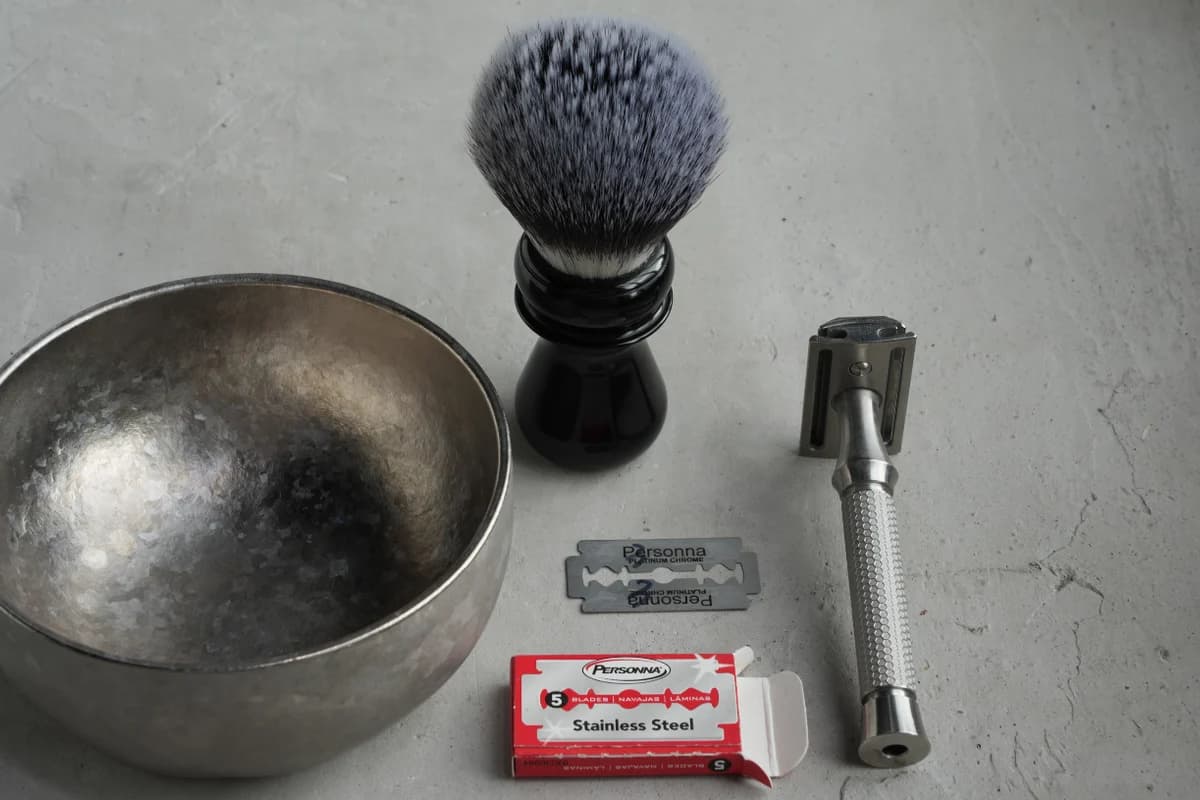
The test question is narrow: how does the photographed Personna blade behave when mounted in the 0.76 mm-gap Vector 316L and used with one fixed two-pass routine? Across the recorded window, the pairing kept its cutting smoothness and comfort while showing only a modest third-use change in efficiency. This entry joins the Vector Blade Compatibility Database.
Blade Identification: What the Pack Actually Shows
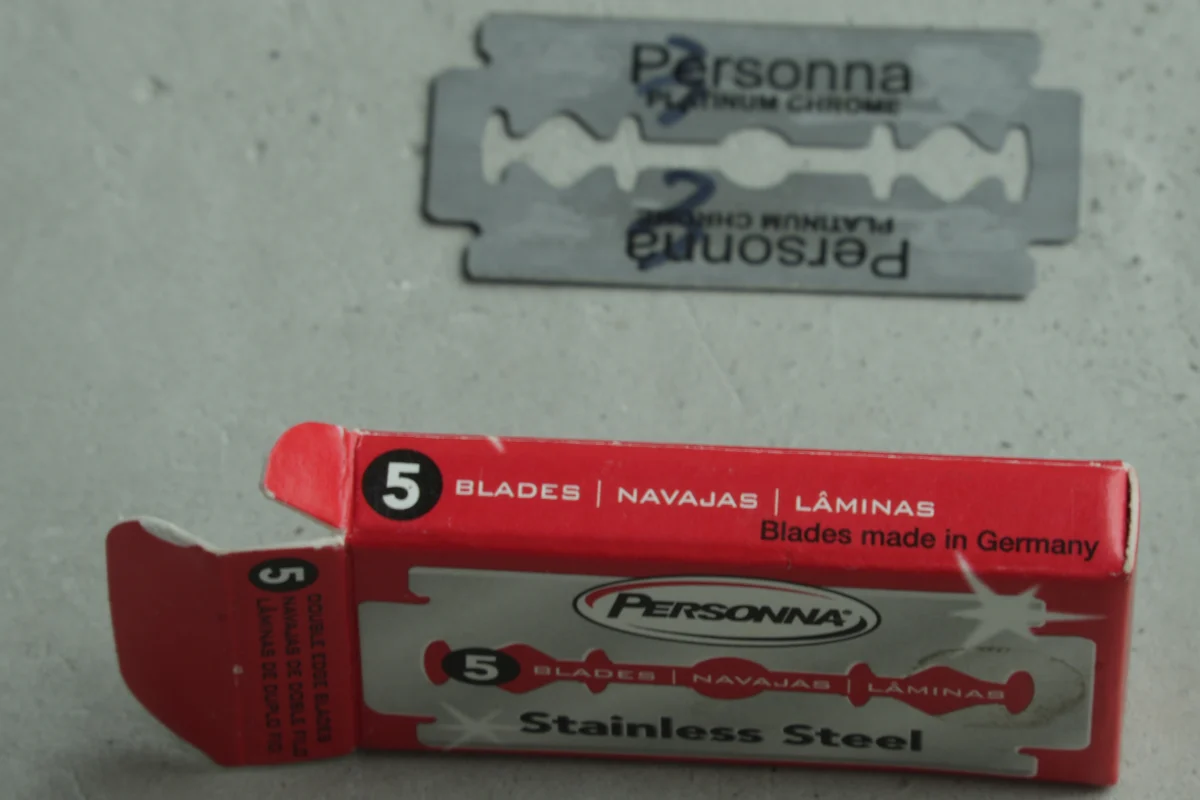
Identification is restricted to the supplied photographs. The red box carries the Personna name, the product line Stainless Steel, a five-blade count and the printed origin statement “Blades made in Germany.” The loose blade is stampedPersonna and Platinum Chrome.
Those two labels stay distinct. “Stainless Steel” is the box line, while “Platinum Chrome” is the blade stamp. The supplied faces do not identify a manufacturer, distributor or brand owner, so this article does not assign one.
Test Conditions
- Tester: ORMIXA — one skin profile, fixed rubric
- Razor: ORMIXA Vector 316L stainless, 0.76 mm gap
- Bowl: ORMIXA Titanium Shaving Bowl, Double-Wall Lather Bowl — Silver
- Soap: Proraso Shaving Soap in a Bowl — Sensitive (green tea & oatmeal), bowl-lathered
- Brush: ORMIXA 6061 Aluminum Line — Black, 24 mm Black & White synthetic (the 24 mm knot used here has since left the public catalogue; the line now ships at 26 mm)
- Preparation: no hot-water face wash; no pre-shave oil; brush soaked in tap water for about 1 minute
- Pass pattern: WTG → ATG; XTG skipped; target SS, not BBS
- Post-shave: alum block, followed at 30 minutes and 4 hours
- Intervals: 141h recorded baseline, then 97h and 73h
- Room conditions: 28 °C / 85% RH on Shave 1; 30 °C / 80% RH on Shaves 2–3
Test Period Summary
Three uses of the same blade were logged from 9–16 July 2026. Each session used the same WTG → ATG pattern and deliberately skipped XTG. The run therefore measures a stable SS-target routine. A BBS attempt and maximum-lifespan test sit outside this record.
Shave 1 — Fresh
2026-07-09 · 141h recorded growth
- Closeness
- 7/10
- Smoothness
- 10/10
- Irritation
- 10/10
The fresh edge felt sharp with slight blade presence but no drag. WTG was crisp; after ATG, stubble was almost impossible to detect by touch. Zero nicks and zero weepers. Alum was very mild. Touch: SS (2-pass, BBS not targeted).
Shave 2 — 97h
2026-07-13 · 97h growth
- Closeness
- 7/10
- Smoothness
- 10/10
- Irritation
- 9/10
The second use repeated the first session: slight blade presence, a decisive WTG pass and no pulling. ATG again left almost no detectable stubble. Zero nicks and zero weepers. Alum was mild. Touch: SS.
Shave 3 — 73h
2026-07-16 · 73h growth
- Closeness
- 7/10
- Smoothness
- 10/10
- Irritation
- 9/10
The third use remained sharp and completed both passes without drag. ATG left detectable stubble and audible feedback eased one point; comfort held. Zero nicks and zero weepers. Alum was mild. Touch: SS.
Five-Axis Scores
| Shave | Closeness | Smoothness | Irritation | Audible | Lather | Total |
|---|---|---|---|---|---|---|
| 1 — fresh | 7 | 10 | 10 | 10 | 10 | 47 |
| 2 — 97h | 7 | 10 | 9 | 10 | 10 | 46 |
| 3 — 73h | 7 | 10 | 9 | 9 | 10 | 45 |
Average: 46.0/50. Touch was SS in all three sessions. Closeness is normalized to 7 so the numeric score agrees with the SS touch result and the no-XTG, non-BBS protocol; the correction is logged in the source record and score lock.
Day-by-Day
Shave 1 (2026-07-09, 141h recorded growth)
The fresh blade arrived with clear sharpness and a small amount of blade presence, but no pulling. WTG cut decisively from the opening stroke. XTG was skipped because BBS was not the target; after ATG, stubble was almost impossible to find by touch.
There were no difficult-area events at the jaw, neck, upper lip or Adam’s apple. The session ended with zero nicks and zero weepers. Alum was very mild, skin felt fresh at 30 minutes and fully relaxed at 4 hours.
Touch: SS. Scores: Closeness 7 / Smoothness 10 / Irritation 10 / Audible 10 / Lather 10.
Shave 2 (2026-07-13, 97h growth)
The second use repeated the opening pattern. Slight blade presence was still readable, but the edge remained sharp and WTG stayed crisp with no drag. ATG again left almost no detectable stubble.
The jaw, neck, upper lip and Adam’s apple logged no difficulty. Nicks and weepers remained at zero. Alum was mild; skin was fresh at 30 minutes and fully relaxed at 4 hours. Irritation moved from 10 to 9, without a reported burn, rash or tightness event.
Touch: SS. Scores: Closeness 7 / Smoothness 10 / Irritation 9 / Audible 10 / Lather 10.
Shave 3 (2026-07-16, 73h growth)
On the third use, the blade still completed WTG and ATG without drag. The change appeared after the cut: stubble was detectable by touch after ATG, and audible feedback eased from 10 to 9. That is a mild efficiency signal, not a multi-axis collapse.
Smoothness and lather compatibility remained at 10, irritation held at 9, and there were again zero nicks and zero weepers. Alum stayed mild; the 30-minute and 4-hour follow-ups remained fresh and fully relaxed. The contemporaneous session note says three uses were still well short of the pairing’s apparent limit, but the test did not continue far enough to measure that limit.
Touch: SS. Scores: Closeness 7 / Smoothness 10 / Irritation 9 / Audible 9 / Lather 10.
What Worked in the Pairing
Smooth cutting held through the full window
Smoothness stayed at 10 for all three uses. The WTG notes are unusually consistent: decisive cutting, no pulling and no need to manage a deteriorating edge. The third-use efficiency signal arrived after ATG; WTG still ran without drag.
The safety record stayed clean
Across six recorded passes, the pairing produced zero nicks and zero weepers. Alum was very mild on Shave 1 and mild on Shaves 2–3, while the 4-hour check remained fully relaxed every time. Comfort therefore stayed stable through Shave 3.
The lather match was stable
Bowl-lathered Proraso Sensitive scored 10 for compatibility in all three sessions. With the soap, brush and bowl held constant, there is no lather-axis change to explain the one-point decline in the final total.
Friction Points in the Pairing
Shave 3 gives the first efficiency signal
Audible feedback eased one point and ATG left detectable stubble on the third use. Smoothness, lather and safety stayed intact, and no drag appeared. The supported conclusion is narrow: the pairing was slightly less efficient on Shave 3 than on Shaves 1–2 and remained usable.
The protocol does not answer a BBS question
All three sessions intentionally skipped XTG and logged SS touch. A BBS-target routine would add a pass and change exposure, pressure and irritation risk, so maximum closeness cannot be inferred from this dataset.
Difficult Areas
- Jaw / jawline: no difficulty logged in any session.
- Neck: no WTG or ATG event logged in any session.
- Upper lip / under the nose: no difficulty logged in any session.
- Adam’s apple / under the chin: no difficulty logged in any session.
Pairing Recommendation for Vector 316L Owners
Under the logged conditions, the Vector 316L × Personna Stainless Steel pairing supports a controlled two-pass SS routine across at least three uses. It is the strongest fit in this dataset when the priority is smooth cutting, a clean blood-point record and mild post-shave feedback.
The data does not establish how the blade behaves in a different razor, during a three-pass BBS routine or beyond Shave 3. It also does not isolate whether the small third-use efficiency change belongs to the blade, the 0.76 mm head geometry or ordinary within-session variation. Those are follow-up questions, not findings from this run.
Video Evidence
Three unedited session records:
- Shave 1 of 3: youtu.be/HiALpBj0nRE
- Shave 2 of 3: youtu.be/qhkwTYpmhLM
- Shave 3 of 3: youtu.be/9ahsggL-00U
Cross-Pairing Reference
Current Vector × DE-blade pairing scores, averaged across the same five axes:
| Pairing | Avg / 50 | Trend | Best window |
|---|---|---|---|
| Vector TC4 × Treet Platinum | 47.0 | flat on all five axes | Shaves 1–3 |
| Vector TC4 × Super Treet Platinum | 46.7 | two flat sessions, one point back at S3 | Shaves 1–3 |
| Vector 316L × Astra SP (green) | 46.0 | flat, no decay | Shaves 1–3 |
| Vector 316L × Personna Stainless | 46.0 | stable, mild S3 efficiency signal | Shaves 1–3 |
| Vector 316L × Gillette Perma-Sharp | 46.0 | flat with mild S3 long-stroke signal | Shaves 1–3 |
| Vector 316L × Iridium Super | 45.7 | two flat sessions, one point back at S3 | Shaves 1–2 |
| Vector TC4 × Shark Super | 45.7 | two flat sessions, one point back at S3 | Shaves 1–3 |
| Vector 316L × Dorco Prime | 44.3 | one point back at S2, then flat | Shaves 1–3 |
| Vector 316L × Feather Hi-Stainless | 44.0 | flat on all five axes | Shaves 1–3 |
| Vector 316L × Gillette Nacet | 42.7 | clean, mild S3 dip | Shaves 1–2 |
| Vector 316L × Gillette Silver Blue | 42.7 | 2-shave golden window | Shaves 1–2 |
| Vector 316L × Derby Extra | 42.0 | shallow uniform decline, stays in band | Shaves 1–2 |
| Vector TC4 × Voskhod Teflon | 40.0 | S2 dip, partial recovery | Shave 1 |
| Vector 316L × Wilkinson Classic | 35.7 | monotonic decline | Shaves 1–2 |
| Vector 316L × Wilkinson (India) | 35.3 | monotonic decline | Shaves 1–2 |
Personna and Astra Superior Platinum share the same 47 / 46 / 45 curve and 46.0 average in the registry, but the shapes are not identical. Personna’s final point moved on audible feedback while smoothness stayed at 10; the Astra record must be read in its own article rather than treated as a blade-only comparison.
The Nacet and Silver Blue rows used the same Vector 316L and Proraso Sensitive soap but not every session variable was identical, including brush setup and growth interval. The table is therefore a pairing reference, not a controlled ranking of loose blades.
→ Full Vector Blade Compatibility Database
Methodology Notes
- Attribution C — pairing window / within-session variation: the one-point Shave-3 change was not accompanied by drag, reduced smoothness, blood points or a harsher alum response. A single-razor, three-use run cannot isolate blade decay from head geometry or normal session variation.
- Closeness normalization: the submitted notes paired closeness scores of 10 / 10 / 9 with SS touch, no XTG and an explicit non-BBS target. Under the published anchor, SS corresponds to 6–7; closeness is locked at 7 / 7 / 7 so the numeric and tactile records agree. All other submitted axis scores are preserved.
- Date normalization: Shave 3 is recorded as 16 July, not 13 July. The video metadata places it on 16 July and that date produces the submitted 73-hour interval from Shave 2. Shave 2’s calculated interval is 97 hours from the logged timestamps.
- Identification boundary: Germany is box-verified; “Platinum Chrome” is a blade stamp. No factory, corporate owner or coating construction is inferred from either mark.
- No lifespan endpoint: three shaves were completed, and the third remained comfortable. That supports a three-use window, not a claim about maximum blade life.
Pairing Verdict
After three shaves, the Vector 316L × Personna Stainless Steel pairing closes at 46.0/50 — smooth and stable through the full observed window, with a mild third-use efficiency signal and no comfort break.
The strongest evidence is the repeatability: smoothness and lather at 10 in every session, no drag, zero nicks, zero weepers and mild alum. Shave 3 was not identical to the first two — audible feedback eased and ATG left detectable stubble — but nothing in the record shows the blade had reached its usable limit. The defensible conclusion stops at the observed window.
Sources
- American Academy of Dermatology — How to shave
- Cleveland Clinic — Razor Burn
- ORMIXA session logs and locked score record; scoring method in the Vector Blade Compatibility methodology
Disclosure
Internal pairing test. Not sponsored. ORMIXA has no commercial relationship with Personna or the blade vendor and does not sell this blade. The photographed pack is documented only from the supplied evidence; acquisition channel, manufacturer and corporate brand owner are not established by the available material.
ORMIXA products are sold by ECE Innovate Homes LLC and manufactured by Guangzhou Yanyang Technology Co., Ltd. under trademark license.
Manufacturer-conducted testing has an inherent perspective. To keep the evidence inspectable, every session video is linked, corrections are logged in the normalized source file, and the same five-axis rubric is used across the database.
Related
- ← Full Vector Blade Compatibility Database
- Same 46.0 average — Vector 316L × Astra Superior Platinum →
- The razor used in this test — Vector 316L →
- The brush used in this test — Harbor →
- The bowl used in this test — Titanium Double-Wall →
Frequently asked questions
- Does Personna Stainless Steel pair well with the Vector 316L?
- In this 3-shave test, the pairing scored 47 / 46 / 45 for a 46.0/50 average. Smoothness and lather compatibility stayed at 10, with zero nicks, zero weepers and no drag. Shave 3 showed a mild efficiency signal, but no comfort break. This is pairing data, not a rating of the blade in isolation.
- How many shaves did the Personna blade last in this test?
- The same blade completed all three logged shaves comfortably. Shave 3 still scored 45/50, although audible feedback eased to 9 and ATG left detectable stubble. Testing stopped after three uses, so the record supports a three-use window but does not establish maximum blade life.
- Why is closeness scored 7 when the shave felt very close?
- The routine used WTG and ATG only, skipped XTG and explicitly targeted SS rather than BBS. The published anchor places SS at 6-7, so closeness was normalized to 7 in all three sessions to keep the numeric score consistent with the tactile result. The raw correction is preserved in the source record.
- Where was this Personna Stainless Steel blade made?
- The photographed red box states “Blades made in Germany.” The loose blade is stamped “Personna” and “Platinum Chrome.” The available package faces do not identify a manufacturer, distributor or corporate brand owner, so none is inferred.
- How does this pairing compare with Astra on the Vector 316L?
- Both pairings have a 47 / 46 / 45 curve and a 46.0/50 average in the current registry. Personna kept smoothness at 10 and lost its Shave-3 point on audible feedback. This compares two razor-blade pairings; it does not establish that either loose blade is universally better.
- Is ORMIXA recommending Personna blades in general?
- No. The article documents one Personna Stainless Steel blade paired with one Vector 316L under a fixed two-pass routine. It does not rate Personna blades in isolation, predict performance in other razors or make a general purchasing recommendation.