

A single-blade razor is exactly what the name says — one blade does all the cutting, slicing each hair once at the surface instead of hooking it up and severing it below the skin the way a multi-blade cartridge does. That single pass across the skin is the reason most people leave cartridges: one edge dragging once tends to irritate less than four or five edges dragging in sequence, and the running cost drops to a few cents a shave. This guide covers what a single-blade razor is, why it gets confused with the “single-edge” razors that are a different category entirely, and what separates a forgiving one from a punishing one.
TL;DR — What a single-blade razor is
A single-blade razor uses one blade to cut each hair once at skin level, rather than the four or five stacked blades of a cartridge that lift the hair and cut it below the surface. The American Academy of Dermatology names a single-blade razor (or an electric razor) as a recommended option for anyone prone to razor bumps. Change the blade every 5 to 7 shaves, shave in the direction the hair grows, and let the razor’s weight set the pressure.
What is a single-blade razor?
A single-blade razor is any razor that cuts with one blade at a time. The classic example is the double-edge (DE) safety razor: a fixed head clamps a single flat blade between a top cap and a base plate, and that one blade does every bit of the cutting. The blade has a sharpened edge on each of its long sides, so you can flip it to use the second edge, but only one edge ever touches skin on a given stroke — it is still one blade doing one cut. That is what makes it a single-blade razor in the honest sense of the phrase.
The geometry of the head decides how the shave feels. Two numbers matter: the blade gap (how far the edge sits from the guard) and the blade exposure (how far it protrudes past the guard plane). A modest gap and exposure put a razor in the mild-to-moderate range, forgiving enough for a first single-blade shave while still cutting efficiently. The ORMIXA Vector, for example, runs a 0.76 mm blade gap and 0.14 mm blade exposure and weighs 60 g in TC4 titanium (104 g in 316L stainless) — the mass is deliberate, because on a single-blade razor the weight of the tool is meant to supply the pressure so your hand does not have to.
This is the opposite of a multi-blade cartridge. A cartridge stacks four or five short blades in a row: the leading edge tugs each hair up out of the follicle, and the trailing edges cut it off below the skin surface before it snaps back. That mechanism gives a very close shave, but the retracted hair and the repeated drag of several edges across one patch are also what drive much of the irritation people carry over from cartridges. A single blade removes the stack and cuts once, at or just above skin level.
Single blade vs single edge — they are not the same thing
This is the distinction that trips up almost every shopper, and it is worth getting exactly right before you buy. “Single blade” counts how many blades cut — one. “Single edge” describes a specific type of blade: one with a single sharpened side, held in a heavier steel spine. So the two terms answer different questions, and a razor can be single-blade without being single-edge.
Double-edge (DE)
A double-edge razor takes a thin, flat blade sharpened on both long sides. You load one blade, and it presents one edge to the skin at a time; flip it when the first edge dulls. DE blades are the cheap, universal standard — a single blade costs a few cents, and almost any brand fits almost any DE razor. The Vector is a double-edge razor. Because it holds one blade doing one cut, it is correctly described as a single-blade razor.
Single-edge (SE)
A single-edge razor uses a different blade entirely — a stiffer blade sharpened on one side, in the style of the old injector and GEM razors. Single-edge razor blades are a separate product line from DE blades and are not interchangeable with them. An SE razor is also a single-blade razor, but the blade format, the feel, and the resupply are different.
The short version: both DE and SE razors are single-blade razors, so a single-blade safety razor can be either. ORMIXA builds a double-edge razor, not a single-edge one — a distinction that matters mostly for which blades you buy. The single-edge vs double-edge guide goes deeper on blade cost, availability, and who each format suits.
Why does one blade irritate less than a cartridge?
The comfort difference comes down to how deep the hair is cut and how many times an edge crosses the skin. Cleveland Clinic describes what happens after the cut plainly: the shaved hairs become sharp like spears, and those spears can turn back and penetrate the skin. How deep the hair was cut decides how easily that happens, and that is where the two razors part. The cartridge’s lift-and-sever sequence leaves the cut end below the surface — the source of its very close shave and, for a lot of people, its ingrown hairs. A single blade cutting at skin level leaves that end outside the skin instead.
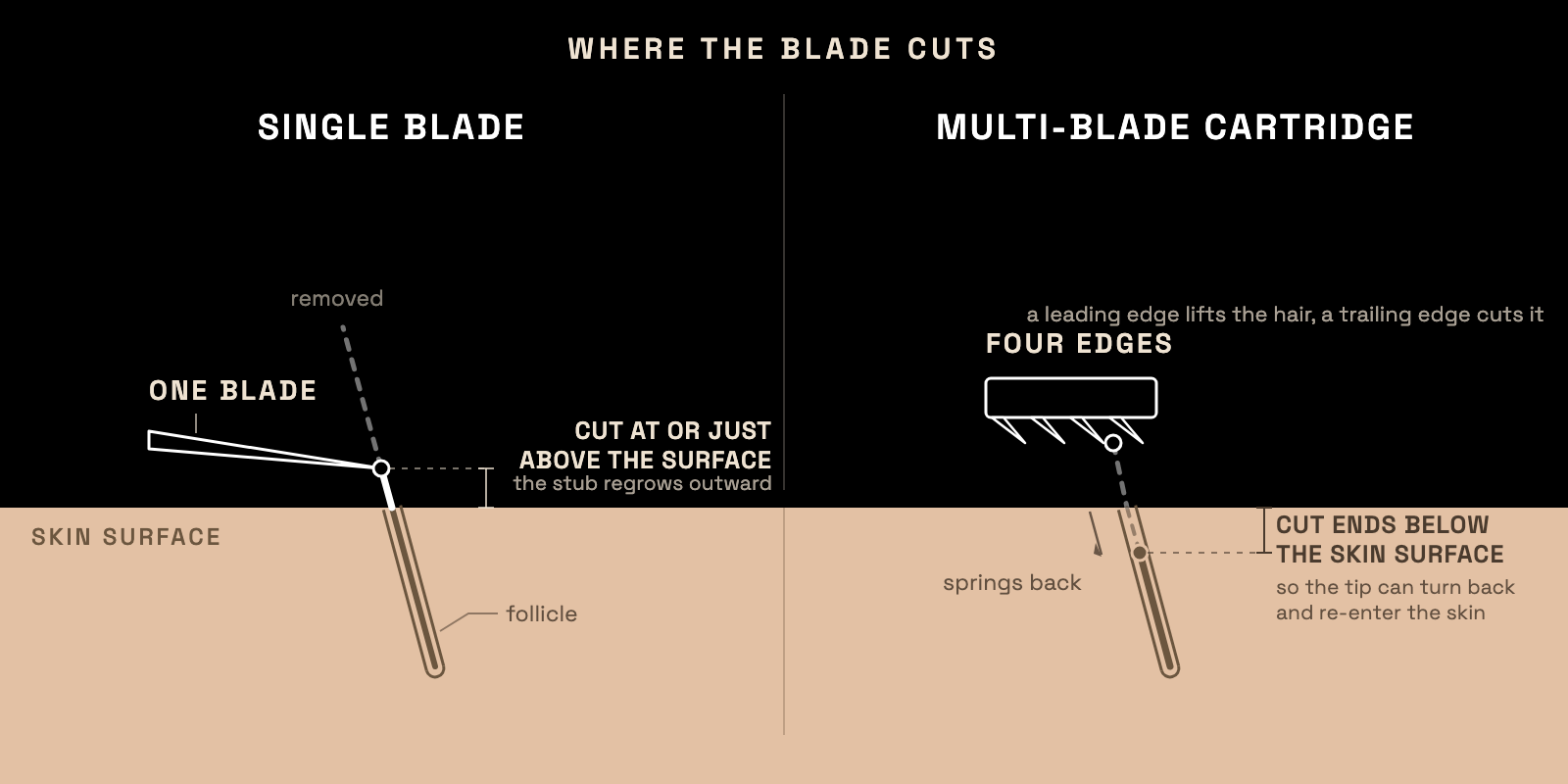
The second factor is friction. Each of the four or five edges in a cartridge drags across the same skin on every stroke. The American Academy of Dermatology, in its guidance on preventing razor bumps, recommends a single-blade or electric razor and tells shavers to avoid shaving closely or putting much pressure on the skin — the exact two things a stacked cartridge encourages. Cleveland Clinic’s razor burn guidance lands in the same place: use light, short strokes, and avoid shaving over the same section more than once. One edge, one pass, is simply less mechanical abuse than several edges dragged repeatedly.
None of this is automatic. A single-blade razor rewards technique the cartridge hid from you — you set the angle yourself, roughly 30 degrees, and let the weight do the pressing. Done with a heavy hand or too many passes, one blade can irritate as much as five. The mechanical advantage is real, but it only shows up with the light touch the dermatology sources describe.
Is a single blade better for your skin?
For irritation-prone skin, the professional guidance points toward a single blade. The American Academy of Dermatology recommends a single-blade or electric razor for people who get razor bumps, alongside shaving in the direction the hair grows and replacing the blade every 5 to 7 shaves to keep it sharp. The logic is consistent across sources: a shallower cut and less repeated drag give reactive skin fewer chances to inflame.
The honest qualifier is that “better for your skin” depends on how you use it. A dull blade, an aggressive angle, or four passes chasing a baby-smooth result will irritate skin no matter how many blades the razor has. And anyone with active acne, eczema, or a diagnosed skin condition should raise a routine change with a dermatologist rather than treat a shaving guide as medical advice. For most people carrying low-grade redness or ingrown bumps from a cartridge, a single blade used with a light hand is the change most likely to help; the sensitive-skin guide goes further into what reactive skin needs from the rest of the routine.
What makes a good single-blade razor?
“Best” is the wrong question, because the right single-blade razor depends on your skin, your beard, and how forgiving you need the learning curve to be. A more useful question is what to look for, and a few criteria separate a razor that helps a beginner from one that fights them.
A mild-to-moderate head
The blade gap and exposure decide how much edge meets skin. A modest gap and low exposure keep the shave efficient while leaving room for the angle and pressure errors every beginner makes. High-aggression and adjustable heads exist and suit experienced shavers, but they punish the exact mistakes a first-timer is most likely to make. The Vector’s 0.76 mm gap and 0.14 mm exposure sit in that mild-to-moderate band by design.
Enough weight to set the pressure
A single-blade razor works best when the tool’s own mass supplies the pressure. A razor that is too light tempts you to press, which is what causes nicks and burn. Enough mass in the head and handle lets you rest the razor on the skin and simply guide it. The Vector sits at 60 g in TC4 titanium and 104 g in 316L stainless — both built around that idea, the steel version simply supplying more of the pressure for you.
One honest blade, and standard resupply
The blade is the consumable, and a good single-blade razor takes a cheap, widely available blade rather than a proprietary one. Standard double-edge blades cost a few cents each and come from dozens of makers, so you can sample brands to find the one your skin likes without being locked to a single supplier. The razor is the one-time cost; the blades are the part that keeps the running cost low for years.
Those criteria map directly onto the Vector — a mild-to-moderate fixed head, deliberate weight, and standard DE blades. Whether it is the right first razor for you is a fit question, and the guide to choosing a safety razor walks through how the options compare on gap, weight, and handle so you can match one to your own beard and skin.
Where to start
A single-blade razor is a technique change first and a gear change second. The payoff — less irritation, fewer ingrown hairs, and a per-shave cost measured in cents — lands only once the light-touch, single-pass habit replaces the press-and-drag one a cartridge trained. The way through that curve is to change one variable, the razor, and let the blade and lather follow as the habit settles. The technique itself is the part worth reading before your first shave — the guide to using a safety razor covers the angle, the pressure, and the pass order that a cartridge never asked you to think about.
Sources
- American Academy of Dermatology — Razor bump remedies (recommends a single-blade or electric razor; avoid shaving closely or with pressure; blade sharp for 5–7 shaves)
- American Academy of Dermatology — How to shave (change the blade after 5–7 shaves; shave in the direction the hair grows; shave lightly to prevent nicks)
- Cleveland Clinic — Razor burn (cut hairs turn sharp and can penetrate the skin; use light, short strokes; avoid shaving the same section more than once; keep the blade sharp)
Disclosure
ORMIXA products are sold by ECE Innovate Homes LLC and manufactured by Guangzhou Yanyang Technology Co., Ltd. under trademark license.
Frequently asked questions
- Is a safety razor a single blade razor?
- Yes. A double-edge safety razor holds one flat blade that does all the cutting, so it is a single-blade razor. The blade is sharpened on both long sides, but only one edge touches skin per stroke — it is still one blade making one cut, which is what the phrase means.
- Why does a single blade irritate less than a multi-blade cartridge?
- A cartridge stacks four or five blades that lift each hair and cut it below the skin, and the retracted hair can turn back and cause razor bumps. A single blade cuts once at the surface and drags across the skin fewer times. The American Academy of Dermatology names a single-blade or electric razor among its recommendations for people prone to razor bumps.
- What is the difference between single edge and double edge?
- Both are single-blade razors, but the blade format differs. A double-edge (DE) blade is thin and sharpened on both long sides, so you flip it to use the second edge. A single-edge (SE) blade is stiffer and sharpened on one side, in the injector or GEM style. DE and SE blades are not interchangeable.
- Is a single blade better for your skin?
- For irritation-prone skin, the guidance points that way. The American Academy of Dermatology recommends a single-blade or electric razor for razor bumps because a shallower cut and less repeated drag give reactive skin fewer chances to inflame. It depends on technique, though — a dull blade or heavy pressure irritates skin regardless of blade count.
- Does ORMIXA make a single-edge razor?
- No. ORMIXA makes the Vector, a double-edge (DE) safety razor. It uses one standard double-edge blade — so it is a single-blade razor — but it is not a single-edge (SE) razor and does not take single-edge blades. If you need SE blades, a DE razor is not the tool.
- What should I look for in a good single blade razor?
- A mild-to-moderate head that stays forgiving on the learning curve, enough weight that the tool sets the pressure instead of your hand, and standard double-edge blades that cost a few cents and come from many makers. The razor is the one-time cost; cheap, universal blades keep the running cost low for years.