

If you want to know how to use a safety razor without irritating your face, three things matter: angle, pressure, and grain direction. A safety razor is a single-blade tool — no pivot, no flex, no compensation for bad technique. Get those three right and a DE razor gives a cleaner, lower-irritation shave than a cartridge for most faces.
What you need
- A double-edge safety razor (the ORMIXA Vector uses a closed-comb head with a 0.76 mm blade gap — a mild-to-moderate blade feel, good for most face types)
- A blade sampler pack (a LEDGER 5-blade assembly ships free with every Vector)
- A shaving soap or cream and a brush, or a slick lather from a tube
- Hot water
Step 1: Prep your face
Shower first, or hold a hot towel against your face for 60 seconds. The goal is to soften the hair shaft. Dry, cold hair resists cutting and causes the blade to tug instead of slice. The American Academy of Dermatology makes the same point: wet and warm the skin before shaving.
Step 2: Load and lock the blade
Unscrew the handle, place a fresh DE blade on the base plate, align the screw hole, and re-tighten. The blade should sit flat with equal overhang on both sides. If it is crooked, loosen and reseat. A misaligned blade pulls on one side and skips on the other.
Step 3: Find the safety razor angle
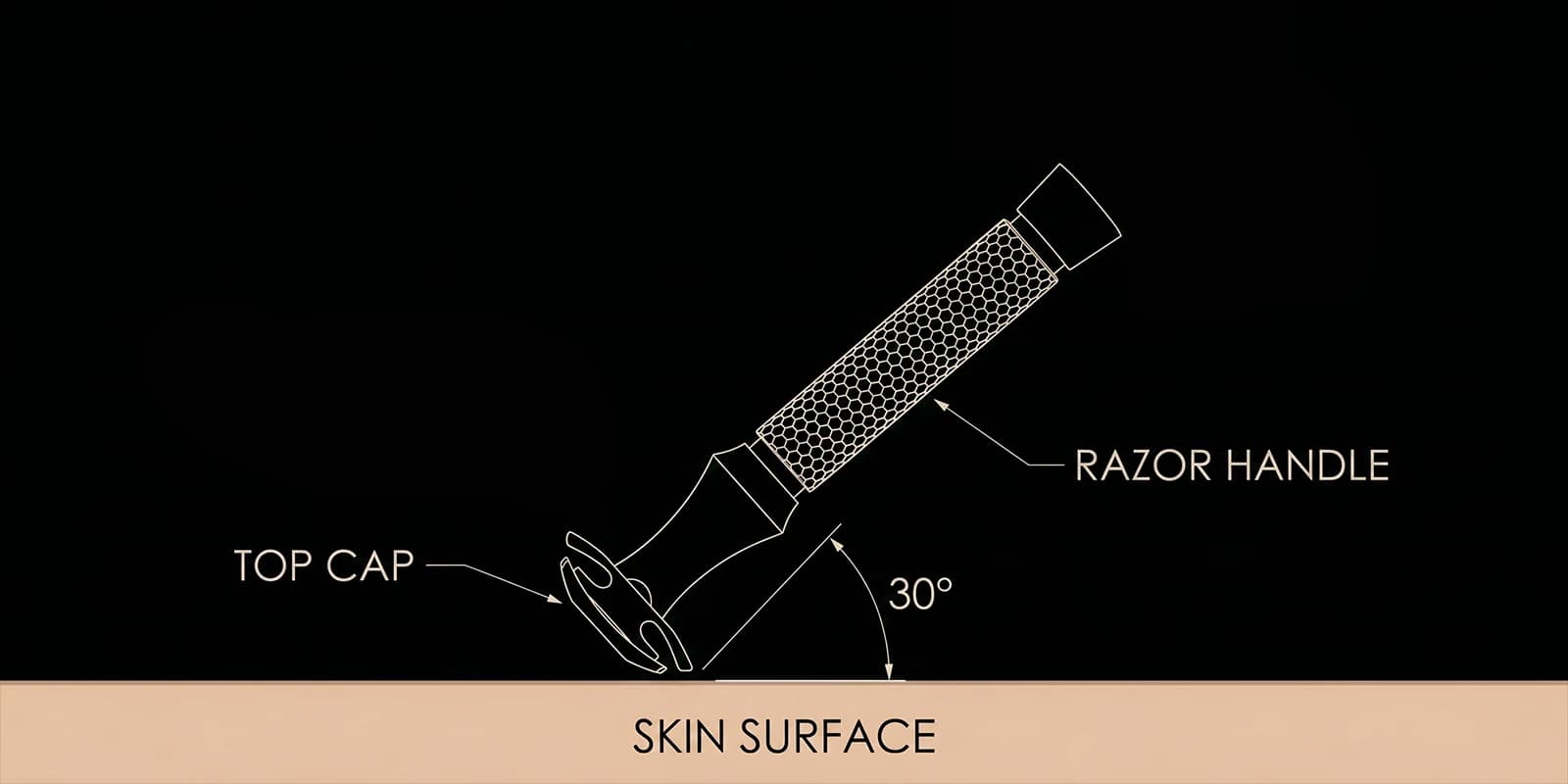
This is where most beginners fail. Rest the top cap flat against your cheek — the blade is now parallel to your skin and not cutting anything. Slowly tilt the handle away from your face until you feel the blade just begin to contact the stubble. That is your cutting angle. For most DE razors it is roughly 30° from the skin.
The Vector’s closed-comb geometry naturally limits the blade exposure, so the margin of error is wider than on open-comb or adjustable razors. If you feel scraping, your angle is too steep. Pull back toward flat and try again.
Step 4: Let the weight do the work
Do not press the razor into your skin. A CNC-machined razor like the Vector weighs 60–104 g depending on material. That mass is your cutting force. Your hand only guides direction. Think of it as dragging a paint roller — you steer, gravity and weight do the rest.
If you push, the blade bites deeper than the gap allows and you get nicks. If you skim with zero pressure, the blade glides at the angle the head geometry was designed for.
Step 5: Shave with the grain (first pass)
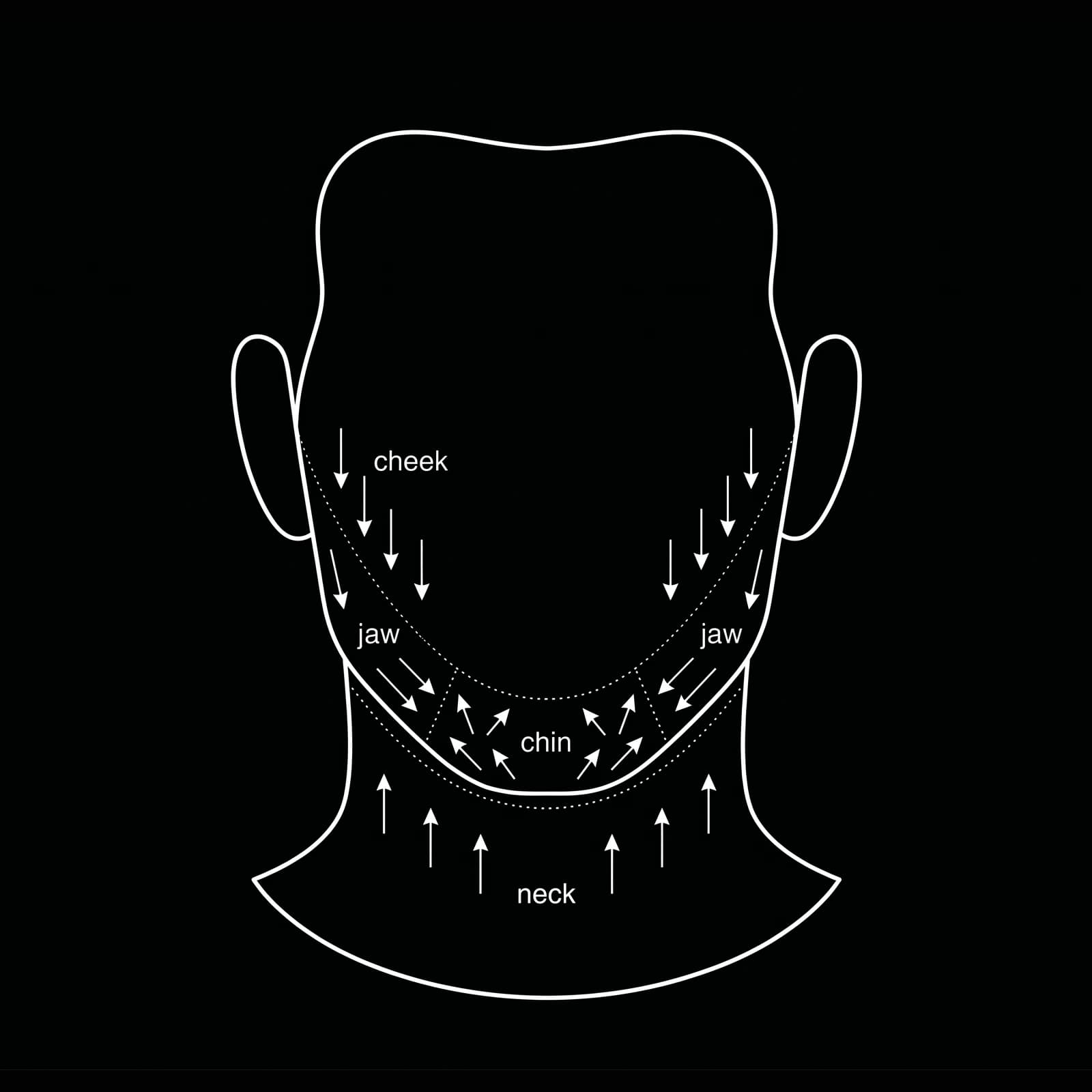
Map your grain direction before you start. Run your hand across your face — the rough direction is against the grain, the smooth direction is with it. On your first pass, shave exclusively with the grain. Short strokes, 3–4 cm at a time. Rinse the blade under hot water after every stroke or two.
One with-the-grain pass removes most of the stubble. For many situations — office, daily routine — that is enough.
Step 6: Optional second pass (across the grain)
Re-lather. On the second pass, shave across the grain, perpendicular to the growth direction. This picks up the remaining stubble without the irritation risk of going directly against the grain.
Most experienced DE users stop here. An against-the-grain third pass is possible but unnecessary for almost everyone. If your skin tolerates it, go for it. If you are new, skip it for the first month.
The three passes at a glance
| Pass | Direction | When | Irritation risk |
|---|---|---|---|
| First | With the grain | Every shave | Low |
| Second | Across the grain | Daily polish | Low–moderate |
| Third | Against the grain | Special occasion only | High |
Common safety razor technique mistakes
- Pressing too hard. The most common cause of irritation. Let the razor’s weight work.
- Too steep an angle. If you hear scraping, flatten out.
- Dull blade. A DE blade lasts 5–7 shavesdepending on hair density. Change it before it tugs. Blades cost pennies; your face is worth more.
- Skipping prep. Cold, dry hair doubles the force needed to cut it. Warm water prep fixes it.
- Going against the grain too early. Master with-the-grain first. Add cross-grain after a week. Against-grain after a month. The AAD flags against-the-grain shaving as a leading cause of razor bumps.
Blade choice matters
Not all DE blades are the same. A Feather is sharper than a Derby. A Voskhod sits somewhere in between. The right blade depends on your hair type, your skin, and the razor you pair it with. A sampler pack is the only honest way to find what works. Try each blade for 3 shaves before judging. For measured pairings, our TC4 blade compatibility database logs how specific blades behave with the Vector head.
After the shave
Rinse the razor under hot water, shake out excess water, and leave it to air-dry. Do not wipe the blade — touching the edge is how you nick your fingers and dull the blade. If you use a Vector with a stand, rest it head-down so water drains away from the blade.
Splash cold water on your face. Apply an alcohol-free aftershave balm or moisturizer if your skin needs it. Fragrance that burns on application is doing nothing for your skin.
Safety razor shaving tips — double edge razor how to (TL;DR)
- Cutting angle: roughly 30° from the skin — rest cap flat, tilt handle until blade contacts stubble.
- Pressure: zero. The razor’s weight (60–104 g) does the cutting; your hand only steers.
- First pass: with the grain only. Short 3–4 cm strokes. Rinse every 1–2 strokes.
- Second pass: across the grain (optional). Stop here for daily routine.
- Common safety razor technique mistakes: pressing too hard, steep angle, dull blade (5–7 shaves max), skipping prep.
- Blade change: 5–7 shaves depending on hair density. Don’t push past tug.
Sources
- American Academy of Dermatology — How to Shave (wet the skin first, shave with the grain, use light pressure)
- Cleveland Clinic — Razor Burn (dry shaving, shaving too fast & dull blades cause irritation)
- Ogunbiyi A., Pseudofolliculitis Barbae (2019) — how sharp shaved hair tips penetrate skin and cause razor bumps
Disclosure
ORMIXA products are sold by ECE Innovate Homes LLC and manufactured by Guangzhou Yanyang Technology Co., Ltd. under trademark license.
Looking for the right razor? See all ORMIXA products →
Frequently asked questions
- What angle should I hold a safety razor at?
- Roughly 30 degrees from the skin. Rest the top cap flat against your cheek, then tilt the handle away until the blade just contacts the stubble. If you hear scraping, the angle is too steep — pull back toward flat.
- How much pressure should I use with a safety razor?
- None. Let the razor's own weight (60 g in TC4 titanium, 104 g in 316L steel on the Vector) do the cutting; your hand only steers direction. Pressing harder makes the blade bite deeper than the head geometry allows, which causes nicks and irritation.
- How many passes does a safety razor shave take?
- One with-the-grain pass removes most stubble and is enough for daily use. An optional second pass across the grain polishes it closer. An against-the-grain third pass is rarely necessary and carries the highest irritation risk.
- How often should I change a double-edge blade?
- Every 5 to 7 shaves, depending on hair density. Change it before it starts to tug — a dull blade is the second most common cause of irritation after pressing too hard.
- Should I shave with or against the grain first?
- Always with the grain on the first pass. Map your grain by running a hand across your face: the rough direction is against the grain. Add a cross-grain pass after a week, and against-grain only after a month if your skin tolerates it.
- Why does my safety razor irritate my skin?
- Almost always one of four causes: pressing too hard, holding too steep an angle, using a dull blade, or skipping prep. Soften the hair with a hot shower or towel first, let the weight do the work, and keep the angle shallow.