

Badger brush vs synthetic — the badger vs synthetic shaving brush question is the most common one we get from brush buyers (“is badger worth the money?”). It depends on what you optimize for — specifically, what each fiber type does to water and soap at the mechanical level.
We make both. The ORMIXA Harbor ships with Badger and Synthetic knots depending on the series. We have no incentive to push one over the other — the handle is the same across all knot types, and our margin does not change with your knot choice.
Badger vs synthetic shaving brush (TL;DR)
Badger knots absorb water into the hair shaft for a wetter lather with less effort, but need 5–20 shaves to break in and cost more. High-end synthetic fibers are ready day one, vegan, and outlast the handle — close enough that most shavers cannot feel much difference. The Harbor handle takes either knot; the knot is what drives the price difference. Decide based on whether lather quality or convenience matters more to you.
Where they differ — a shaving brush knot comparison
1. Water retention
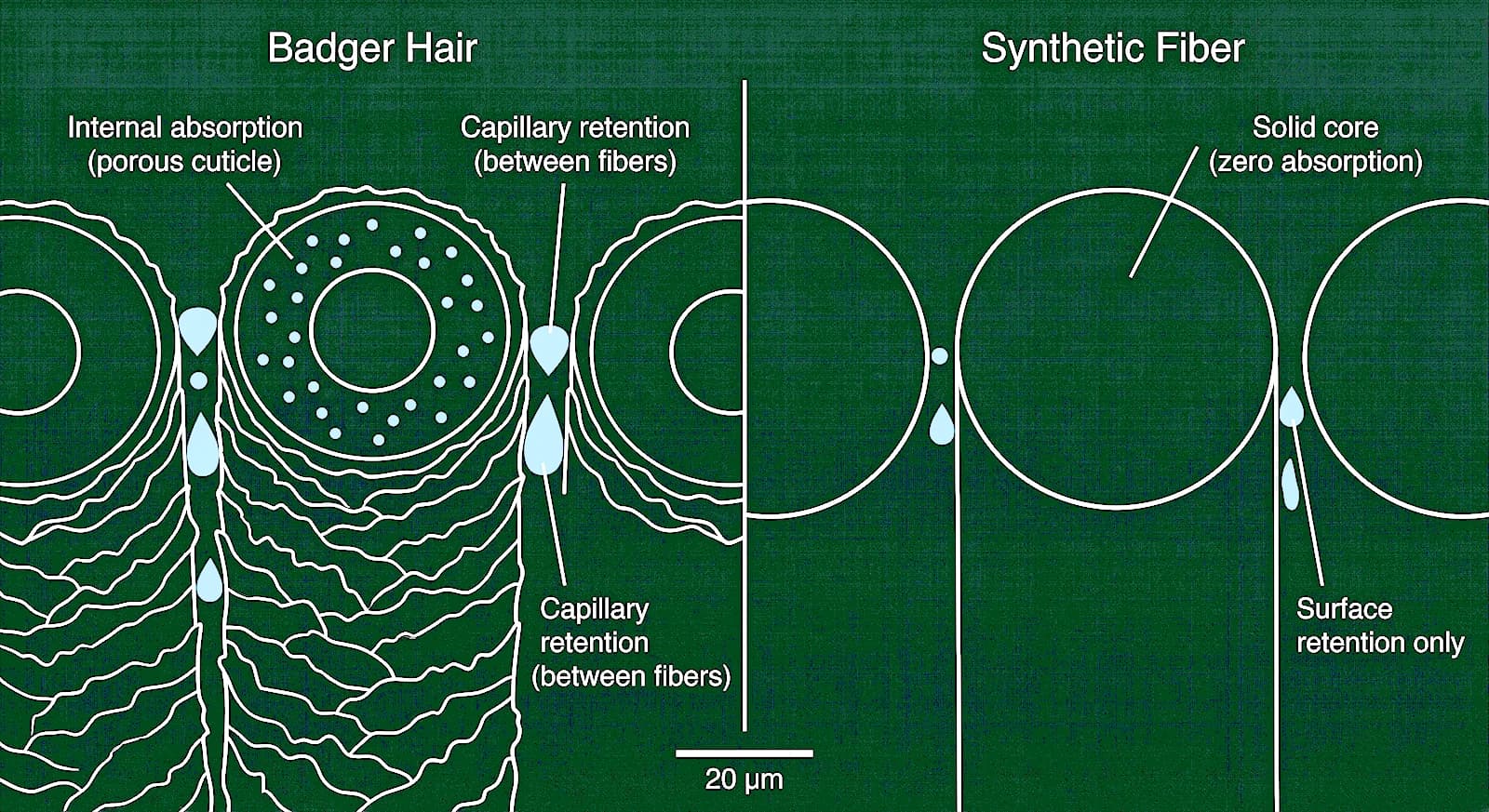
Badger hair — specifically Two-Band grade, the type used in the Harbor TA2 Line — has a porous cuticle structure. It absorbs water into the shaft itself, on top of holding it between fibers by capillary action. A soaked badger knot holds more water than its dry weight. The mechanism is well documented — keratin fibers are hygroscopic, taking up water between their protein chains (see animal-hair water-absorption research and keratin structure reviews). This means the brush delivers more water to the soap puck and builds a wetter, slicker lather with less effort.
Synthetic fibers are solid filaments. They hold water between the fibers but the shaft stays dry. Total retention is lower. You compensate by loading more water manually — easy, but one extra step.
2. Break-in period
A new badger knot smells. It is stiff. The tips may feel scratchy for the first 10–20 uses as the outer cuticle softens through repeated soaking. Two-Band Badger (the grade the Harbor TA2 Line uses) breaks in faster than lower grades, but still needs 5–10 shaves.
A synthetic knot is ready from day one. The fibers are uniform from the factory — skip straight to lathering.
3. Face feel
Badger tips splay and flex with a natural taper. They feel softer at the tips but have backbone through the body of the knot. Two-Band Badger offers the best balance: soft tips with firm backbone.
Synthetic fibers have engineered tips (flagged, tapered, or rounded depending on grade). High-end synthetics like the Tuxedo fiber approximate badger feel closely. Lower-grade synthetics feel rubbery or plasticky. The Harbor uses that same fiber class in both Fan and Bulb knots — the face feel is close enough to badger that the gap is hard to notice.
4. Durability
Badger hair degrades over time. With daily use, expect 5–10 yearsbefore the knot sheds noticeably; a dedicated rotation brush that sees use 2–3 times per week can last 15+ years. Synthetic fibers resist mildew, soap chemistry, and biodegradation — a synthetic knot will outlast the handle.
5. Cost
Badger hair is a natural material with supply constraints. Sourcing quality Two-Band Badger costs more than synthetic fiber at the knot level, and that gap flows directly to the retail price.
On the Harbor configurator, the TA2 Titanium Line is $89.90 with a Synthetic knot or $119 with a Badger knot. The 6061 Aluminum Axis is $59.90 with a Synthetic knot or $89.90 with a Badger knot. The 6061 Aluminum Line is $39.90 with a Synthetic knot. The handle material differs too, but the knot is the primary cost driver at the upper tier.
Decision matrix
| Factor | Badger | Synthetic |
|---|---|---|
| Water retention | High (absorbed) | Moderate (capillary) |
| Break-in | 5–20 shaves | None |
| Face feel | Natural taper, soft tips | Engineered tips, close to badger |
| Durability | 5–15 years | Outlasts the handle |
| Vegan | No | Yes |
| Price (Harbor) | From $89.90 (Axis) / $119 (TA2) | From $39.90 (Line) / $59.90 (Axis) |
Choose a Harbor configuration
Prefer natural hair? Start with Harbor Aluminum Axis with 26 mm Two Band Badger. This pairs the natural knot with a Navy Blue aluminum handle.
Prefer a titanium handle? Harbor TA2 Titanium with 26 mm Two Band Badger combines a Gradient Crystalline handle with natural hair. TA2 also accepts Synthetic knots if you prefer animal-free fibers.
Want faster drying and no animal hair? Choose Harbor Aluminum Line with 26 mm Classic Tuxedo Synthetic. It is the lower-priced starting point in the Harbor range. Rinse after use and let the knot dry between shaves.
These links open complete configurations. The product page shows current price and stock before you add to cart. Aluminum Line takes Synthetic only; Axis and TA2 offer both Synthetic and Two Band Badger.
Sources
- American Academy of Dermatology — How to Shave (skin prep & lather)
- Sharpologist — synthetic vs badger brush water retention (independent wet-shaving reference)
Disclosure
ORMIXA products are sold by ECE Innovate Homes LLC and manufactured by Guangzhou Yanyang Technology Co., Ltd. under trademark license.
Build your Harbor brush → · All products · Safety razor buying guide →
Frequently asked questions
- Is a badger shaving brush worth the money?
- If you want the best lather with the least effort, yes. Badger hair absorbs water into the shaft, delivering more moisture to the soap. If you want zero maintenance and a lower price, high-end synthetic fibers come close enough that the gap is hard to notice in daily use.
- How long does a badger shaving brush last?
- With daily use, 5 to 10 years before noticeable shedding. In a rotation (2-3 uses per week), 15+ years. Synthetic knots outlast the handle.
- Can a synthetic shaving brush feel like badger?
- High-end synthetics (Tuxedo-grade fiber and similar) come close enough that spotting the difference takes a deliberate back-to-back comparison. Their tips are engineered to mimic badger taper. Lower-grade synthetics feel rubbery or plasticky and do not pass for badger.
- What is the best synthetic knot type for shaving?
- Tuxedo-grade synthetic fiber sits at the top of the synthetic range — it balances soft tips against backbone, retains water well between fibers, and dries quickly. Cheaper synthetics (unbranded white fibers, basic nylon) feel stiffer and hold less water.
- How do I break in a new badger shaving brush?
- Soak the knot in warm water for 5 minutes before the first use. Make lather on a soap puck rather than directly on the face for the first 5-10 shaves. The smell fades within the first few uses; tip stiffness softens within 5-20 shaves depending on grade. Two-Band badger breaks in faster than lower grades.
- Do I need a stand for my shaving brush?
- A stand is not strictly required but it extends knot life. Storing the brush handle-down lets water drain out of the knot base instead of pooling there, which prevents mildew in badger knots and resin softening in some handle materials. For daily use, a stand is worth the small cost.