

A safety razor blade pairing run — Vector 316L × Wilkinson Sword Classic DE blades, across three shaves at 72-hour cadence. Shave 1 of the pairing opened with high sharpness exposure but narrow angle tolerance; Shaves 2–3 declined monotonically across every dimension, with Shave 3 producing the pairing’s first WTG drag and first stinging alum reaction.
Vector 316L × Wilkinson Sword Classic (TL;DR)
Across 3 shaves the Vector 316L × Wilkinson Sword Classic pairing scored 35.7/50 — sharp first contact but a narrow angle-tolerance window that tightened each session, with Shave 3 crossing into irritation territory. Verdict: a high-sharpness edge that demands precise angle control on the 0.76 mm gap. Pairing data transfers 1:1 to the Vector TC4.
Conducted by a single ORMIXA tester (one skin profile) on the Vector 316L — the material variant used is logged per entry of the blade compatibility database. Session-by-session notes follow ORMIXA’s published pairing rubric. This article documents pairing data — never a rating of either product in isolation.
On the Vector 316L with the standard 2-pass routine (WTG → ATG, target SS), the pairing opened at 38/50 and dropped to 32/50 by Shave 3. Pairing total rolled up to 35.7/50. This is the third pairing data point in the TC4 Titanium Safety Razor Blade Compatibility Project, and the second pairing on the Vector 316L (after the Wilkinson Sword Saloon Pack India sibling, 35/50).
About the Companion Blade — Wilkinson Sword Classic DE Identification
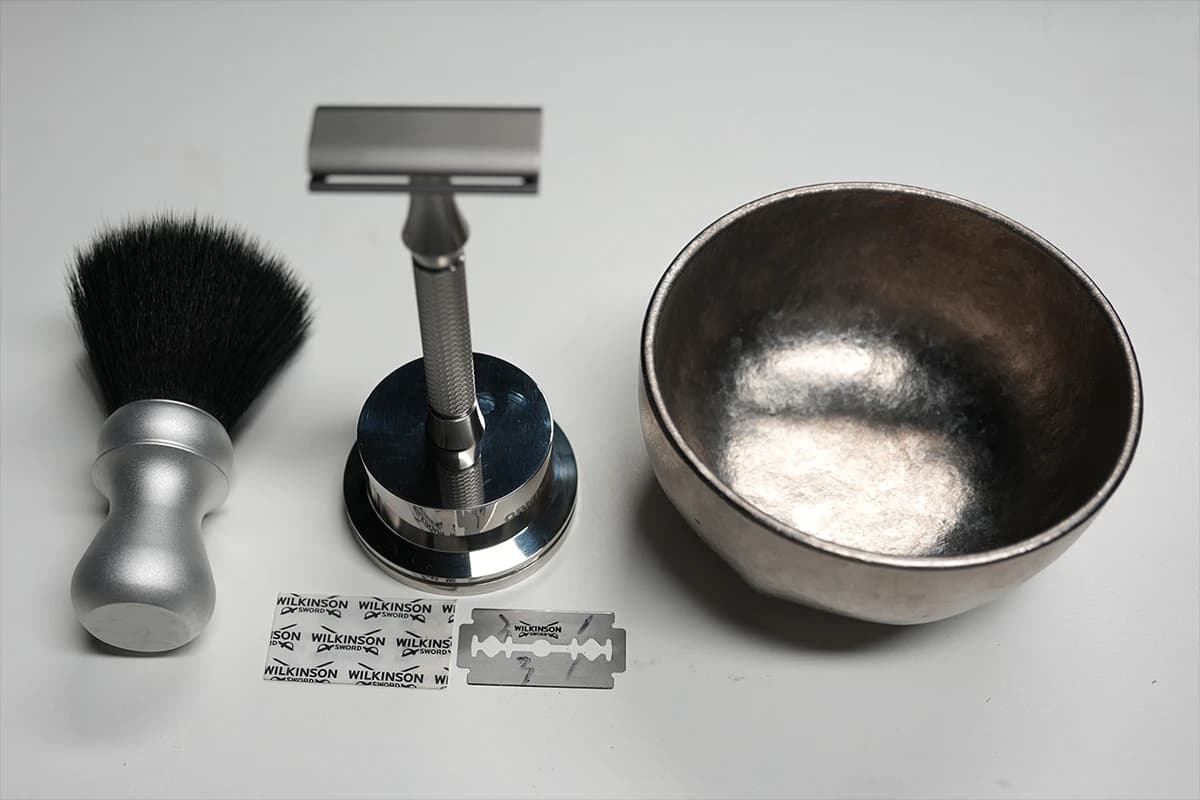
The Wilkinson Sword Classic DE blade tested here is a 5-blade Double Edge pack. The retail box front-panel carries a single ‘WILKINSON SWORD’ brand mark with the dual-sword emblem, with ‘Double Edge’ as the variant banner. The box side panel shows dual royal warrant lines (“BY APPOINTMENT TO H.M. THE QUEEN” and the Duke of Edinburgh royal warrant) plus a Polish-language tear-strip instruction (‘Oderwij tę część’). The box base prints ‘5’ — five-blade pack. Individual blades are etched ‘WILKINSON SWORD’. Made in Germany. The box carriesno Gillette, P&G, or Edgewell parent-brand co-print — a visual contrast against the sibling Wilkinson Sword Saloon Pack (India) pairing, where the box co-brands ‘Gillette®’ with ‘Wilkinson Sword®’ for the South Asian distribution channel. ORMIXA has no commercial relationship to Wilkinson Sword or its corporate parent (Edgewell Personal Care, as of the last public-record check before this article) — this pack was purchased at retail for pairing evaluation.
Test Conditions
- Tester: ORMIXA — one skin profile, fixed rubric
- Razor: ORMIXA Vector 316L (0.76 mm gap)
- Pre-shave: cold-water face rinse, ~6 seconds; no hot towel; no pre-shave oil
- Soap: ARKO shaving stick (Turkey), applied direct to face and lathered with the brush
- Brush: ORMIXA Harbor — 6061 Aluminum Line · Silver · 24 mm Classic Tuxedo synthetic (Silver was a prototype finish and never entered the catalogue, which ships the 6061 Aluminum Line in Black; the 24 mm knot used here has since left the public catalogue, and the line now ships at 26 mm)
- Water: cold throughout
- Pass pattern: WTG → ATG (2-pass; XTG skipped, target SS not BBS)
- Post-shave: cold rinse + alum block
- Sessions: 3 shaves total at ~72-hour spacing
- Conditions: 28.5 °C / 75% humidity (Shave 1), 27 °C / 70% (Shave 2), 27 °C / 95% (Shave 3)
Results also apply to Vector TC4 — same blade gap and head geometry. See the methodology for material-specific perception differences between 316L and TC4.
Test Period Summary
3 shaves total at 72-hour spacing. Pass pattern: WTG → ATG (2-pass) each session. Every score dropped from Shave 1 to Shave 3 — no dimension recovered or held flat. The pairing’s defining signal is the WTG-first drag debut at Shave 3, which had not appeared at Shaves 1 or 2.
Shave 1 — Fresh
2026-05-16 · 93h growth
- Closeness
- 7/10
- Smoothness
- 8/10
- Irritation
- 6/10
First contact: high sharpness exposure, no blade feel, no drag on the WTG pass. Angle tolerance narrower than we had calibrated for from the sibling Wilkinson Sword Saloon Pack pairing — WTG produced 1 nick on the chin (first-stroke angle miss); ATG produced 5 weepers across the lip region (upper 3 + lower 2) plus 1 on the neck, all traceable to under-calibrated angle work on a new edge profile. Touch: SS. Alum: full-face warming, no sting.
Shave 2 — 72h
2026-05-19 · 72h growth
- Closeness
- 7/10
- Smoothness
- 7/10
- Irritation
- 6/10
Sharpness still on; first-stroke blade-feel awareness present. Despite Shave 1’s angle-tolerance lesson, ATG still produced 7 weepers in the lip region (upper 4 + lower 3) plus 1 on the neck, with 1 chin nick — the pairing’s angle window narrowed further between Shave 1 and Shave 2. Touch: SS. Alum: full-face warming, no sting.
Shave 3 — 74h
2026-05-22 · 74h growth
- Closeness
- 6/10
- Smoothness
- 6/10
- Irritation
- 4/10
Edge tolerance collapsed. WTG produced drag for the first time across this pairing — 2 weepers on the lower lip on the WTG pass alone (Shaves 1–2 had zero WTG weepers). ATG added 6 more (upper 3 + lower 3) plus 1 nick at the mouth corner. Touch: SS. Alum: full-face warming with stinging across the cuts for the first time — the pairing crossed into rubric 3–4 (irritation territory).
Day-by-Day
Shave 1 (2026-05-16, 93h growth)
The Wilkinson Sword Classic blade went on the Vector 316L for the first time. The retail pack uses minimal blade-paper wrapping compared with the sibling Wilkinson Sword Saloon Pack box — sharpness exposure on first contact registered high. WTG ran clean across the cheek and jaw expanse with no drag and no audible blade feel.
The angle window for this pairing turned out narrower than we had calibrated from the sibling pairing. WTG produced 1 nick on the chin from a single first-stroke angle miss. ATG, after re-lather, produced 5 weepers across the lip region (upper 3 + lower 2) plus 1 on the neck — all attributable to under-calibrated angle work against a sharper edge profile. Lubrication on this run was adequate; the issue was angle.
Jaw line cleared cleanly under 2-pass for 93h growth — the longer growth window pre-cleared by the higher sharpness. Adam’s apple region was clean. Alum block went on with full-face warming and burning sensation at the nick and weeper sites, but stayed below the rubric 3–4 stinging threshold across the face. 30 min: clean, mild tightness; 4 hr: neutral.
Touch: SS. Scores: Closeness 7 / Smoothness 8 / Irritation 6 / Audible 9 / Lather 8. Total: 38/50.
Shave 2 (2026-05-19, 72h growth)
First-contact feel was still acceptable but the pairing’s angle window had narrowed further. WTG ran clean across the cheek — no weepers, no drag — but mild blade-feel awareness was present in a way it had not been at Shave 1’s WTG.
ATG produced 7 weepers in the lip region (upper 4 + lower 3) and 1 on the neck. The chin produced 1 more nick — the second across the pairing’s window. Shave 1’s angle lesson was noted but technique remained at Shave 1 baseline; the lip region weeper count climbed from 5 (Shave 1) to 7 (Shave 2). We flagged this climb as a pairing-side signal warranting deliberate angle correction in Shave 3.
Alum block produced light burning across the face, with stronger burning at the weeper sites — stayed below the rubric 3–4 stinging threshold. 30 min: clean, mild tightness; 4 hr: neutral.
Touch: SS. Scores: Closeness 7 / Smoothness 7 / Irritation 6 / Audible 9 / Lather 8. Total: 37/50.
Shave 3 (2026-05-22, 74h growth)
Edge tolerance collapsed. For the first time across this pairing’s 3-shave window, the WTG pass itself produced drag — perceptible across the chin and lip region from the first stroke. WTG drew 2 weepers on the lower lip (Shaves 1–2 had zero WTG weepers across the pairing).
ATG, with an edge that had visibly fatigued, added 6 more weepers — upper 3 + lower 3 — and 1 nick at the mouth corner. Total Shave 3 events: 8 weepers + 1 nick, with WTG contributing for the first time.
Alum block crossed into stinging across the cuts and warmed the rest of the face — the pairing’s first stinging alum reaction across the 3-shave window. 30 min: clean, mild tightness; 4 hr: neutral, but the lip region tendered longer than on prior shaves of the pairing.
Touch: SS. Scores: Closeness 6 / Smoothness 6 / Irritation 4 / Audible 8 / Lather 8. Total: 32/50.
What Worked in the Pairing
Shave 1 first-contact smoothness against the new edge
The Wilkinson Sword Classic edge presented at Shave 1 produced smoothness 8 against no perceptible blade feel during WTG. For a DE blade pairing on a mild razor (0.76 mm gap), that’s a usable first-shave opening — sharpness exposure was high and showed up as cutting efficiency, while blade feel stayed quiet through WTG.
ARKO lather chemistry held flat across all 3 shaves
Cold-water lather from the ARKO stick stayed thick through both passes; the Vector 316L head + Wilkinson Sword Classic edge didn’t clog at any session. Lather compatibility scored 8/10 across all 3 shaves — the soap chemistry never interfered. This is the only dimension where the pairing held flat through the test window.
Friction Points in the Pairing
Monotonic decline that angle correction cannot reverse
Four of five rubric dimensions dropped from Shave 1 to Shave 3 (closeness 7→7→6, smoothness 8→7→6, irritation 6→6→4, audible 9→9→8), with lip-region weepers rising in parallel (5→7→8); only Lather held flat at 8/8/8 (lather chemistry discussed in “What Worked in the Pairing” above). The Shave 2 → Shave 3 transition added the first WTG drag + first WTG weepers + first stinging alum reaction simultaneously. Pairings where the decline traces to operator technique typically flatten when we correct across sessions; this one kept declining straight through the correction.
Angle tolerance narrower than the sibling Wilkinson Sword Saloon Pack pairing
Across both Shaves 1 and 2, the lip region weeper count was higher than the sibling Wilkinson Sword Saloon Pack (India) pairing produced at the same growth point on the same Vector 316L (Shave 1: 5 vs 1; Shave 2: 7 vs 2). The variant difference here is the new-edge profile — Classic ships with a higher sharpness exposure out of the wrapper, which manifests as a narrower angle window. Cutting force per stroke stays comparable to the sibling pairing. This is the clearest classic-specific differentiator from the sibling pairing.
Irritation reaches the rubric 3–4 band at Shave 3
The Irritation dimension fell from 6 → 6 → 4 across the 3 shaves — Shave 3’s 4 sits in the rubric’s “dulling triggers irritation” band (3–4). The alum log says the same thing: warming only on the first 2 sessions, then stinging across the lip cuts on Shave 3. The pairing’s irritation profile compresses on the same Shave 3 timeline as the sibling Saloon Pack pairing.
Difficult Areas (Pairing on this skin profile)
- Jaw: Shave 1 produced 1 WTG chin nick (first-stroke angle miss); Shave 2 produced 1 ATG chin nick (second across the pairing’s window); Shave 3 clean — two isolated nicks across the whole window.
- Neck (right side, spiral hair growth): 1 weeper on Shave 1 (under-lubrication on first contact) + 1 weeper on Shave 2 (residual ATG angle); Shave 3 clean. The neck is not the primary failure region for this pairing.
- Upper lip / lower lip / under nose: This is where the pairing’s decline concentrates. Shave 1: 5 weepers. Shave 2: 7 weepers. Shave 3: 8 weepers (including 2 on WTG, a first across the pairing). The lip region’s precision-angle work is penalised by the pairing’s narrow angle tolerance window, and that tolerance narrows further across the 3-shave run.
- Adam’s apple / under chin: Clean across all 3 shaves when we stayed with short strokes and re-lathered before each pass. No blood points, no persistent irritation.
- Mouth corner: Shave 3 produced 1 nick — first appearance of this site across the pairing’s window, consistent with the Shave 3 edge collapse.
Pairing Recommendation for Vector 316L Owners
If you already own (or are considering) the Vector 316L, this pairing with Wilkinson Sword Classic is data-supported across a 2-shave window:
- Shaves 1-2 both hold in the usable band — closeness 7, irritation 6, no stinging alum reaction. Cost-per-shave model = 2 shaves per blade × 5 blades per pack = 10 shaves per pack.
- Sharpness exposure is higher than the sibling Wilkinson Sword Saloon Pack pairing — the practical guidance is to keep angle work disciplined from Shave 1.
When this pairing data does not support extension:
- You target 3+ shaves per blade as your cost-per-shave model — Shave 3 of this pairing crosses out of the usable band (WTG drag debut, lip-region weepers 5→7→8, alum reaction warming→warming→stinging, irritation 6→4).
- You expect prep discipline alone to recover the pairing past Shave 2 — on this 3-shave run, sustained prep + angle calibration did not recover the lip-region weeper count.
- You’re sensitive to irritation in the lip region — Shave 3 of this pairing crossed into rubric 3–4 (stinging alum).
Note: this is pairing data on the Vector 316L specifically. ORMIXA makes no recommendation about Wilkinson Sword Classic blades in isolation, or on razors outside this database. The same blade on a more aggressive razor (larger gap) or a less aggressive razor (smaller gap) may produce a different pairing window — each of those is its own compatibility test.
Video Evidence
Three sessions, raw footage, no edits:
- Shave 1 of 3: youtu.be/RURWH-buEDE
- Shave 2 of 3: youtu.be/s_2rOk2dPiI
- Shave 3 of 3: youtu.be/pVdrAJw72cw
Pairing Verdict
After 3 shaves of the Vector 316L × Wilkinson Sword Classic pairing: 35.7/50. Score drops every shave; Shaves 1-2 stay in the usable band, Shave 3 crosses into stinging territory with the pairing’s first WTG drag debut. Best window = Shaves 1-2.
The standard 3-option attribution framework (A = blade itself short-lived, B = razor geometry amplifies the dulling curve, C = operator technique pollution) cannot be formally isolated from single-razor data. But the observed signals point heavily to A on this pairing:
- Four of five rubric dimensions decline monotonically; only Lather holds flat at 8/8/8 — a uniform decline pattern across the four affected measurements (lather chemistry discussed in “What Worked in the Pairing” above).
- Across sustained baseline prep + deliberate Shave 3 angle tightening, the lip-region weeper count still climbed (5 → 7 → 8).
- Shave 3 added the pairing’s first WTG drag and first stinging alum reaction simultaneously — a transition consistent with edge fatigue collapse. Single-session inflections fit edge fatigue better than gradual technique drift would.
This pairing walks a closely parallel curve to the sibling Vector 316L × Wilkinson Sword Saloon Pack (India) pairing — both produce usable Shaves 1-2, both cross into stinging alum at Shave 3, both attribute heavily to A under single-razor data. The two variants differ in retail brand presentation (Classic = single Wilkinson Sword, Germany; Saloon Pack = Wilkinson Sword + Gillette India co-brand, India) but track the same pairing-window on this razor. A separate cross-variant synthesis article documents the family-level signal in detail; this article scopes to the single-pairing data point.
Pending controls: Wilkinson Sword Classic × different razor (e.g. lower-aggression head, or Vector TC4 instead of 316L) would test the B hypothesis directly. Until that data exists, the verdict on this pairing is: use for Shaves 1-2 on Vector 316L; do not extend to Shave 3 (crosses into stinging alum territory and WTG drag).
Vector TC4 owners: this pairing data transfers 1:1 to your razor. The cutting geometry is identical — only the in-hand feel differs.
Cross-Pairing Reference
The database holds fifteen pairings; this matrix compares the Wilkinson Sword family’s two variants (Saloon Pack India + Classic Germany), which track each other closely on the Vector 316L, against the Voskhod reference entry — noting that the Vector TC4 razor used for that pairing makes 5-dimension cross-comparison invalid.
| Dimension | Vector TC4 × Voskhod Teflon Coated | Vector 316L × Wilkinson Sword Saloon Pack (India) | Vector 316L × Wilkinson Sword Classic (Germany) |
|---|---|---|---|
| Pairing total (5-dim avg) | 40/50 | 35.3/50 | 35.7/50 |
| Attribution signal | C (technique pollution dominant) | A (pairing decline dominant) | A (pairing decline dominant) |
| Shave 1 → Shave 3 curve | Peak opening + mid-session dip + partial Shave 3 recovery on improved prep | Peak opening + monotonic decline that prep upgrade does not reverse | Peak opening + monotonic decline; WTG drag debut at Shave 3 |
| Best window | Shave 1 (S2 dip; prep bought back part of S3) | Shaves 1-2 (Shave 3 past window) | Shaves 1-2 (Shave 3 past window) |
| Irritation crossed rubric 3–4? | No | Yes, by Shave 3 | Yes, by Shave 3 |
Material caveat: the Voskhod column was tested on Vector TC4; the two Wilkinson Sword columns were tested on Vector 316L. Razor material affects in-hand feel and vibration dampening independently of cutting geometry, so 5-dimension numeric comparison across the material boundary is not valid. The Voskhod column is retained as a database reference only — for like-for-like reading, compare the two Vector 316L columns directly.
→ Read the Vector 316L × Wilkinson Sword Saloon Pack (India) pairing data
→ Read the Vector TC4 × Voskhod Teflon Coated pairing data
Methodology Notes
Three deviations to flag for transparency on this run:
- Same Vector material as the sibling Wilkinson Sword pairing: this run used Vector 316L stainless — the same razor unit the Wilkinson Sword Saloon Pack (India) cluster used. Razor variable is controlled across the Wilkinson Sword pairings. The Voskhod cluster used Vector TC4 titanium; that material difference matters for in-hand feel but not for blade-edge geometry (gap and head geometry are identical across 316L and TC4).
- Different brush from the sibling Wilkinson Sword pairing: this run used ORMIXA Harbor — 6061 Aluminum Line, Silver finish, 24 mm Classic Tuxedo knot. The Wilkinson Sword Saloon Pack cluster used Harbor — 6061 Aluminum Axis, Tactical Black SPLIT, 26 mm Synthetic. Same handle line (6061 Aluminum), same knot category (synthetic); finish and knot diameter differ. Lather density is comparable in cold-water ARKO routine — the brush variable is not isolated in this database and may need its own control series later.
- Angle calibration was deliberately tightened going into Shave 3: following Shave 1’s lip-region angle-tolerance signal, Shave 2 proceeded at baseline technique without deliberate tightening and the lip-region weeper count climbed (5 → 7). For Shave 3 we explicitly tightened ATG angle work to test whether the pairing’s lip-region weeper count would respond to technique correction. Under this tightened angle calibration, the count still climbed (7 → 8). Operator-side ceiling would have flattened or recovered the count; the climb isolates the decline as a pairing-side signal. This mirrors the Saloon Pack cluster’s deliberate Shave 3 lather upgrade — a different technique lever run with the same diagnostic intent.
Sources
- American Academy of Dermatology — How to Shave (shaving with the grain, angle & irritation prevention)
- Cleveland Clinic — Razor Burn (how a blade moving across skin causes irritation)
- Science of Sharp — Quantifying Sharp (measuring blade-edge width & sharpness)
- ORMIXA blade-test shave logs — one skin profile, fixed rubric; method in the blade compatibility test methodology
Disclosure
Internal lab pairing test. Not sponsored. ORMIXA does not receive commercial consideration from Wilkinson Sword, Edgewell Personal Care, Gillette, Gillette India, P&G, or any DE blade vendor for pairing data or scoring.
ORMIXA products are sold by ECE Innovate Homes LLC and manufactured by Guangzhou Yanyang Technology Co., Ltd. under trademark license.
ORMIXA does not sell razor blades. This pack of Wilkinson Sword Classic blades was purchased at retail. Neither Wilkinson Sword nor its corporate parent has any commercial relationship to ORMIXA, ECE Innovate Homes LLC, or Guangzhou Yanyang Technology.
If you think the manufacturer-conducted testing framing biases the methodology, fair concern. Video evidence is linked above for every session, methodology was published before testing started, and the pairing database includes Vector pairings with blades whose makers are direct competitors to Wilkinson Sword. Send your own pairing data — we’ll compare.
Related
- ← Back to the full TC4 Blade Compatibility Database
- ← Sibling pairing: Vector 316L × Wilkinson Sword Saloon Pack (India)
- ← Previous database entry: Vector TC4 × Voskhod Teflon Coated
- The razor used in this pairing test — Vector 316L →
- The brush used in this pairing test — Harbor →
- About ORMIXA →
Frequently asked questions
- Does the Vector 316L pair well with Wilkinson Sword Classic blades?
- In a 3-shave test the pairing scored 35.7/50. First contact was sharp with no drag, but the angle-tolerance window was narrow and tightened each session — Shave 3 crossed into irritation territory. On the Vector 0.76 mm gap it behaves as a high-sharpness edge that demands precise angle control. This is pairing data, not a rating of the blade in isolation.
- Why did the pairing score decline across the three shaves?
- The angle-tolerance window narrowed session to session: Shave 1 opened at 38/50, dropping to 32/50 by Shave 3, which produced the pairing's first with-the-grain drag and first stinging alum reaction. The decline tracked the edge profile and angle window, documented shave by shave in the body.
- Does this pairing data apply to the Vector TC4?
- Yes, 1:1. The Vector 316L and TC4 share the same head geometry and 0.76 mm blade gap — only in-hand weight differs, so the cutting behavior of the pairing transfers directly.
- How does the Wilkinson Sword Classic pairing compare to Voskhod on the Vector?
- The Voskhod Teflon Coated pairing (run on the Vector TC4) scored 40/50 and read as a forgiving companion edge; this Wilkinson Sword Classic pairing (Vector 316L) scored 35.7/50 with a narrower angle window. The two ran on different material variants, so read them as separate data points in the database, not a head-to-head.
- Did the pairing give a BBS shave?
- No — it produced SS (socially smooth) from the 2-pass with-the-grain to against-the-grain routine. BBS would require an across-the-grain pass outside this pairing protocol.
- Is ORMIXA recommending Wilkinson Sword blades?
- No. ORMIXA does not sell razor blades and makes no recommendation about Wilkinson Sword blades in isolation or on razors outside this database. This article documents how one third-party blade performed when paired with the Vector — pairing data only, per ORMIXA editorial scope.